
View the Maccaferri entry on BPindex
Oct 9, 2026 · @Matthew Showan
Surface erosion rarely makes headlines on its own, but it is often where problems on a development site begin. Rills and gullies forming on a freshly cut batter, scour where a swale or downpipe discharges, or topsoil washing off a regraded slope before grass has established can each lead to silted drainage, sediment leaving the site, damaged landscaping and pavements, and in time a shallow slip that encroaches on a yard, car park or building platform.
That risk is growing. To deliver a larger building footprint, more parking or bigger hardstands, sites are increasingly cut back and regraded to steeper batters, while rainfall intensity continues to rise. Yet the choice of erosion control mat or blanket is still often made by habit or product marketing rather than by calculation. The publication of the new ISO/TR 18228-8:2026 gives designers and specifiers an opportunity to change that.
What the new Technical Report sets out
ISO/TR 18228-8:2026, published in June 2026 by ISO/TC 221, is the eighth part of the ISO/TR 18228 series on design using geosynthetics. It gives guidance on designing geosynthetics for surface erosion control on slopes and on river or channel banks. It deliberately excludes overall slope stability and coastal protection, which are treated elsewhere.
As a Technical Report it is guidance rather than a normative standard. Its value lies in bringing together, in one internationally agreed document, a calculation-based route that many designers have known about but rarely applied.
For rainfall-driven erosion on slopes, the approach is built on the Revised Universal Soil Loss Equation (RUSLE), which estimates average annual soil loss as:
A = R . K . LS . C . P
Here R is rainfall erosivity, K soil erodibility, LS the combined slope length and steepness factor, C the cover factor and P the support practice factor. Bare soil has C = 1; a protective cover reduces it. The report links a product’s C value to full-scale rainfall simulation testing of the type described in ASTM D6459, so the cover factor becomes a measured product property rather than a judgement.
For stormwater channels, swales, ditches and other conveyance features that carry flow intermittently, the design is checked against two limit criteria: permissible flow velocity and permissible shear stress. Erosion control geosynthetics are typically applied where velocities reach about 3 m/s for sustained periods, or up to 6 m/s for short durations.
From method to design calculation
The RUSLE approach is not new, but in practice it has been awkward to apply. Each factor draws on different data: regional rainfall records for R, particle size distribution or soil texture for K, survey geometry for LS, and test data for C. Bringing these together by hand for every batter on a site, let alone every site in a development programme, is time-consuming, and it is easy to see why designers have tended to default to a familiar product.
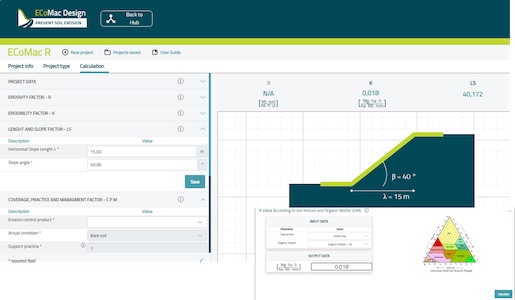 Maccaferri’s EcoMac software, available free through the company’s eDesign platform, follows the same calculation framework as the Technical Report. It has three modules, each mapped to a distinct design check:
| Module | Design check | Typical building-site application |
| EcoMac R | Annual soil loss on a slope by RUSLE, unprotected and protected | Cut-back and regraded batters, fill slopes around building platforms, landscaped embankments |
| EcoMac S | Required geomat tensile strength and pin spacing on slopes | Steeper or longer batters behind warehouses, yards and car parks, where installation loads govern |
| EcoMac B | Anchorage of geomats on channel banks against flow-induced shear | Stormwater channels and swales, detention basin batters, culvert and pipe outfalls |
The value of the tool is less in any single calculation than in making the design traceable. Each input is recorded, each factor can be checked against the Technical Report, and the client, certifier or local authority reviewer can see why a given product was selected.
Matching the product to the site
The real benefit of a calculated approach is that it lets the designer specify enough protection, rather than the most protection. Erosion conditions vary widely between sites, and often within one: a gentle landscaped bank in sandy soil on a housing scheme presents a very different problem from a long, steep cut in clay behind a distribution warehouse on an exposed, high-rainfall site. A single standard specification will be over-designed on some slopes and possibly inadequate on others.
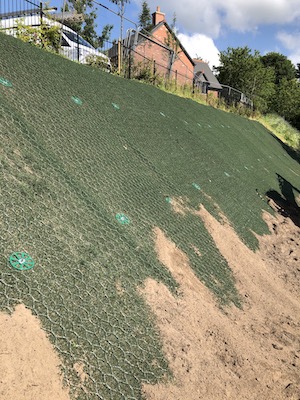 Working through RUSLE makes the drivers explicit. A worked example published by Maccaferri engineers considered a 100 m long clay loam slope at 33°. Unprotected, the calculated soil loss was about 506 t/ha per year; with a reinforced geomat of C = 0.043, it fell to about 22 t/ha per year, a reduction of roughly 95%. Most building-site batters are shorter than this, which is precisely the point: on a shorter, flatter slope, or one in less erodible soil, the same target loss might be met by a lighter, cheaper mat or by a biodegradable blanket alone.
The cover factor itself is also not a fixed number. Test data for one geomat show C rising from about 0.003 at 50 mm/h rainfall intensity to about 0.012 at 150 mm/h. Designing against a realistic local intensity, rather than a worst case applied everywhere, avoids paying for performance the site will not need.
Installation design offers a second lever. In the same study, increasing pin spacing from 1.5 m to 2.0 m raised the required characteristic tensile strength of the geomat from 55 kN/m to 60 kN/m, while cutting pin frequency from 0.40 to 0.30 per m². On a large regrading scheme that is a 25% reduction in pins and the labour to install them, set against a modest increase in product strength. Which combination is cheaper depends on local material and labour rates, and EcoMac S allows those options to be compared directly.
None of this produces a dramatic headline saving on every job. What it does is remove the hidden margin that comes from specifying by habit, and across a large site, or a developer’s pipeline of projects, those margins add up.
 Practical points for designers
A calculation is only as good as its inputs, and several deserve care on building projects.
- Rainfall erosivity. Many published R-factor relationships are regional and were derived outside the UK. Designers should be clear which data set they have used and whether it reflects current and projected rainfall intensity.
- Soil data. Cut slopes often expose variable or weathered material, and imported or site-won fill used to build up platforms may differ from what the site investigation found. The K factor should reflect what will actually be at the surface.
- Product C values. These should come from full-scale rainfall testing, and the test intensity should be stated. A C value quoted without its test conditions is of limited use.
- The Technical Report addresses surface erosion only. It does not replace a stability assessment of cut and fill slopes, retaining structures or the building platform, and erosion protection should not be relied upon to address deeper instability or poor drainage.
- Construction phase. On building sites the highest erosion risk is often the period between bulk earthworks and final landscaping, when slopes are bare and drainage is incomplete. Temporary protection and sediment control for this stage, which may be required by planning conditions or environmental permits, should be designed alongside the permanent solution.
- Most erosion control products are intended to protect the slope until vegetation establishes. Programme, seeding, watering and access for landscape maintenance remain part of the design, particularly where slopes will be handed over to an owner or facilities manager.
Software makes the method quicker to apply, but it does not remove the need for engineering judgement on these points.
Graded range of products
Maccaferri has a range of erosion control products from biodegradable mats with a short design life to support vegetation establishment (BioMac Coir and Jute blankets) to man-made reinforced mats to provide longer term surface stabilisation (MacMat R, MacMat R-Bio).
Conclusion
ISO/TR 18228-8:2026 gives the industry a common, internationally recognised basis for designing surface erosion control, replacing rules of thumb with a calculation that can be checked. For developers and building owners, that means specifications that can be justified slope by slope; for designers and specifiers, a clearer audit trail; and for the project, more confidence in using steeper batters to make the most of the available land.
Tools such as EcoMac lower the effort needed to follow the method, which is what will make it routine rather than occasional. The likely outcome is not a revolution in erosion control, but steadier, better-targeted specification, with protection matched to the risk and cost matched to the protection.
Sources
- ISO/TR 18228-8:2026, Design using geosynthetics, Part 8: Surface erosion control, ISO
- Santoli, Lugli and Trovato (2025), Comprehensive overview of soil erosion control, E3S Web of Conferences 644, EuroGeo 8
- Rimoldi (2020), Design for erosion control according to ISO TR 18228-8, GeoAmericas 2020
- EcoMac: Advanced Erosion Control Design Software, Maccaferri