Why POWERFLEX® RV-K is a better cable choice than standard NYY cables
View the Top Cable entry on BPindex
For years, NYY cables have been a economic, reliable, fixed-installation standard all over Europe. But what if you could have the same advantages with unparalleled flexibility and better electrical performance? RV-K cables with class 5 conductors and XLPE insulation are becoming the preferred choice for industrial installations across Europe.
 While NYY cables have their place, the RV-K cables are redefining efficiency and performance on the job site. We are increasingly seeing this cable specified in the UK as well as across Europe. Let’s break down why making the switch to RV-K is a cost-effective game-changer for your industrial installations.
DECODING THE CABLE DESIGNATION: NYY VS RV-K … AND MORE
Understanding the cable designations reveals their core purpose and construction, so you can specify with confidence.
What does NYY cable mean?
NYY refers to a unarmoured power 0,6/1kV cable, most suited for energy supply in fixed installations. The cable construction is the following:
- Conductor: solid or stranded, plain copper
- Insulation: PVC
- Outer sheath: PVC
NYY cables are German Standard Industrial cables designed for fixed installations in buildings and industrial sites. Available as NYY-J with an earthing conductor, or as NYY-O without earthing, these cables are offered in single core or multicore versions (2, 3, 4, or 5 cores, cross-sections offered up to 630 mm².)
NYY cable can be installed indoors where there is little chance of mechanical damage. Cables can be fixed on cable trays, within conduits or fixed to walls. This cable is not suitable for direct burial.
What does RV-K cable mean?
RV-K refers to a flexible, low-voltage 0,6/1kV power cable used In Europe -and many other international markets following IEC standards- for electricity supply. It is used in indoor and outdoor installations, and it is well known for its high flexibility, durability, and moisture resistance. The cable construction is the following:
- Conductor: class 5 (flexible) copper
- Insulation: XLPE
- Outer sheath: PVC
RV-K cable is designed according to IEC 60502-1 and AENOR UNE 21123-2 standard.
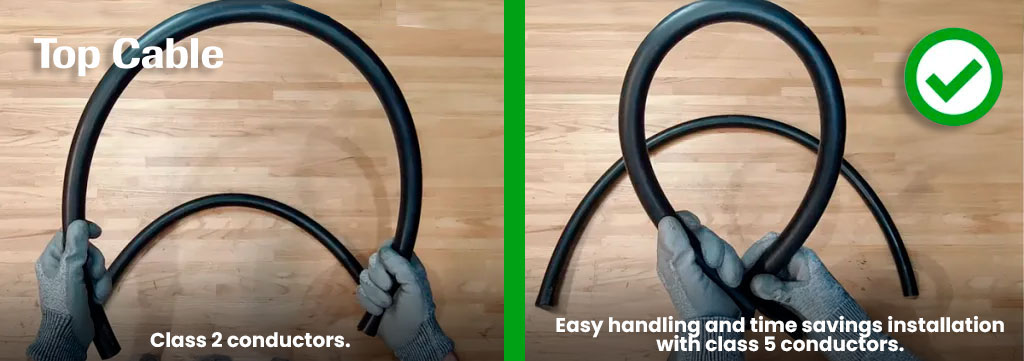
CLASS 5 COPPER CONDUCTOR: The high flexibility of the RV-K cable -thanks to its class 5 copper conductors- makes cable routing for installation process substantially easier and, as a result, is particularly suitable for use in difficult layouts including connection within industrial applications.
 XLPE INSULATION: XLPE insulationis superior to PVC because it allows higher continuous operating temperatures (90ºC vs 70ºC), enabling greater current carrying capacity and better performance under overload conditions. XLPE also offers improved electrical properties, longevity, and resistance to thermal aging compared to PVC.
Are NYY, NYY-J and NYY-O the same?
While NYY, NYY-J and NYY-O may look similar, this simple letter code prevents confusion and ensures the correct cable is selected for the electrical and safety requirements of the installation. Misunderstanding them can lead to ordering the wrong cable, causing project delays, safety hazards, and unexpected costs.
- NYY: The base cable type. By itself, it has no dedicated earth conductor.
- NYY-J: “J” = with a bare earth conductor. This is the most common version for grounded power applications.
- NYY-O: “O” = without earth conductor.
A look at a closely related cable: what does N2XH mean?
Within the range of low voltage industrial power cables, N2XH cable should also be considered. It is closely related to the NYY, but stands out for its enhanced flexibility and superior LSZH fire performance. The “H” in the cable designation stands for Halogen-Free. This cable outer sheath is Low Smoke (it does not emit dense, corrosive smoke or acidic gases) and Zero Halogen when exposed to fire.
NYY AND RV-K CABLE APPLICATIONS
Both NYY and RV-K power cables are perfect and equal cost-effective for:
- Energy distribution in industrial and commercial buildings.
- Connection of electrical equipment and tables.
- False floors or technical channels installations.
- Motor power lines, lighting, production machines.
- Tertiary facilities (hotels, offices, warehouses).
- Suitable for installation on cable paths, in conduits, In chute or full walls.
NYY cables cannot be used for:
- Flexible power supply cable
- Moving applications in machinery, control cabinets, and automation
- Underground installations (when NYY electrical cables are required to comply with the buried requirements of BS7671, they should be installed in conduits or pipes).
When RV-K cable is preferred?
Class 5 conductors are becoming the preferred choice for industrial installations across Europe due to their cost effectiveness, flexibility and ease of installation.
- For easy and fast Installation: it means less physical effort and time required for your team.
- For easier and safer cable termination: flexible strands are simpler to fit into terminals and connectors securely.
- To reduce damage risk: Less strain on the cable during installation means a lower risk of internal conductor damage, enhancing the long-term reliability.
- High-density cabling environments: In dynamic environments like modern data centers, Class 5’s flexibility allows for easier updates and scalability, making it a more suitable choice for high-density cabling.
STANDARD NYY CABLES vs POWERFLEX® RV-K
Here’s a quick comparison table to highlight the key advantages:
| Feature | NYY cables | RV-K cable | |
| Designation Meaning | PVC/PVC, fixed installation. | XLPE/PVC, fixed installation with flexible conductor. |
It’s the flexible XLPE option. |
| Conductor | Class 2 Copper. | Class 5 (flexible) Copper. | Superior flexibility for easier handling and faster installation. |
| Flexibility | Standard / Rigid. | High. | Reduces installation time and labor costs. |
| Installation Ease | Good, can be challenging in tight spaces. | Excellent. | Simplifies complex routing and termination. |
| Durability | High for fixed installation. | High for fixed & occasional movement. |
More versatile and resistant to work-hardening from bending. |
| Max. service temperature | 70ºC | 90ºC | Greater current carrying capacity and better performance under overload conditions. |
| Min. service temperature | -20ºC | -40ºC | Better temperature performance on cold environments. |
| Application Scope | All over Europe. | All over Europe. | A more adaptable solution for a wider range of projects. |
INDUSTRY INSIGHT: THE GLOBAL PUSH FOR EFFICIENCY
Worldwide, the industrial cable market is prioritizing solutions that reduce total project costs. A recent study highlighted that labor can account for up to 60-70% of total installation costs. Choosing cables that enable faster installation, like RV-K designs, is no longer a luxury but a strategic necessity to stay competitive on a global scale.
PLANNING YOUR NEXT CABLE PROJECT?
When specifying cables for your next tender or project, defaulting to “NYY” cable can lead to receiving a less performance cable. Always specify “POWERFLEX® RV-K” or “NYY flex” in your documentation to ensure you get all the functionalities of the NYY cable while adding a significant performant capability at no additional cost. Ask your cable distributor for a quote on POWERFLEX RV-K.
And if your project needs an extra fire safety performance (or is subjected to CPR Cca or B2ca public places requirements) ask for TOXFREE® N2XH flex option.
POWERFLEX® RV-K stock & logistics
A superior product is only as good as its availability. We understand that project timelines are non-negotiable. Furthermore, POWERFLEX RV-K is a standard cable within our Top Cable manufacturing program. To provide the fastest possible delivery, we maintain a comprehensive stock of POWERFLEX® RV-K cables in the most popular cross-sections, ready for immediate dispatch in our central European warehouse.
Typical cross-sections of POWERFLEX® RV-K in Stock
We consistently stock a wide range of single core or multi-core cables:, including (but not limited to):
- RV-K 1, 2, 3, 4, 5 x 1.5 mm² to 10 mm² (for standard lighting and power).
- RV-K 1, 2, 3, 4, 5 x 16 mm² to 95 mm² (for industrial circuits and distribution).
- RV-K 1, 2, 3, 4, 5 x 120 mm² to 185 mm² (for heavy power applications).
- RV-K 1, 2, 3, 4, 5 x 240 mm² to 630 mm² ((for main distribution and high-load circuits).
Thanks to our strategic logistics network, we guarantee fast and reliable delivery all across Europe. Whether your site is in the UK, Ireland, Germany, France, Spain, Portugal, the Netherlands, Italy, Eastern European countries or Scandinavia, you can count on getting the high-quality POWERFLEX® RV-K cables you need, when you need them.
EXPERIENCE THE POWERFLEX® RV-K DIFFERENCE
Want to learn more about why POWERFLEX® RV-K is becoming the preferred choice for industrial installations across Europe? Read our dedicated blog post about POWERFLEX® RV-K.
Upgrade to the flexibility, durability, and efficiency of POWERFLEX® RV-K. Get a competitive quote today and see how we can power your project forward. Our team is ready to advise on the perfect cable solution for your specific needs.