Skip to content
BPindex — The Largest Building Products Directory in the UK

PIR

Taking outdoor LED to the next level for professionals

Building Products Index Ltd LED Lighting Leave a Comment

View the Timeguard entry on BPindex

View the Timeguard website

The demand for automatic outdoor LED lighting never seems to fade. There are plenty of products for installers to choose from, but which should you choose to add a professional touch? We looked at the trusted Timeguard range:


  • Customisation

One of the ‘Top’ products since its launch, is the Timeguard LED Pro range, a range that really does tick all the boxes for professional installers.

For those of you still unfamiliar with the concept, LED Pro is a range of floodlights with interchangeable controls. Installers choose the most suitable floodlight power for the job at hand, IE: 10W to 100W per flood, and then decide how they want it switched: PIR, photocell, RF remote, or as a slave – and plug the two together on site. Change your mind? It’s easy to mx and match. Look out for a new integrated functionality later this year, which will be ideal for new installs or to update existing ones.


  • Wide beam lights that really do flood

It might sound simple, but the right sort of illumination can’t be taken for granted. When it’s right, it’s the signature of good quality design. If you need greater light coverage be sure to ask for a wide beam floodlight design.

Uncontrolled LED’s emit a straight beam so, if the floodlight isn’t designed to control and distribute the light evenly, the floodlight will have a spotlight-like effect when what people really want is a wide even spread of light. A quick check is to keep a look out for lenses over the diodes as that’s a sure tip that the designer has considered light beams and angles. Where you have a big area to illuminate, choose LED floodlights with arrays designed specifically to provide the ‘really wide’ beam you may need. It is an option we now offer across our ranges, including the LED-X rust-resistant models.

  • Rust free good looks

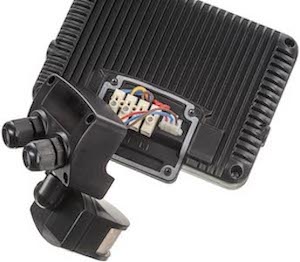
Rust resistance is crucial for keeping good looks and avoiding the tell-tale sign of unsightly running marks often seen down the wall. Even though most LED floodlights are now made primarily of polycarbonate, the brackets are normally always mild steel that will corrode and rust. That’s why we designed the rust resistant range, ideal for coastal areas or installation in damper places with every single metallic component, including the bracket manufactured from rust-resistant 316 stainless steel – even down to the screws on the PCB board.

When we designed the rust resistant floodlight range, we also took the opportunity to devise an optional pan & tilt bracket that allows for the floodlight to be panned sideways (left & right) and then vertically by the floodlight fitting itself for precise and accurate area illumination.

Using stainless steel components inside and out keep these lights corrosion-free for years and allowed for a curved bracket so you can pan as well as tilt the lamp to suit.

  • The not-so-basic bulkheads

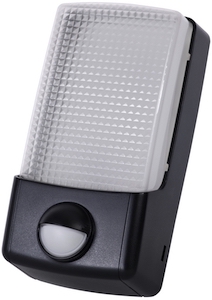
Demand for bulkhead designs that sit flush to the wall never falters, but there’s no reason for them to be left behind in the quality and design stakes. We continue to improve on them and, while we still offer retro die-cast models, our LED88 polycarbonate versions with & without PIR’s seem to be a market favourite. Easy to install, easy to use and easy on the eye.

  • Small is beautiful

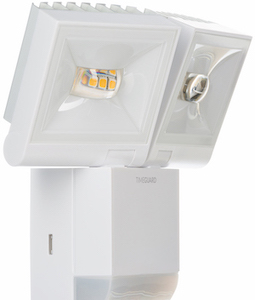
When we first introduced the revolutionary design of the ultra-compact Nighteye range, with both single headed and twin headed versions, it was widely seen that the single units are hardly bigger than a man’s hand – wow!  “Could they do the job”, you asked?  Well, they certainly can, and they’ve proved that they also last the course and give years & years of service. The next step was evolution, incorporating the PIR detector within the main housing in the EVO range so that the detectors are ‘hidden’ but still offer easy to set time and lux control settings. With single and twin floodlight options in black or white, they look great and they do a great job!  We rest our case.

Available in black and white these lamps with concealed PI detectors are hardly bigger than your hand

Find out more at www.timeguard.com – or give us a call us and we can talk about the ranges available and which ones best suit your needs.

Choosing PIRs

Building Products Index Ltd LED Lighting Leave a Comment

View the Timeguard entry on BPi

Visit the Timeguard website

Don’t set yourself up for PIR failure, says Timeguard

Timeguard ceiling mounted PIR detector“What’s the cheapest PIR you’ve got, mate”. That was overheard at a wholesale counter within earshot of a visiting Timeguard representative who only stopped spluttering when he heard the ‘right’ reply from the man behind the counter. “What’s it going to be used for?”. Phew!

PIR detectors are not all the same, but they are typically mounted on ceilings or high on walls – places that are hard to get to if they fail or need constant readjustments.

Branded quality is always the safest option, but even the you need to make sure you get the specification right. So here are just 3 key questions to help them to help you get the balance between price and performance right:

  1. What type of lights and what load?

These days the job will almost always be LED lighting, so make sure they know to pick a PIR detector that is specifically tested with and rated for LED loads.

We’ve been saying for years how important this is. LED lights have a strong inrush current and it is that which the PIR should be rated for, not the subsequent low running current.  You shouldn’t need to do the maths, the specification should already state what LED loading is acceptable – if not steer clear.  We think it’s always wise to add at least 10% for good measure).

The huge difference between ratings for the same PIR detector for halogen and LED still comes as quite a surprise to some people. For instance, our new mini linkable PIR, is rated for 1000W max. halogen and 250W max. LED.

  1. Is it going to be a straightforward stand-alone automatic switch?

If you are looking at very high LED ratings, for a single PIR to switch several lights, double check the spec. For instance, our top-selling 360o ceiling mounted detector has a maximum LED load of 150W, but we rate it for a maximum of 10 separate LED 10W lamps (100W). Yet we are happy to rate – and guarantee – it for 5 sets of LED lamps above 10W, right up to the 150W limit. This is because due to their physical size lower wattage LED lamps (GU10 type lamps) commonly have very simple circuitry with surge protection and power factor correction omitted, this puts a massive strain on whatever is switching/controlling them.

Looking for a big rating might also mean that a big area is to be lit. So perhaps a single PIR detector will not be able to give the comprehensive detection field needed.  Would multiple PIRs be better?

Timeguard mini PIR and plig in slave_lowresMaybe it would be easier – and less expensive – to be able to link a master and several slaves together? When these come fitted with cables and standard RJ11 plugs and sockets, huge amounts of time can be saved on both installation and set up.  The ingenious Timeguard linkable concept makes wiring simple because up to 5 slaves are linked by pre-fitted plug-in wires that stay hidden behind a suspended ceiling. Simples.

  1. Where’s it going?

Will the detector be surface mounted on a wall, flush mounted in a standard ceiling aperture, or would a corner bracket help? How important are looks to the end user?

Do you need the option to mask part of the detector?  What’s the room being used for and do they really need presence detection around desks or areas where people sit fairly still? If it’s going to be within reach of passers by and ‘keen’ building occupants, do you need to ensure that the controls are tamper proof?

Timeguard tamper proof PIR

Indoors or out? Check the IP rating. If outdoors, might it be easier to replace old and corroded lights with an all-in-one floodlight with integral PIR detector designed to withstand the British climate. Check out the corrosion-free Timeguard coastal range.

All this might give you cause to rethink. Branded quality is still the best assurance of fit-and forget  quality. No-one wants to have to go back and change a failed PIR detector.

Updates to VMZINC BBA certificates for warm roof systems

Building Products Index Ltd Roofing Leave a Comment

View the VMZINC entry on BPI

Visit the VMZINC Website

Langwith College University of York, Heslington, York (UK)BBA certificates for the VMZINC ‘Compact roof using cellular glass insulation’ and ‘Structural roof using PIR or mineral board insulation’ have been updated and extended. The compact roof utilises Foamglas® cellular glass insulation to prevent the passage of water vapour and is therefore ideal for buildings with a high vapour drive such as swimming pools. Both systems are installed without mechanical fixings penetrating the insulation, thus greatly reducing scope for thermal bridging. VMZINC remains the only zinc manufacturer to have such accreditation and can additionally offer a BRE Green Guide A+ rating for the structural roof system.

Enquiries to:-

VMZINC
Four Rivers House, Fentiman Walk
Hertford, Herts, SG14 1DB
01992 822288
01992 58446

E: vmzinc.uk@umicore.com

www.vmzinc.co.uk