
Skip to content
BPindex — The Largest Building Products Directory in the UK

ACO Water Management

New guide and webinar set to tackle commercial drainage challenges

Anna Skinner Building Drainage, Drainage Leave a Comment

View the ACO entry on BPindex

Visit the ACO website

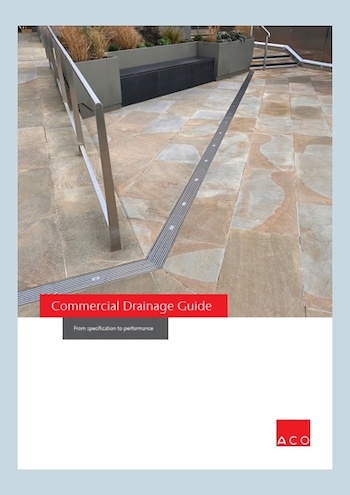
The UK is facing a public water shortfall of five billion litres a day by 2055, according to the Environment Agency, and in response to this, ACO Building Drainage has launched a new Commercial Drainage Guide to give specifiers, engineers and architects the technical knowledge needed to ensure resilient and effective drainage for their projects.
More resilient and effective drainage helps conserve and protect water resources by improving overall water management, enabling rainwater retention and reuse, reducing pollution, preventing sewer failures and helping buildings operate more efficiently under increasing climate and water-resource pressures.

Alongside the guide, ACO is also hosting a free one-hour webinar – Design Requirements for Commercial Drainage – which covers how to choose the right drainage for commercial kitchens, food and beverage manufacturing, leisure facilities, education environments and industrial settings.

Both the guide and webinar offer expert advice on these matters, recommending earlier specification and planned maintenance. The guide draws on the knowledge of Mario Finelli, Head of Key Projects at ACO, as well as more than 60 years of ACO experience.

Mario said: “Drainage is easy to ignore until it stops working and many systems are poorly designed and maintained as a result. Emergency repairs, blockages and difficult maintenance all lead to increased costs over the life of a drainage system and cause an increase in downtime and health & safety risks. The core message in the guide is that project teams that plan maintenance and running costs in advance reduce these risks from the start.”

The webinar, led by Mario, covers how to choose the right drainage for commercial kitchens, food and beverage manufacturing, leisure facilities, education environments and industrial settings. Corrosion resistance, load classifications, hydraulic performance, hygiene requirements and floor finishes all feature, using real projects to show how each decision affects safety, durability and efficiency. By attending, delegates will be better able to:

  • Understand the factors that influence commercial drainage design, including materials, loading and hydraulic performance
  • Specify stainless steel grades and finishes to suit environmental and chemical exposure
  • Assess load classifications and select solutions for pedestrian, vehicular and industrial use
  • Recognise the benefits of linear and point drainage and when each is most appropriate
  • Apply hygiene-by-design principles and location-specific requirements across commercial sectors
  • Reference British and European standards to support compliant specification

Mario continued: “Drainage gets specified last and noticed first when it goes wrong. A channel that doesn’t suit the floor finish, or a separator value-engineered out of the scheme, costs far more to fix than it ever saved, and the guide and webinar are there to help specifiers get it right first time.”

The free guide is available to download here. The webinar can be viewed here.

ACO Water Management launch their Surface & Grating Visualiser

Building Products Index Ltd Drainage Leave a Comment

View the ACO Water Management entry on BPI

Visit the ACO Water Management Website

Style, aesthetics, performance and reliability are all important factors when specifying surface water management systems. Globally recognised as the no. 1 choice in managing surface water, ACO provide designers with the widest range of channel and grating styles to choose from.

surface +By using a range of different design options including light, form, texture, material and colour, ACO’s grating and channel styles can be used to complement or enhance many landscape designs. Alternatively for projects which require discreet drainage to blend subtly with the design of the landscape, ACO’s comprehensive range of slot drainage systems can provide an aesthetically-pleasing finish.

Explore the multiple options in our standard product range using our new Grating Visualiser tool, or for projects which require something a little different, speak to the ACO team, who can help create your bespoke design.


WELSH HOUSE BUILDER TURNS TO STORMBRIXX

Building Products Index Ltd Drainage Leave a Comment

View the ACO water management entry on BPI

Visit the ACO water management website

Llanmoor Homes, a family run housebuilder in South Wales, has turned to ACO Water Management’s StormBrixx with man access for the management of rainwater on its Rogerstone, Newport development. With the system being proposed for adoption under a Section 104 Agreement (Water Industry Act 1991) subject to the successful completion of a trial, its ease of access for monitoring and maintenance was key.

 In the past, the overriding principle of drainage on a development was to get rain water off the surface, underground and away into the water company surface water drain or combined sewer, or the nearest watercourse.  However, with increasing urbanisation, plus the effects of climate change, this design culture is no longer valid as the sewer network has become overburdened.  Following widespread flooding in 2007, the Pitt Review recommended better management of flood risk, down to site level. This was followed by the partially enacted Flood and Water Management Act being published in 2010, which intended to implement these recommendations in England and Wales.

There has been much discussion on the implementation of Schedule 3 of the Act, relating to Sustainable Drainage Systems (SuDS), which initially proposed that SuDS Approval Bodies (SABs) would be set up within local authorities and that these would approve, and automatically adopt and maintain SuDS schemes.  However, following public consultation at the end of 2014, Schedule 3 will not be implemented in England as foreseen. Instead, from April 6th, SuDS designs have to be submitted as part of the planning application process and local authorities will only adopt and maintain SuDS that are in public open spaces.  This means that developers need to take steps to arrange transfer of ownership and responsibility, through management companies and the like, for maintenance of SuDS that do not fall under the local authority’s remit – unless the SuDS system is adopted by water companies in more or less the same way that sewers sometimes are.

This therefore puts new demands on housing developers to demonstrate how surface water is to be managed at the planning stage along with ongoing maintenance of the system.

In Wales the situation is different. Some of what would have come into force under Schedule 3 through SABs is being undertaken by Dwr Cymru Welsh Water with sealed geocellular storage being adoptable under Section 104 Agreements.  Through this route, normally a developer would enter into a formal agreement in relation to the adoption of the drains and sewers. Although SuDS are not covered in the Sewers for Adoption document used by Developers and Water Companies, they are being allowed for trial projects in Wales to test different products; ACO’s man access StormBrixx at the Rogerstone site is one example.

Llanmoor Homes has been utilising SuDS solutions on a number of its developments to capture and retain as much water as possible at source and ultimately provide discharges much closer to the undeveloped state. With this attenuation system on its Rogerstone site being potentially adoptable (dependent on a successful trial), the principle of maintenance was key and therefore the system’s access and maintenance ability was paramount in its specification.

The company has utilised underground geocelluar storage systems in the past on several projects but the lack of access was a real issue. For the Rogerstone development Llanmoor Homes had a requirement for 200 m3 of attenuation and was looking to take the use of geocelluar storage to the next level in terms of the monitoring and maintenance. ACO’s StormBrixx system with its man access provision met the project’s exacting needs.  This project is providing the ideal trial for this product where it will be monitored for 12 months. It is hoped it will then become an exemplar project, showing the real benefits of utilising an accessible and maintainable system such as StormBrixx for sites such as this.

StormBrixx is designed for surface water infiltration and attenuation.  Its open cell structure allows easy access for CCTV and jetting equipment, which enables the whole system, including all the extremities, to be inspected and maintained from just a few access points.

Developers also have to consider the design of the drainage in terms of ensuring it is able to cope with extreme events of a higher intensity than the design requirements, in other words designing for exceedance.  Following the guidance in ‘Sewers for Adoption’, the Rogerstone system was designed to receive a 1 in 30 year storm event. Design of a SuDS system for a development will typically need to cope with the Environment Agency preferred 100-year return period plus 20 or 30% climate change, to cope with further weather extremities. Most usefully this is done by allowing temporary surface flooding and developers will need to consider floodable areas and demonstrate safe above ground flow paths.

For more information on ACO Water Management, visit www.aco.co.uk