View the Gaia entry on BPi
Visit the Gaia website
The considerable benefits of underfloor heating are now widely understood but should you install a wet or electric system? Gaia Climate Solutions’ Steven Rooney weighs up the options
While many people now appreciate the benefits an underfloor heating (UFH) system can bring, the question still asked by many is which is better – a wet (hydronic) system or an electric system?
 Choosing any heating solution is invariably closely geared to meeting Building Regulations. Until recently, electric underfloor heating was widely employed, but today’s SAP calculations tend to weigh against the sole use of electricity for heating in new build residential developments. Ultimately though, as gas and oil reserves dwindle, prices rise, and electricity generation becomes less reliant on fossil fuels, it seems likely that electricity may be seen as the preferred form of heating once again.
Higher levels of insulation and the consequent reduction in the level of heating required can push the balance towards electric systems. With Passivhaus in particular, the need for heating is minimal so it may not seem as necessary to install a radiator or wet underfloor system fed by a gas boiler – which takes up space and needs servicing – when an electric underfloor system can do the same job on the few occasions heating is needed?
Similarly, electric systems are frequently the first choice in the retrofit market because of the availability of mat systems that are less than 4 mm thick, so can be laid on top of existing floors. Wet systems are simply not that thin, although wet UFH can be installed within suspended timber floors.
 Wet UFH is a clear winner where air or ground source heat pumps or district heating systems are employed as it requires water temperatures of only 45- 50 degrees celsius; much lower than radiator systems.
While comfort for the end user will be exactly the same whichever system is chosen, it is worth remembering that electric mats installed near the surface offer the advantage of a much shorter reaction time than pipes or cables set into a screed. This can be useful in situations where ‘instant’ heat is required.
Overall, supply and installation cost comparisons typically bring both wet and electric systems in at a very similar figure of around £12-14 per m2, including the relevant thermostats. This cost parity results from a number of factors. When making direct comparisons between wet and electric systems, the speed with which the pipe or cable is installed is much the same for both. However, while the pipe used with wet systems is relatively cheap, overall installation costs are higher and the cost of a boiler or heat pump must be added. With electric UFH, the installation costs are less, but the cable is more expensive.
 When it comes to running costs, electric systems are marginally more expensive but maintenance is inevitably greater with wet systems, especially if the boiler or heat pump is included in the equation. There are also moving parts in the manifold and annual safety checks are required. Taking these factors into account, the comparative running costs for heating a two bedroom, new build, semi-detached house over 20 years are around £17,804 for a wet UFH system running off a gas boiler and £12,623 for electric UFH. Although electric UFH is invariably promoted as being ‘maintenance free’, these figures include replacement thermostats.
Both wet and electric systems generally come with 10-year insurance backed warranties, while the pipe for wet systems frequently carries a 50-year manufacturer’s warranty. The associated controls tend to be backed by a two-year warranty. Realistically, the underfloor elements of both systems are usually considered to last the lifetime of the building.
The overriding commonality between wet and electric UFH systems lies in the controls and considerable research and development in this area has benefited both systems. Importantly, this has made UFH even more efficient as it allows systems to operate only when needed and to the exact level of heat output required. Wireless systems offer further flexibility and can link to building management systems with touch screen control or even control from a mobile phone. Wet and electric UFH systems may be linked to operate through a single controller.
 Consequently, complementary wet and electric UFH systems may be installed in a single building. This allows for the highest levels of user comfort while achieving exceptional energy efficiency. For example, in tiled areas, an electric system may be installed to take the chill off the floor in the summer without the need to fire up a boiler or heat pump. Meanwhile, a wet system is installed in those areas where heating is only required during colder periods. On occasions, the two systems are combined to an even greater degree with heating pipes laid into the screed while cable mats are laid above to achieve the ultimate in energy efficiency and comfort.
When it comes to answering the question of ‘which is better’, wet and electric UFH systems have almost equal merit, and it is very much a case of horses for courses.
Steven Rooney is sales director of Gaia Climate Solutions
For more information please call 01359 243 516, email projects@gaia.co.uk or visit www.gaia.co.uk

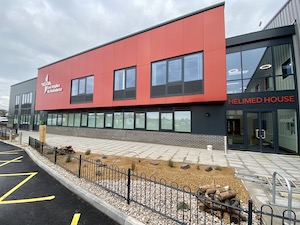 The East Anglian Air Ambulance is a 24hr, 7 days a week charity covering Norfolk, Suffolk, Cambridgeshire and Bedfordshire by air and road. The EAAA exists to save lives by delivering highly skilled doctors and critical care paramedics by air or car to seriously ill or injured people in the region. They are a life-saving charity that is only kept airborne thanks to their incredible supporters.
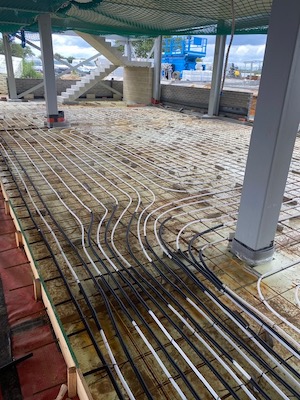
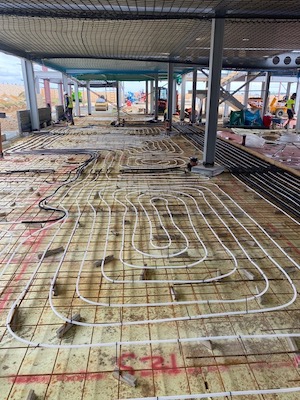 As the build-up requirements called for a robust floor construction there was no scope to install a normal wet UFH system clipped to an insulation layer. The project specification called for relatively low flow and return temperatures of 45/35ºC, this is to future-proof the building for use with heat pumps.
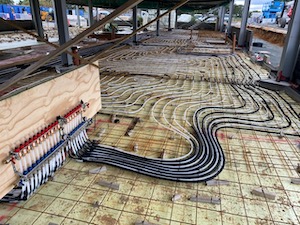 Working on behalf of our client who were the entrusted mechanical and electrical contractors on this project, it was a pleasure to design, supply and install the Underfloor Heating package.


