
Skip to content
BPindex — The Largest Building Products Directory in the UK

Heating products

New research into the impact of biophilic design

Building Products Index Ltd Heating, Ventilation Leave a Comment

View the Jaga Entry on BPi

Visit the Jaga website

Ed SuttieEd Suttie, Research Director, BRE discusses new research into the impact of biophilic design

A building has a multitude of qualities that impact on health, wellbeing and ‘happiness’. From the outside of the building this will relate to aesthetics, vernacular, landscape, perceptions, style, form etc.

From inside the building it is more fundamental, as we interact and experience internal conditions such as daylight levels, air quality, acoustic quality, thermal comfort and aesthetic that directly impact on our health, wellbeing and happiness.

We spend 90% of our lives in buildings and our health and wellbeing is influenced significantly by the built environment. Our personal health and wellbeing (physical, mental and social) impacts on our ability to communicate, work, heal and learn. The benefits of focussing on human centred design to create more restorative environments is being researched more deeply now by BRE. This is so that our future buildings and interiors can be designed and specified to improve productivity and communication (office – and increasingly for many of us that includes a ‘home office’), recovery rates (hospital) and education outcomes (school), which is exciting.

In a typical office-based business 90% of the costs are associated with the staff, yet in the UK up to 60% of office workers don’t have sufficient access to daylight which has a negative impact on the health and wellbeing of occupants. The same is often true when we are working at home. Biophilic design offers an inspiring umbrella under which health and wellbeing qualities can be captured that impact on workplace environments[i]. Harvard professor Edward O Wilson’s book ‘Biophilia’[ii] concluded we have a genetic connection to nature, and hold a biological need for physical, mental and social connections with nature. Presence in natural environments can alleviate negative emotions such as anger, anxiety, depression and stress, whilst helping us to restore, feel calm and be inspired[iii]. Biophilic design brings us into contact with nature via a more human-centred approach.
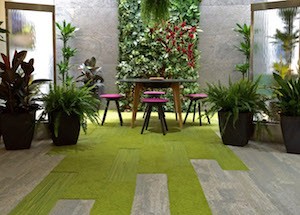
Biophillic DesignBiophilic design acknowledges this genetic connection with numerous benefits to our health and wellbeing and efficiency. The scientific evidence for the positive influence of biophilic design, on the health and wellbeing of building occupants is growing. In an office environment this is shown as quantified improvements in productivity, wellness and a reduction in days absent due to illness. More than 130 million days are lost to sickness absence every year in Great Britain and working-age ill health costs the national economy £100 billion a year. A 1% reduction in absenteeism would convert to a saving, in lost days alone, of £1 billion to the economy. In addition a 15% increase in operational productivity enabled by the internal fit-out of your office adds further benefit.

Building owners and facility managers need to know what they can do within limited budgets to create restorative and occupant health driven environments, and the predicted return on investment. Here evidence is lacking, which was a key motivation for the deeper evidence of the BRE biophilic office project[iv]. The BRE and Oliver Heath Design, supported by a number of partners from green walls, lighting and flooring to colour, furniture and acoustics, have started a research project to deepen the evidence base for biophilic design and its positive impacts on office occupants. This will help realise the untapped potential in our existing buildings.

A live office refurbishment on the BRE Watford campus is providing robust indoor environment and occupant data.

Researchers are conducting a baseline year of pre-refurbishment and a year of post-refurbishment monitoring, evaluating the office environment for daylight, lighting, indoor air quality, acoustic, thermal and humidity comfort. Office occupants will undergo confidential health evaluations, questionnaires and surveys and will use wearable technology to monitor key health metrics.

Each of the project partners is using the office and its test facilities in the project to evaluate their products’ role in the health and wellbeing of office occupants and for wider biophilic design.

The project will show how quantified improvements in productivity and wellness can bring rewards for landlords, occupiers, developers and all those concerned with the office and wider built environment

This comprehensive and long-term study is unique in terms of scale and data capture. It will provide a firm foundation for guidance and adoption of measures in the facilities management and refurbishment sectors to promote health and wellbeing in offices.

However, you do not have to be involved in a major refurbishment or new build project to be able to reap the benefits of this project. For architects, specifiers and others involved in smaller projects, it will give guidance to help improve health and wellbeing through simple interventions such as maximising natural light or the addition of plants. Some may already be trying to do this, but do not have the evidence or support to enable them to convince their clients of the value of such an approach.

For more on the project as it develops throughout 2018 and beyond go to www.bregroup.com/biophilic. Studies and surveys of the existing occupants have already commenced, as has outline design thinking. We expect to commence refurbishment in the Autumn of this year, with a target date of completion of Spring 2019. We are planning a major international conference showcasing the building in May, details will be released on our website shortly.

[i] Human Spaces, ‘The Global Impact of Biophilic Design in the Workplace’, 2015

[ii] Biophilia – the human bond with other species. Edward O Wilson. July 1990 Harvard University Press ISBN: 0674074424

[iii] Van den Berg, A. E., Hartig, T., and Staats, H., ‘Preference for nature in urbanized societies: stress, restoration, and the pursuit of sustainability‘, Journal of Social Issues, pp79-96, Vol 63, No 1, 2007

[iv] The BRE biophilic office project is building robust evidence of the impacts of biophilic designed office refurbishment on occupants to produce guidance to enable more to take advantage of the benefits and to create biophilic designed, energising and restorative indoor spaces bregroup.com/services/research/the-biophilic-office/

Jaga UK asks experts – What is next for the construction industry?

Building Products Index Ltd Heating Leave a Comment

View the Jaga entry on BPi

Visit the Jaga website

How must the construction industry adapt to create a successful future?

by Martin Townsend

Martin Townsend Image

It takes a unique question or experience to inspire a blog, and in this case, the question came from the team at Jaga.  I was asked to discuss the core trends which are currently dominating the future of the construction industry, and whilst any blog on this topic must come with a suitable number of caveats, I have endeavoured to outline my thoughts below.

This subject matter is enormous, and in many ways, the biggest challenge is deciding where to start.

In this case, I begin by considering the past. Whilst every former era of construction is confined to the rearview mirror of history, the lessons learnt during those periods continue to shape the present, and inform the future. One of the biggest construction trends right now is to re-evaluate the methodologies of the past. This is heavily influencing how we approach new and emerging technologies, whether that is with caution, or with full-throttle adoption.

These emerging technologies are many and varied, and are completely changing the face of the industry. Virtual reality and 3D printing have long since left the realms of science fiction to become invaluable tools for those working in construction and architectural design. Equally, we are seeing a cross-pollination of technologies across a raft of sectors – think car batteries moving into the realm of construction – which results in refreshing new ideas and ways of working.

However, for me, the most exciting change is subtler. Conversation within the industry has matured in-line with societal, and there is now an ever-increasing emphasis on the adaptability of spaces, buildings, communities, and neighbourhoods. These must now be designed to meet the rapidly developing needs of an aging population, along with a changing climate, to satisfy current and future demands on the spaces in which we work and live.

In order to facilitate these changes long term, there is also much discussion around how we can balance our rising population and evolving city scapes with the imperative conservation of our resources. There is a developing dialogue around how we can rethink the relationship between suppliers and end-users, and how that can translate into a greater understanding of the benefits of eco-friendly products and systems. I also very much anticipate a rise of the circular economy, whereby we drastically reduce waste whilst increasing well-being, a circumstance which will certainly change construction for the better.

Furthermore, we are seeing a shift in emphasis from quantity to quality. This is particularly relevant to housing developments, where consumers are far better informed than ever-before, and can conduct research on products and builds at the touch of a button. One example of this enforced transparency is consumer interest in long-term operating costs. Savvy buyers are now comfortable asking questions about factors such as the efficiency of a home’s heating system, green finance, or overall adaptability, and have the knowledge to back it up. A consumer led agenda of quality, through demand, rather than the supply side, is gradually becoming a reality.

This new level of transparency also enables a wider group of people to hold corporate groups to account, addressing sustainability issues and furthering public understanding of these. I see this in the conversations which I have daily – individuals involved in construction are beginning to realise that their brands have a responsibility beyond shareholder returns, and this is influencing how projects are developed and completed. Looking to the future, the graduates of today are just as interested in a company’s values and corporate social responsibility (CSR) as they are in performance on the stock exchange, a telling indicator of our future captains of industry.

Equally, as we become more international, there will be an expectation, or perhaps a need, for global governance to shape the construction agenda. In the current climate, it would be easy to stray into Trump or Brexit territory, but these are only a minor part of the story. The Paris Agreement, and the alignment of most (excluding the notable previous example!) high-level views of climate change, is a vital part of the future of construction. And, whilst a great level of volatility remains on the global stage, the increase of products and services being delivered on an international scale means that there is a rising need for consistency and commonality, and this should be driven by standards.

Related to this, is the changing way in which businesses collaborate. Collaboration has always been central to the construction industry, but to me at least, it is becoming more noticeable. This extends beyond collaboration between similar organisations, but also to those – potentially from completely different industries – who share a similar problem. Whilst this, to my mind, can only be a good thing, it’s vital that we develop and maintain governance models to ensure stakeholders can have confidence in what is being achieved, in a way that is not anti-competitive. This leads to interesting discussions around how legislation, such as competition laws originally put in place to protect companies, do not become barriers.

For those whose chosen profession is linked to the construction industry, it is perhaps one of the most exciting periods of the industry to be working in. If you are reading this from outside the sector, I hope this blog has given you pause for thought, and perhaps given you reason to re-evaluate the construction industry as one you may choose to join.Our once male dominated, and arguably, unsafe and unsanitary industry is evolving in front of our eyes. Top minds from top universities are gravitating to the sector, and the way we look at construction is shifting enormously, with innovative technologies, as well as new attitudes, hugely shaping the future.