Skip to content
BPindex — The Largest Building Products Directory in the UK

high density polyethylene

HDPE Soil Waste and Vent

Building Products Index Ltd Drainage, Pipes, Plastic piping Leave a Comment

View the Wavin entry on BPindex

Visit the Wavin website

Wavin HDPE soil waste and vent above ground drainage system provides a solution to the removal of domestic waste water and rainwater from residential and commercial properties using plastic piping systems.

Manufactured from high-density polyethylene (PE HD), the tough and durable HDPE system offers and extraordinary chemical resistance in combination with a high flexibility level and great impact resistance. Wavin HDPE pipes and fittings are jointed by welding, making the joints resistant to tension.

Features and Benefits:

Temperature resistances – resistance to temperatures of up to 90°C continuous temperature and 100°C short term conditions and also withstand freezing of internal waters

Flexibility – Well suited to assemblies subjected to vibration. Ideal for use is seismic zones and across expansion joints

UV resistance – With the addition of a percentage of carbon black, HDPE is UV-stabilised and can therefore be installed outdoors without degradation problems

Ease of Welding – HDPE can be welded both by butt welding and with electrofusion joints

Low weight – the lightness makes transportation and handling easy

Use of adhesives – Due to its high resistance to chemical agents, HDPE cannot be jointed with adhesives

Impact resistance – HDPE’s elasticity gives pipes a high impact strength at temperatures as low as -40°C. This ruggedness makes handling of pipes easy during installation

Smooth bore – The smooth surface of HDPE allows for both an optimum flow of any type of waste material and self-cleaning of pipes

Fire hazards – HDPE doesn’t use any toxic gases during combustion

Wavin HDPE connection seals – Quick-fit coupling and expansion joint seals remain resistant to waste water from house hold appliances, laboratories and hospitals. The seals are produced from an elastomer which guarantees sealing and durability even in extreme conditions

To learn more about Wavin HDPE read a case study about Wavin working with RPM Services on a five block apartment and commercial space – https://blog.wavin.com/en-gb/case-studies/st-george-beaufort-park-wavin-hdpe or to find out more about Wavin HDPE visit the dedicated webpage – PE HD welded pipes and fittings | Wavin UK

HOW THE BUILDING PROFESSION MUST RESPOND TO THE DRAINAGE CHALLENGES OF CLIMATE CHANGE

Building Products Index Ltd Drainage, Linear Drainage, Surface water drainage Leave a Comment

View the Clark-Drain entry on BPindex

Visit the Clark-Drain website

Climate change is subjecting us to more rainfall – and it’s set to get worse.

This raises urgent issues for the building profession and its drainage practices, since it’s not only the volume of rainfall that is set to increase (10% more per year on average by the end of this century, compared to 1986 – 2005) but also the frequency of individual heavy rainfall events.

And, this, of course, means significantly increased flooding risk – threatening everything from housing, to parking, retail and commercial sites, industrial developments, critical transport infrastructure, and everything in between.

In short, the deluge is coming, and the growth in housing and urbanisation is accelerating it.
Clark-Drain-Logo-editAlthough our industry alone can’t stop it, it can reduce the risk associated with it – both now and in the future – by adopting a new generation of innovative surface water design and management tools.

John Carter, Head of Sales and Marketing at Clark-Drain, explains what these solutions look like.

LINEAR DRAINAGE: GOING WITH THE FLOW

Drainage is at the heart of this strategy, and the obvious requirement in an era of increased rainfall is for increased flow capacity.

But this isn’t just about installing larger drains; it’s also about installing drains that manage the flow more intelligently.

So, the use of a linear drain with a sump, for example, not only filters out debris prone to cause blockages and decrease flow efficiency, it also enables the outflow diameter of all channels to be significantly increased.

Likewise, specially designed internal geometry in the drain can actively minimise inert deposits that can clog the channel and reduce flow, or indeed cause or exacerbate flooding.

Critically, incorporating various forms of these intelligent features across a ‘family’ of drainage solutions that are each certified to BS EN1433:2002 means that the same benefits can be delivered – but scaled up where necessary – across every environment, from a house to an airport.

As technical experts in linear drainage, we know that more water demands more than just a bigger channel – it demands a more efficient journey, too.

ECOLOGICAL CHANGE, ECONOMIC REALITY: WHAT’S THE COST?

Whilst drainage innovation is a key weapon in our industry’s fightback against the effects of climate change, it’s of course entirely legitimate to ask what these novel solutions are going to cost, compared to conventional drainage methods.
neofinepaginaDEF (1) copyOur view at Clark-Drain, though, is that innovation – however firmly it is ‘grounded in expertise’, as our own slogan has it – also has to be firmly grounded in the economic reality of our customers’ industry. In other words, it has to pay its way.

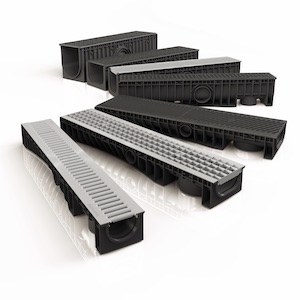
The good news is that we see plenty of evidence to suggest that it can. Innovations like our Technodrain solution, for example, help minimise costs in so many ways:

  • The use of high-density polyethylene (HDPE), combined with an external reinforcing structure, makes for units that are light and extraordinarily robust, so they are cheaper to transport, require fewer workers to carry and install them, and are immune to extreme temperature change and chemical attack from hygiene and road surface substances.

They are therefore cost-efficient from the start, but last longer and so offer low life-cost as well.

  • Easy installation features (tongue and groove joints, preformed lateral and vertical channel outlets) enable rapid connection of multiple channels with a ready-mounted grate, and also provide quick and easy connection to both new and existing discharge pipes.

The time, effort, and therefore expense involved in installation is thus kept to a minimum.

  • Flexible configurations and connections (tee- and cross-section joints) mean that the drainage line can be easily adapted, enabling rapid, on-the-fly improvements to be made.

This makes it possible to enhance the accuracy, efficiency and cost-effectiveness of the whole drainage system.

magnum city c 250 copyTechnodrain is just one of the innovative technologies we create for linear drainage systems.  Our leading portfolio of channel and grate assemblies, monocast, heavy duty and high capacity drainage systems have the design versatility to be used across all construction environments – both residential and commercial – each expertly designed to provide the optimum solution in surface water control.

DRAIN WATER, NOT COFFERS

Climate change means we face challenges – but the fightback isn’t feasible if drainage becomes a financial sink-hole for our industry.

Drainage must become more efficient. It must become more intelligent. It must become more cost-effective.

And we believe it has.  To find out more, please visit clark-drain.com

Delta Membranes – Every Penny Counts

Building Products Index Ltd Dampproofing 1 Comment

View the Delta Membrane entry on BPI

Visit the Delta Membrane Website

1606 Delta - BPI Basement materials 01 copyOver recent years there has been increasing pressure on budgets, and cost-effective construction techniques have been the order of the day. The same goes for refurbishment projects, which is where Delta Membrane Systems offers a wide range of products that help with the damp proofing of internal walls, particularly in basement projects.
Too often, basements are left redundant or as ‘dumping grounds’, but the truth is that they can be functional, useful spaces that can enhance the emotional and monetary value to a home.
1606 Delta - BPI Basement materials 02 copyDelta Membrane Systems has long argued that using its package of products designed specifically for basement refurbishment will bring a basement back to a habitable condition, at a cost-effective price.
A typical product for walls is the Delta MS-500 which is made from high density polyethylene. While the membrane itself is just 0.6mm thick, it features 8mm studs on the wall-side and it is these studs that create the drainage channel – allowing up to 135 litres/minute/metre of incoming water to be drained – well in excess of the likely demands.
Incorporating 20mm studs, Delta MS20 is another membrane in the collection that offers impressive operational characteristics. These include a compressive strength rating of 150kN/m2, and high capacity drainage to easily cope with the worst of likely conditions. It can be used in applications where extra drainage capacity is required, such as deeper structures, or where a larger flow rate is likely.
1606 Delta - BPI Basement materials 03 copyThanks to the membranes, all water entering the property drains down the wall into a channel that leads to a sump unit hidden below ground floor level. It is then pumped to a suitable drainage outlet which might be a soil vent pipe, or simply to an outside drain or soak-away.
Managing the damp ingress, rather than trying to prevent it altogether, is the sensible and economic option for basement refurbishment, and Delta Membrane Systems is a one-stop-shop for all the materials needed.
Delta Membrane Systems prides itself on the extensive collection of products it has on offer to overcome the problems of water ingress into a property – both existing and new-build. However, the service does not stop there as the company is happy to share its knowledge and offer technical advice wherever needed.