
View the Smoke Vents entry on BPindex
Nobody wants to consider the possibility of a fire in a completed building, but informed design decisions can significantly reduce the risks if the worst happens. In many fire scenarios, it is smoke – often spreading more quickly than flames themselves – that presents the greatest danger, filling spaces, obscuring escape routes and disorientating occupants.
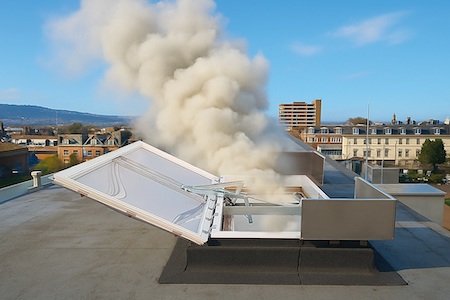 Fire burns. Smoke kills.
Most fire-related fatalities are caused by smoke inhalation, often long before flames reach occupied spaces. Modern construction materials can intensify this risk by producing dense, toxic fumes. Controlling the movement of smoke is therefore a fundamental part of any fire safety strategy, particularly in buildings with shared escape routes, protected stairways or more complex layouts.
Use smoke ventilation to protect escape routes.
Smoke ventilation systems allow heat and smoke to escape at high level, helping to maintain a clearer layer of air beneath. This improves visibility in stairways, corridors and other escape routes, supports evacuation and assists fire-fighting operations. In commercial developments, multi-occupancy residential buildings and mixed-use schemes, effective smoke control can play a vital role in protecting life and supporting compliance.
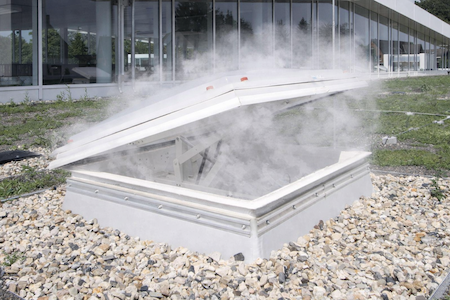 A specification issue, not an afterthought.
Smoke ventilation may not be required in every project, but where it is needed, it should always be addressed early. Guidance within Approved Document B, alongside standards such as BS 9991 and BS 9999, can influence the need for smoke ventilation depending on factors such as building height, compartmentation, travel distances, protected stairways and occupancy type. Considering these requirements at the outset helps design teams avoid costly revisions and achieve better coordination across the wider fire strategy.
Let the system respond automatically.
Automatic Opening Vents (AOVs) are widely used as part of smoke control strategies in both residential and commercial buildings. Connected to the fire detection system, an AOV opens automatically when smoke is detected, allowing heat and smoke to escape without relying on manual intervention. This is particularly important in larger buildings, unfamiliar environments and areas with higher occupant loads.
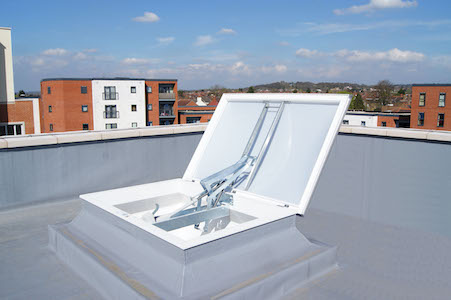
Specify systems that meet recognised standards.
Any smoke ventilation system should be fully tested and certified for its intended application. AOVs should be CE marked and tested to BS EN 12101-2, demonstrating suitability for smoke control and alignment with relevant Building Regulations guidance. For architects and developers, product performance, certification and integration with the overall fire strategy should all form part of the specification process.
Plan smoke ventilation at the design stage.
At Smoke Vents, we support architects and developers in specifying smoke ventilation early, helping to simplify compliance and deliver safer, more resilient buildings.