Skip to content
BPindex — The Largest Building Products Directory in the UK

PIR Detection

All Present and Correct

Building Products Index Ltd PIR Detection Leave a Comment

PrintView the Timeguard entry on BPindex

Visit the Timeguard website

Presence and motion detectors are the devices that you want to be able to fit and forget, so you need reliable high-quality branded products and the Timeguard range has everything you need – including  a helpline for any queries you have.

Passive infrared is the most economical and widely used sensor technology and the key choices here are between motion detection and the more-sensitive ‘presence detection’, of say people sitting and working at a desk. Increasingly popular now are the models that get the combined movement / sensitivity balance just right with precision sensitivity covering the core detection field plus motion detection extending over a wider area.  Of course, there will be a price differential, and that’s why it’s important you can easily find all the information you need to make the right choice by simply visiting the Timeguard website.
PIRs are the discreet workhorses of lighting and HVAC control
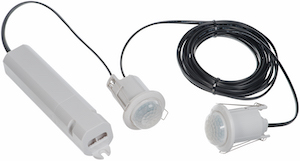
Combining presence and motion detection: the top selling SLFM360N / Pic: SLFM360N 360o PIR detector.
Innovative master and slave set up- up to 5 slaves can simply be plugged in in series
Joined up thinking: Timeguard’s easy-install linkable mini-PIRs.

Check that the detectors you choose keep you in control.  They will measure ambient light intensity so they will only trigger when certain pre-set low lighting thresholds are reached, not in broad daylight. This level should be adjustable to suit the premises. They should also offer the option to adjust the ON time. If these controls are missing and/or they are difficult to access and use, the detector is unlikely to do the best job for your customers. Easy and accurate control are hallmarks of the Timeguard ranges, and one of the many reasons installers choose them time and time again.

With very low profile flush mount detectors,  the controls are hidden in the body of the unit, so look for good spring clips that hold the device securely while still enabling  you to remove the unit from an aperture with ease should you need to adjust the settings and replace it securely without damaging the ceiling. Or perhaps, if super-sleek profiling isn’t vital, choose devices that offer external access to the controls without compromising on looks. We’ve proved that surface mount can still look sleek!

We did a bit of lateral thinking with the controls on the linkable mini PIRs, which allow for an array of detectors with a master and up to five slaves connected using standard pre-wired RJ11 sockets. A quick & easy drop-down twist-and-lock design makes reaching the controls as easy as changing a lightbulb.

We also offer the option of hand-held remote control for several of our presence detectors.
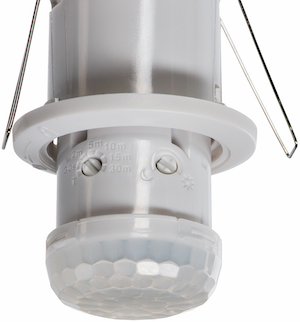
Easy access to PIR conrols with twist and lock design
Making control as easy as changing a lightbulb … twist and lock back when you are done.

Of course, PIR’s may not always fit the bill for what you need, especially in larger and partitioned spaces, so that’s when you may need active microwave (MW) devices. Operating in different areas of the light spectrum, they send out microwave pulses to measure the reflection off a moving object.  The Timeguard models look no different from regular PIR detectors when fitted.  Check the website for more information.

 Check out the range and specifications at www.timeguard.com

All present and correct

Building Products Index Ltd PIR Detection Leave a Comment

View the Timeguard entry on BPindex

Visit the Timeguard website

Picture 1

PIRs are everywhere, but they should not be thought of as basic, commodity items. Opting for the cheapest off-the-shelf PIR is never wise because replacing faulty devices is never easy just because of where they are likely to be mounted.

What, then, if you have invested in branded quality but the lights still aren’t working s expected? Here the problems are more likely to arise from having specified the wrong PIR for the job or getting the set up wrong.

The Tech Team at Timeguard are always happy to advise, and there’s no premium charge for calling them. There’s also plenty of information on the company website and product packaging and instruction leaflets. All the same, we asked them what you should be asking yourself before you choose a motion or presence detector.

What type of lights and what load?

Be sure to pick a PIR detector that is specifically tested with and rated for LED loads if that’s what you need to control.

You shouldn’t need to do the maths yourself: the specification on the box should already state what LED loading is acceptable – if not steer clear.  Timeguard thinks it’s always wise to add at least 10% for good measure.

There’s a huge difference between ratings for the same PIR detector for halogen and LED. For instance, while Timeguard’s mini linkable PIR foris rated for 1000W max. halogen, the LED rating is 250W max. LED. That’s because the LED rating allows for the strong inrush current on switching, not the subsequent low running current.  That said, 250W is usually enough for these PIRs with the option of up to five pre-wired RJ11 plug-in slave units per master, allowing for quick installation for corridor and multi-zone use.

Picture 2

Will there be lots of luminaries?

Take care if the total LED load is getting near the limit of the PIR’s specification, especially when controlling small luminaries.  Due to their physical size, lower wattage LED lamps (GU10 type lamps) commonly have very simple circuitry with surge protection and power factor correction omitted. That puts a massive strain on whatever is switching/controlling them.

So, for instance, the Timeguard SLW360o ceiling-mounted and flush-mounted detectors have a maximum LED load of 150W but are rated for a maximum of 10 separate LED10W lamps (ie only 100W). Yet the firm rates – and guarantees – them for LED lamps above 10W, right up to the 150W limit.

Where’s it going?

Most good PIRs now offer more sensitive presence detection. Remember, PIRs are often installed so that lights or fans turn off when a space is empty, so more often than not they do need to be able to detect the difference between an empty room and people sitting quietly  at a desk.

You don’t have to spend £100s for a single detector that offers presence detection. Presence detection is standard on most Timeguard PIR detectors.

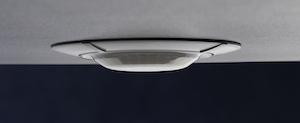
Will the detector be surface or flush mounted in a standard ceiling aperture? Most people prefer flush mounting if practicable, but Timeguard has proved that surface mount doesn’t have to mean clunky looking if the manufacturer has put the effort into design.

Picture 3

As a rule, a ceiling height of 2.5m will give optimum coverage but be sure to check the manufacturer’s instructions. You also need to be aware that highly reflective surfaces and heat sources like extractor fans nearby can interfere with sensitivity. Remember, too, that sensitivity is greatest for movement across the field, rather than directly towards it when choosing locations. It may be useful to mask part of the detector to avoid nuisance switching, and unnecessary call backs form disgruntled customers.

Choose products that make installation and setting up straightforward, because it’s usually done at the top of a ladder! Big wiring terminals and simple adjustment controls should be at the top of your wish list.

The bottom line, as ever, is branded quality assurance – good products, good information and good, free tech desk back up for installers.

Are you ready to offer daylight harvesting – with or without DALI control?

Building Products Index Ltd LED Lighting, lighting, PIR Detection Leave a Comment

View the Timeguard entry on BPindexPrint

Visit the Timeguard website


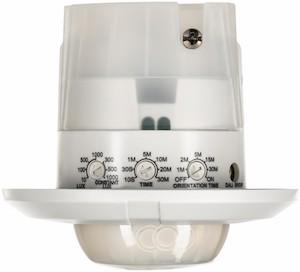
PDFMCDALI_Side_On

You will undoubtedly have come across DALI in the course of your work, but maybe thought it was only for the big contractors on the big jobs?  That may have been the case in the past, but DALI controls and devices are finding their way into the mainstream. Now PIR leader Timeguard has released a line-up of DALI-compatible PIR switches.  With POR switch,  power supply and remote IR control all provided, you have everything you need to get started from a brand you know you can trust. After all, as installers you are used to providing homeowners and businesses with zoned lighting and scene setting – why not take it to the next level?

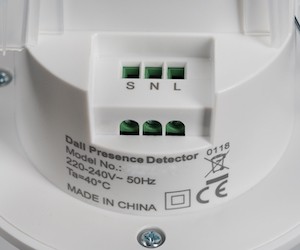
PDFMCDALI_PDFMDALI_Connections1And if you’re not ready, or the project doesn’t warrant DALI scene setting, then you can use these new PIRs as standalone detectors and still offer your customers daylight harvesting. That’s just another way of saying that lights will turn on and off in response to changes in the natural light, as the sun goes in and out, as well according to the time of day. You may also have heard this referred to as constant light control that, in the past, has been the preserve of PIR detectors designed – and priced – for the top end of the market.


Why bother?

Make best use of natural light with daylight harvestingThere are clearly cases and places where ordinary lighting is fine: if the application is simple and doesn’t require daylight harvesting (an important energy saving feature now specified in Building Regulations) , dimming, occupancy control or individual user control,  DALI isn’t the answer. But when you do need to design in or add any of these functions, then it is worth thinking about.

A DALI system just needs a DALI bus for communication between different points on the system such as the controller and a PIR.  So, an extra pair of cables between devices and control points of the system is needed : standard 2-core, minimum 1.5mm is sufficient. A DALI loop can contain up to 64 devices – typically LED drivers or PIRs – with multiple loops linked for larger projects.

What is it?

dali_logo_1The Digital Addressable Lighting Interface (DALI) is a standard that enables different devices on a system to talk to each other – they don’t even need to come from the same manufacturer. It’s an international standard, specifically created for lighting, for a two-way communication system that gives easy control and versatility. In a traditional system, control signals are one-way. In a DALI system, signal traffic is two-way, meaning LEDs can be commanded to perform requested actions, such as switch ON/OFF or DIM, but they can also be asked to provide information. The LED driver or switch can provide, for instance, information about intensity and energy consumption, or it can simply verify that it is working.

A DALI network consists of a controller, a power supply (which may be built into the controller) and one or more slave devices (eg ballasts, drivers, dimmers and PIR detectors) that have DALI interfaces. The controller can address devices individually or by multicast. Each device can be assigned to up to/any of 16 groups and can store up to 16 scenes that can be controlled by a single command

DALI sends messages around, and just like computer networks, the ballast with the right address picks the message up and follows the instruction: it might be ‘turn all the lights in the corridor on’, or it could be ‘switch to the theatre lighting scene in the conference room’.

Now that you know the basics, the decision may be a little more straightforward. Do you want to light several multi-function rooms that require different lighting options depending on time of day, usage etc. If so, think about DALI control with the new Timeguard range.