Skip to content
BPindex — The Largest Building Products Directory in the UK

Pumps and Macerators

The importance of building regulations when installing a macerator, pump or lifting station for any project requiring waste discharge.

Building Products Index Ltd Macerator pump units, Pumps and Macerators Leave a Comment

View the Saniflo entry on BPindex

Visit the Saniflo website

Whilst macerators and lifting stations may not represent the glamorous side of the plumbing sector, they are nonetheless, some of the most useful products out there. Love them or hate them, they are transforming unused spaces and helping to add extra facilities to buildings all over the UK. And the largest units are taking waste from whole buildings whose facilities are below the levels of the public mains drains.

Building Regulations approval is a statutory requirement set by the Government in order to ensure that buildings are designed and constructed in accordance with regulations and associated legislation. Projects that require approval include:

  • Erection of a new building
  • Extension or alteration of an existing building
  • Loft conversions
  • Plumbing, drainage and ventilation windows, and fuel burning appliances of any type.
  • Many types of electrical works on buildings.

Building Regulations are designed to protect the health and safety of building users and for projects that require a macerator, pump and/or lifting station it is mandatory to adhere to Part G and Part H. While plumbers, contractors and installers should be fully aware of the regulations, it is incumbent on the customer to ensure compliance.

Part G and Part H Building Regulations

Part G covers sanitation, hot water safety and water efficiency. And, when adding facilities and discharging to a drain, part 4.24 is the key regulation to understand;

A WC fitted with a macerator and pump may be connected to a small bore drainage system discharging to a discharge stack if:

  • There is also access to a WC discharging directly to a gravity system
  • The pump meets the requirements of BS EN 12050-1:2001

Part 5.10 stipulates that a sanitary appliance used for personal washing fitted with a macerator and pump may be connected to a small bore drainage system discharged to a discharge stack if:

  • There is also access to washing facilities discharging directly to a gravity system
  • The macerator and pump meets the requirements of BS EN 12050-2:2001

Part H covers drainage & waste disposal and the important stipulations for pumps:

2.36      Where gravity drainage is impractical, a pumping solution will be needed

2.37      This should conform to BS EN 12050 in basements and BS EN 12056-4 for pumps located

inside buildings

2.38      Lifting station/pump installations for outside buildings should refer to BS EN 752 – 6 for

guidance on design

2.39      where foul water is to be pumped, the effluent receiving chamber should be sized to contain a 24hr inflow to allow for disruption in service. The minimum daily discharge of foul drainage should be taken as 150 litres per head per day for domestic use. For other types of building the capacity of the receiving chamber should be based on the calculated daily demand of the water intake for the building. Where only a proportion of the foul sewage is to be pumped, then the capacity should be pro-rata. In all pumped systems the controls should be arranged to optimise operation.

Saniflo has developed a CIBSE-approved CPD programme which is designed to discuss and offer technical training on macerators and lifting stations for commercial and domestic buildings, including regulations. Appointments can be booked via marketing@saniflo.co.uk
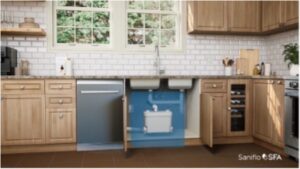
Building Regs for pumps, macerators and lifting stations

Building Products Index Ltd Pumps and Macerators Leave a Comment

View the Saniflo entry on BPindex

Visit the Saniflo website

Upgrading, extending or changing the use of a building will usually involve the addition of bathroom, washing or cleaning facilities. And when conventional drainage isn’t possible there is usually a practical pumping solution from Saniflo to help with the job. Of course, prior to specifying the product required, always check the latest Building Regulations, in particular Part G and Part H.

PART G

Part G covers sanitation, hot water safety and water efficiency with two key regulations affecting macerator and pump use:

Part 4.24

A WC fitted with a macerator and pump may be connected to a small-bore drainage system discharging to a discharge stack if:

  • There is also access to a WC discharging directly to a gravity system
  • The pump meets the requirements of BS EN 12050-1:2001

Part 5.10

A sanitary appliance used for personal washing fitted with a macerator and pump may be connect to a small-bore drainage system discharged to a discharge stack if:

  • There is also access to washing facilities discharging directly to a gravity system
  • The macerator and pump meet the requirements of BS EN 12050-2:2001

Part H

Covering drainage and waste disposal, the important stipulations for pumps include:

2.36      Where gravity drainage is impractical, a pumping solution will be needed

2.37      This should conform to BS EN 12050 in basements and BS EN 12056-4 for pumps located inside buildings

2.38      Lifting station/pump installations for outside buildings should refer to BS EN 752 – 6 for guidance on design

2.39      where foul water is to be pumped, the effluent receiving chamber should be sized to contain a 24hr inflow to allow for disruption in service. The minimum daily discharge of foul drainage should be taken as 150 litres per head per day for domestic use. For other types of building the capacity of the receiving chamber should be based on the calculated daily demand of the water intake for the building. Where only a proportion of the foul sewage is to be pumped, then the capacity should be pro-rata. In all pumped systems the controls should be arranged to optimise operation.

Need further clarification? Book a CPD with Saniflo here


Saniflo outdoor pump range extended

Building Products Index Ltd Pumps and Macerators Leave a Comment

View the Saniflo entry on BPindex

Visit the Saniflo website

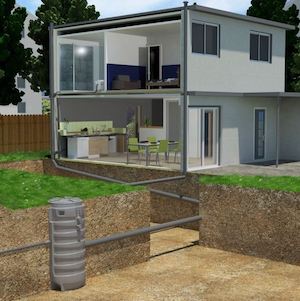
Sanifos 1300 in situSanifos is a range of underground pumps leading macerator supplier, Saniflo. Three original pumps with capacities between 110 and 500 litres were originally introduced to take the waste away from buildings with no gravity drainage by a pump that could be sited underground. Now, this range has been refreshed with two model upgrades and extended with a number of new models.

The Sanifos 280 replaces the original 250 and offers an additional 30 litres capacity, whilst the new Sanifos 610 provides a huge 110 litres additional capacity over its 500 litre predecessor. Both models have two macerating options – a grinder or a vortex impeller and can pump up to 14m and 16m respectively. All models feature a wired alarm for early warning of any problems, whilst the Sanifos 610 offers a choice of single or twin pumps, three phase or single phase, stop and check valve and a SMART unit as standard on models with two pumps.

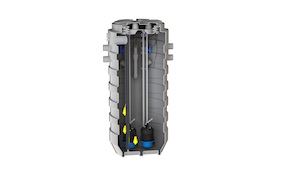
1300 Sanifos HR copyFor public buildings or for multiple smaller buildings, Saniflo has introduced four large capacity models starting with the Sanifos 1300 which can pump waste up an impressive 17m. This unit features two pumps mounted on a cast iron mounting base with stainless steel guide bars. A choice of inlet height position is available and a template is provided for this purpose. Three further models – the 1600, 2100 and 3100 – enable customised lifting station solutions according to the project in hand. This includes single or three phase, alarms and control boxes, covers, float and pump options, as well as multiple connections required.

Whether it is for a full house, an extension, a series of glamping pods or the installation of a washroom, the Sanifos pumps provide a solution when traditional drainage is not available or civils works are too costly and troublesome.