View the Cembrit entry on BPi
Visit the Cembrit website
Bolder coloured cladding is growing in popularity. Ged Ferris, Marketing Manager of Cembrit supplies some background.
 The standard method for choosing the colour of a façade material is with the use of colour samples. However, it is not uncommon for the finished façade to look different to the sample colour. There are many factors which contribute to this perceived discrepancy, many of which are due to the varying conditions under which a façade is viewed. A sample will often be viewed against a white background, while a façade will be viewed from near and afar, in a variety of light conditions and in different weather conditions. Professional designers and architects, and others who work with exterior colours on a regular basis soon become aware of the difficulties, and usually find a way to master them.
Traditional colours
Although popular in Europe, coloured cladding is only now starting to make serious inroads into the UK built environment. This is largely because our traditional building techniques have used monolithic, heavy stone or brick materials which tend to have an earth colour palette of browns, greys, blacks, as well as more creamy lime colours. As such, the built environment in the UK tends towards subtle, natural shades.
In other parts of the world, timber is often the chosen material for exterior cladding. Timber needs to be treated before it is used on the outside of the building and it is also easy to colour; whether through painting or staining, depending on the desired finish. This has created an environment where people see more coloured buildings and are used to brighter colours. Designers in Scandinavia tend to incorporate more vivid colours, and mix colours that we would tend to think would clash. Not only that, there are building examples in Scandanavia and Russia, as well as further east, where architects and designers have used what we would call a highlight colour, on very large areas of a building, sometimes it’s entire façade. It is probably true to say that these types of installation don’t always correspond with what we might call ‘British’ tastes or what we think of as generally acceptable in a building.
Mixing it up
Broadly speaking, in the UK it is common have a darker roof combined with a lighter façade, the standard look, so to speak, for houses across the land. On larger buildings, and those covered with rainscreen cladding, you don’t see the roof as they tend to be flat and have plant installed on them, so there isn’t the colour contrast. There are though, definite signs that our horizons are broadening. So although our most popular sample requests (and indeed sales) are for greys and blacks and whites, we are getting more demand for colours.
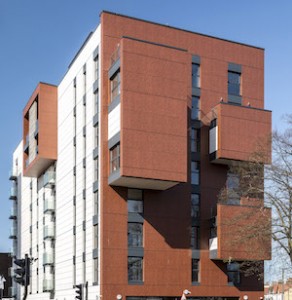
We are seeing more colour variety creeping into the projects we are involved in. Rather than a whole coloured building though, there is an increasing trend to use ‘highlight’ colours which can accentuate different aspects of a building façade. The challenge for the architect and designer is how to do this well and what materials to use.
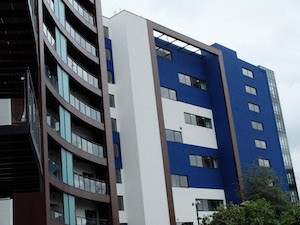
A good example of this is a recently refurbished apartment block in Portsmouth. Approximately 800m² of Cembrit Cembonit cladding has been used to overclad an apartment block in Portsmouth and the building now features an attractive stair tower which combines Cembonit Flint and Granite colours.
The block is situated in the heart of Portsmouth, on Westminster Place, just a few miles away from the popular designer shopping outlet Gunwharf Quays and the City’s Historic Dockyards. Due to its coastal location, the project required a material which would be striking to look at, but also durable against water staining. Ashford-based cladding specialist, Teiko Ltd was the main contractor on the project. As Matt Swaffer of Teiko noted, the company wanted to create an attractive design, so predominantly installed Cembonit in Flint, with around 10% of the cladding being in Granite to provide an accent colour. This created a great feature for the stair tower and has rejuvenated the appearance of the whole property. Cembonit is hydrophobated – a treatment which seals the board and prevents water absorption and staining.
Points
A key point to consider when using coloured cladding is whether the colour carries through the entire board or, is it just an outer layer? In the UK we tend to prefer a ‘through-coloured’ board where the colour is intrinsic to the board as it has been added during the manufacturing process. Cladding is exposed to the elements and all its effects – sun, rain and wind, as well as impact – in the long term ‘through coloured’ boards will not show abrasion and weathering damage as visibly as surface coated claddings. UV exposure can be particularly harmful and fade claddings that are not colour stable. Surface abrasion will be more visible if the “body” of the cladding is a different colour to the surface. Cembrit however has a range of claddings to suit various budgets and requirements:
Cembonit: a through coloured board
Cembonit has a directional grain on the surface. You can see the fibre and natural characteristics of the raw materials, and you can see and feel the sanding lines on the surface. As the seasons change and the years pass, the natural ageing of the fibre cement leaves subtle traces on the surface, and the cladding will gradually acquire a distinctive patina. The hydrophobation process means that cut edges do not need to be sealed, which is a real advantage for both cutter merchants and installers.
Solid: colour in the substrate and a treated surface which matches the base colour
The special thing about Cembrit Solid boards is that they’re the same colour all the way through. Each of the core colours is matched with a full-coverage painted surface in vibrant yet resilient colours. This means if you choose Cembrit Solid boards to provide a facade with a particular colour, every board will feature that colour on every surface and edge, and with the same colour on the edges of any cut-outs or drilled holes.
Transparent: shows the colour but the surface is protected (New for 2017)
Cembrit Transparent cladding boards combine the textured nuances and natural characteristics of the base board with a long lasting performance of the transparent top coat. The colour added to the fibre cement reveals and highlights the fibres and other raw materials that provide its strength and character. The extremely durable transparent coating then protects the board and ensures a smooth surface with a long service life.
Cover: a grey board with a paint coating applied on the surface
Cembrit Cover is the ideal solution if you prefer the strongest colours and bolder design statements. The natural grey fibre cement core is completely covered by a layer of water-based acrylic paint. There are 26 standard Cembrit colours available giving designers a selection of common shades and accents. In addition up to 2000 NCS colours can be chosen from for special situations, if it is a viable production run and the lead time is acceptable for the client.
A range of Cembrit cladding will be on show at Architect@work which is to be held at Olympia London, 25 – 26 January 2017. Visit the show to find out more about how Cembrit can add colour to your cladding projects.
www.cembrit.co.uk