Skip to content
BPindex — The Largest Building Products Directory in the UK

Wall insulation

What Role Does the Building Envelope Play in Creating a Greener Building?
Building Products Index Ltd Insulation, Wall insulation Leave a Comment

View the SAS Render Systems entry on BPindex

Visit the SAS Render Systems website

Creating greener buildings isn’t just about renewable energy or efficient heating systems. The performance of the building itself plays a major role in how much energy is required to keep it comfortable.

The building envelope – including the external walls, roof, floors, windows and doors – separates the internal environment from the conditions outside. Improving its thermal performance can reduce heat loss, lower energy demand and help protect the building fabric.

Reducing Heat Loss Through External Walls
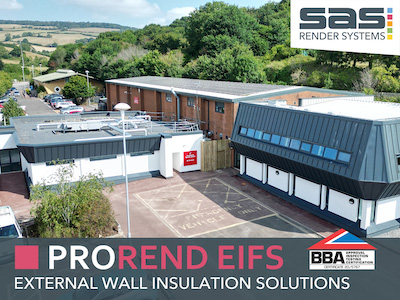
External walls can be a significant source of heat loss, particularly in older or poorly insulated properties.

When heat passes easily through the external walls, more energy is needed to maintain a comfortable internal temperature. Improving insulation helps slow this transfer of heat and allows the building to retain warmth for longer.

External Wall Insulation (EWI) achieves this by adding a continuous layer of insulation to the outside of the building.

As well as improving the U-value of the wall, externally applied insulation can help reduce thermal bridging by creating a more continuous thermal layer across the façade.

Why a Fabric-First Approach Matters

A fabric-first approach focuses on improving the performance of the building envelope before relying on additional technology to reduce energy consumption.

Improving insulation can reduce the amount of energy a building needs in the first place, helping heating systems operate more efficiently and creating more stable internal temperatures.

For existing buildings, this can be particularly valuable. Rather than replacing the structure, upgrading the external envelope can improve its thermal performance while retaining the existing building.

Protecting the Building Fabric
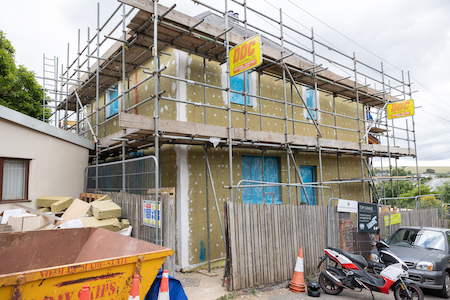
A high-performing building envelope needs to do more than retain heat.

External walls are continuously exposed to rain, wind and changing temperatures. A correctly specified EWI system combines insulation with reinforced basecoats and a protective decorative finish to create a complete external façade.

By positioning the insulation externally, the existing wall construction is also protected from some of the temperature fluctuations experienced at the outside of the building.

Careful detailing remains essential, particularly around windows, doors, rooflines, penetrations and other junctions where continuity of insulation and weather protection must be maintained.

Improving Building Performance with ProRend EIFS 
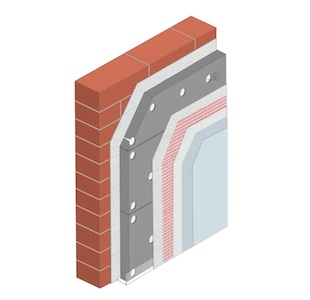
ProRend EIFS from SAS Render Systems provides an integrated external wall insulation and render solution for improving the thermal performance and appearance of suitable buildings.

The system combines external insulation with a reinforced ProRend basecoat, alkali-resistant reinforcing mesh, primer and a ProRend decorative finish.

Different insulation types and thicknesses can be specified depending on the existing construction and required thermal performance, while the range of ProRend finishes provides flexibility over the final appearance of the façade.

SAS can also provide project-specific technical support, including U-value calculations, system specifications, insulation guidance and construction details.

A Better Building Envelope for the Future

Creating greener buildings starts with reducing unnecessary energy demand.

By improving the thermal performance of external walls, reducing heat loss and protecting the underlying building fabric, External Wall Insulation can play an important role in creating more energy-efficient and resilient buildings.

For both refurbishment and suitable new-build applications, ProRend EIFS provides a complete approach to insulation and rendered façade protection, helping improve building performance while providing a high-quality external finish.

Improve Your Building Envelope with ProRend EIFS

Planning an external wall insulation project? The SAS technical team can help you select the right ProRend EIFS build-up for your project, with support including U-value calculations, system specifications and construction details.

Speak to the SAS technical team about your project today via info@sas-europe.com or 01647 24620.

www.sas-europe.com

A STRIVE TOWARD A GREENER FUTURE

Building Products Index Ltd Insulation Leave a Comment

SAS strip WhiteView the SAS entry on BPindex

Visit the SAS website

DEFINING EXTERNAL WALL INSULATION

Image Location: Beacon Avenue Exeter

Beacon Road Exeter4-2 IMG_0075


IMG_0081Construction materials and products are constantly evolving to keep up with the pace of the construction industry, consequently, we have seen a dramatic increase in the number of timber frame houses being built.

With the growth of modular construction utilising off-site construction there has been a decrease in time spent on site, creating consistency and increased productivity.

The energy efficiency of our homes has also become a concern with rising heating costs, meaning more of us are thinking about other innovative solutions like the insulation of our homes.

IMG_0011ICF or insulated concrete form is a fantastic example of a modern system focused on creating exceptionally energy-efficient homes.

ICF is quick to install by stacking polystyrene blocks, filling the hollow with concrete and leaving it to set, resulting in an incredibly strong and thermally efficient structure.

But what about existing houses! Improvement of loft insulation and underfloor insulation can make a notable difference, but what about the walls?

Beacon Road ExeterCavity wall insulation is a popular solution for many homes, although not all housing stock is suitable.

This leaves two main options, increase the insulation inside the house with internal insulation systems, or look at an external insulation system.

External insulation systems are a fantastic way to increase the insulation value of your house while transforming the look of the building.

At SAS, we have developed ProRend EIFS, our comprehensive and fully warranted external insulation system.

ProRendEIFSGrey_ copyTHE ADVANTAGES OF USING PROREND EIFS:

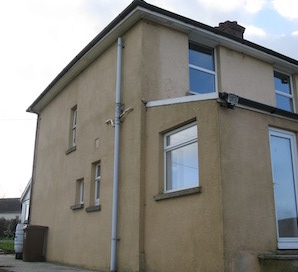
  • Cheriton Bishop, Exeter   Before
    Cheriton Bishop, Exeter
    Before

    BBA without NumberSystem durability up to 30 years – BBA 20/5767

  • Choice of EPS or Mineral wool insulation to suit your requirements
  • Fire tested in accordance with BS-EN 13501 Achieving a rating of A2-S1-D0 (for mineral wool)
  • Drastically increase property’s thermal performance
  • Approved Document Part B Fire Safety compliant
  • Suitable for application up to and above 18m (mineral wool)
  • Available in 30 standard colours plus RAL and NCS matching to 65000+ colours
  • 10-year system warranty
  • Highly water-repellent silicone resin finish
  • Low maintenance costs

SYSTEM BREAKDOWN

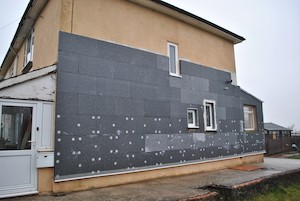
Cheriton Bishop, Exeter   During
Cheriton Bishop, Exeter
During

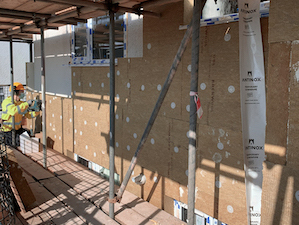
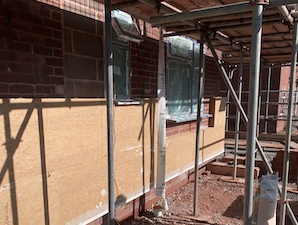
Following any potential surface preparation requirements, the insulation material, either mineral wool or EPS, is adhered to the surface using our specially designed high polymer basecoat.

The insulation slabs are mechanically fixed to the substrate, then the basecoat is applied and fully embedded with a fibreglass reinforcement mesh to tie the whole area together.

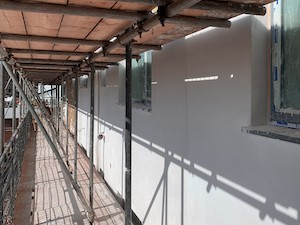
Once cured, a colour primer is applied followed by a highly water-resistant and flexible silicone thin coat.

The whole system achieves a 30-year BBA certification and comes with a 10-year system warranty.

INSULATION OPTIONS:

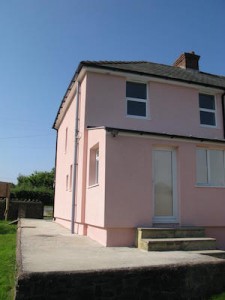
Cheriton Bishop, Exeter   After
Cheriton Bishop, Exeter
After

ProRend EIFS can be installed using either expanded polystyrene (EPS), or mineral wool insulations.

Both options of ProRend EIFs boast superb insulation properties but principally for different property types.

THE ADVANTAGES OF USING EIFS: EXPANDED POLYSTYRENE – EPS

Our premium platinum insulation has fantastically low thermal conductivity, drastically decreasing the overall heat lost through your walls.

As the most cost-effective of the two insulants, EPS is often the material of choice for residential renovations.

MINERAL WOOL

Our high-density mineral wool slab is a fibrous material formed by spinning or drawing molten mineral or rock materials.

The composition of the mineral wool makes it incredibly fire-resistant; this is particularly useful for any high rise or commercial buildings where fire safety is paramount.

Mineral Wool can be utilised as a sole insulant in ProRend EIFS projects or serve as a fire barrier in EPS applications.

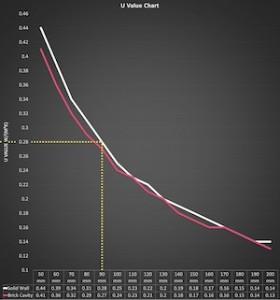
EIFS Graph2 copyWhen considering a renovation to improve thermal efficiency, the regulations refer to the thermal requirements as stated in Approved Document L1B.

L1B states that any newly constructed thermal elements or thermal elements constructed as replacements for existing elements should achieve a U-value of 0.28 W/(m².K).

Two traditional wall makeups are solid walls or brick cavities. We have modelled the reduction in U-value based on various thicknesses of EPS used in our system.

As you can see from the graph, 90mm insulation is often enough to meet the regulations of 0.28 W/(m².K).

Thicker insulation can, of course, be used to further decrease the U-value and make the building that much more thermally efficient.

Whatever your property, if you are looking to increase the thermal efficiency while transforming the exterior, get in touch and SAS will put a bespoke specification together for you and calculate your U-value.