
The impact of climate change must be considered when designing homes today. They will need resilience to cope not only with hotter summers with increased risk of fire but also wetter winters.
There’s a reason why around 25% of new British homes are built with H+H aircrete. As a masonry material, aircrete combines durability, thermal performance and non-combustibility. Few other building materials offer the same combination of benefits.
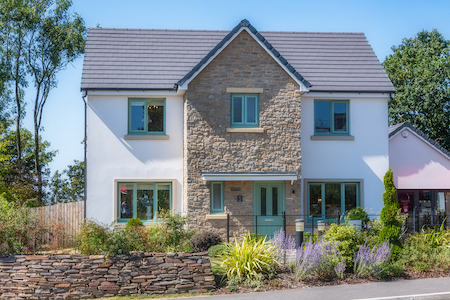 Homes built with aircrete are robust, with a design life of over a century – significantly longer than the 60-year lifespan accepted as standard within the industry. And importantly, homes built with aircrete are resilient.
When designing homes today we need to factor in the impact of climate change. This summer has brought another reminder of just how quickly our climate is changing, with a run of serious heatwaves. With hotter summers expected to continue, future-ready housing must be designed to stay cool and comfortable without excessive reliance on air conditioning.
Tackling overheating with thermal mass
Thermal mass – the ability of a material to absorb and store heat – plays a vital role in maintaining stable internal temperatures. Aircrete’s thermal mass helps absorb excess heat during the day and release it gradually at night, helping moderate internal temperature fluctuations and reduce the risk of overheating. This passive cooling effect can reduce reliance on mechanical cooling systems, helping to reduce both energy use and occupant discomfort.
Building in fire resistance
This summer we have seen a significant increase in wildfires across Britain with 1,132 reported between 1 January and 16 August 2026. Nearly 40 homes were damaged or destroyed by fires in Stourbridge in the West Midlands in August, including 19 houses that were fully destroyed.
Analysis carried out by Sky News using data from the European Forest Fire Information System shows that nearly one in five large wildfires (19%) in England and Wales came within 500m of built-up areas in 2026. It is a worrying statistic and highlights the importance of constructing homes with non-flammable materials.
Aircrete has an A1 fire classification, meaning it is classified as non-combustible. It won’t burn or contribute to the development of fire. We would argue that this attribute isn’t a ‘nice to have’ but an essential.
Preparing for increased flood risk
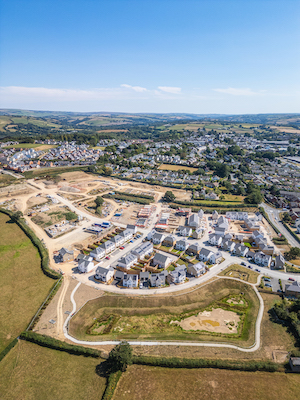 Another major climate risk is the increased frequency and severity of flooding. The Environment Agency has emphasised the importance of property-level flood resilience measures, particularly as 5.7 million properties in England are currently at risk.
Building with durable, non-degradable materials is key to reducing this risk. Masonry systems such as aircrete offer outstanding flood resilience. They don’t rot, warp or degrade over time, and their dimensional stability maintains structural soundness before, during, and after flood events. In contrast, timber construction can be more vulnerable to water damage and may require extensive replacement or remediation following flooding.
As the Mineral Products Association notes: “Masonry construction offers dimensional stability and structural integrity during and after flood events, a stable surface for waterproof membranes, fast restoration post-flood, and is a non-degradable material that doesn’t rot, rust or warp. No other construction method offers this level of resilience.”
As our climate continues to change it becomes ever more important to build resilient homes using materials that stand up to heat, flooding, and long-term environmental change. Aircrete offers a robust solution: durable, thermally efficient and fire-resistant.
Find out more and explore the H+H product range here: https://www.hplush.com/en-uk/