
Whether masonry or timber frame, every house can benefit from an aircrete foundation.
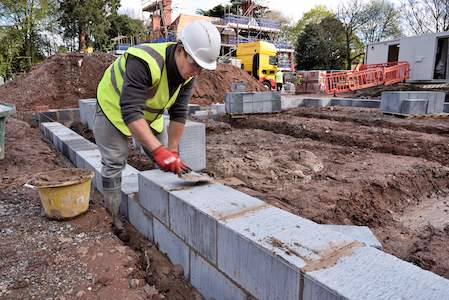 A foundation distributes the weight of a building to the ground so needs to be of the highest quality and reliability to provide stability.
Aircrete is a popular material for building foundations for the wide-ranging benefits it offers as a groundworks solution. Its light weight and fast build-speed enable a building’s foundations to be constructed quickly, easily and cost-effectively.
Advantages of aircrete foundation blocks
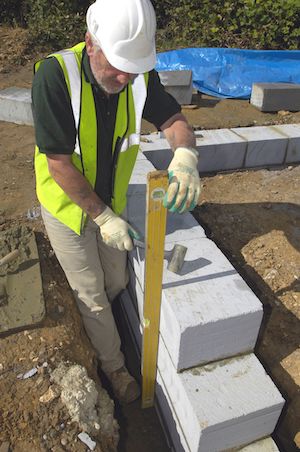
Celcon Foundation Blocks can support both solid and cavity wall constructions along with timber and steel-framed systems. These aircrete blocks, manufactured by H+H, are available in a range of face sizes and thicknesses to ensure the foundation is at least as wide as the thickness of the wall being supported.
 Thermal performance
Aircrete’s material properties make it highly thermally efficient. This enhances a dwelling’s energy efficiency by reducing heat lost into the ground while reducing the need for additional insulation.
Achieving Part L of the building regulations is easy with Celcon Blocks because of the low U-values they achieve. In fact, Part L recommends using aircrete foundation blocks where aircrete is being used in the construction of external walls to ensure continuity of insulation levels within the building fabric.
In addition, the raw materials used in the production of Celcon Blocks give them excellent resistance to sulfate attack and frost damage.
- Speed
Weighing just one third of an equivalent dense aggregate block, Celcon Foundation Blocks are easier to handle and faster to lay, improving productivity.
Celcon Blocks can easily be cut with a hand saw meaning off-cuts can often be incorporated into the build, reducing wastage.
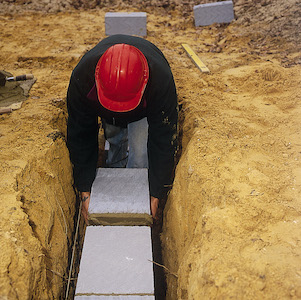
In addition, only a single leaf of blockwork needs to be laid to form the foundations, as opposed to cavity construction which requires two leaves of blockwork and concrete infill. This means works can be completed in less time, reducing labour costs.
 Approved method
Celcon Foundation blocks are approved by the British Board of Agrément (BBA) for use below DPC.
There are also health and safety benefits from handling lighter blocks. Although no specific weight limits are given in legislation, use of the heavier blocks should be subject to a risk assessment and a safe system of work established following the guidance of HSE Construction Information Sheet No. CIS77 ‘Preventing injury from handling heavy blocks’.
H+H products for the construction of foundations
H+H aircrete Foundation Blocks are available in Standard Grade (3.6N/mm2) and High Strength Grade (7.3N/mm2) to support buildings up to three storeys.
The blocks are available in two face sizes, 325 x 215mm and 440 x 215mm. The 440mm face size block is available in three thicknesses: 275mm, 300mm and 355mm.
H+H Standard Grade and Solar Grade aircrete blocks can also be used below the DPC for both the internal and external leaves of cavity foundations. For applications where a higher compressive strength is required, such as the foundations of three and four storey buildings, H+H’s High Strength and Super Strength Grade blocks should be used.
Full technical details for Celcon Foundation Blocks can be viewed on H+H’s website.