Skip to content
BPindex — The Largest Building Products Directory in the UK

Acoustics

Register Now For Building Safety for Future Generations

Building Products Index Ltd Acoustics, Membranes, Uncategorized Leave a Comment

View A. Proctor Group entry on BPindex

Visit A. Proctor Group website

A round table discussion on best practice for the implementation of the Building Safety Act across the industry. Our panel of experts will explore a range of topics around responsibility, risk and managing collaboration to deliver best practice safety management.

  • Industry Goals & Responsibilities
  • Stakeholder Collaboration & Accountability
  • Legislation, Compliance & Risk Management
  • Transparency, Documentation & Communication

Joining the discussion are leading industry experts:

• Iain Fairnington – Technical Director, A. Proctor Group Ltd
• Clare Fenton – Principal Facades Manager, Wates Group
• Peter Davies – Materials Engineer, Part B
• Gavin Hoccom – Partner, Browne Jacobson
• Will Jones – Head of Business Development, A. Proctor Group Ltd

Register now to reserve your place for our forthcoming Round table event “Building Safety for Future Generations” hosted by A. Proctor Group Managing Director Keira Proctor

Webinar Feedback 

We love getting your feedback. Regardless of whether you’ve enjoyed our webinar, or think there’s something we could work on, please let us know by completing our feedback form.

Webinar Certification 

Collect personalised CPD certification after you’ve viewed our webinar. This service downloads a PDF certificate which will appear at the bottom of your browser & will be saved in your downloads folder.

Webinar Product Sample Pack 

A pack containing samples of the materials discussed in our webinar can be posted out to you at your request.

Book An Online Meeting 

Our team are available to take online meetings (usually via the Zoom platform) at a date & time that suits you. We are happy to discuss project specific questions, review drawings, assist with specifications, documentation, calculations or anything else you need. Visit our website to start the process and we’ll get back in touch soon.


Enhancing Comfort through Quiet Spaces with Soprema’s Acoustic Range

Building Products Index Ltd Acoustic Panels, Acoustics Leave a Comment

View the Soprema entry on BPindex

Visit the Soprema website

In the dynamic and bustling world we live in, it is becoming increasingly more important to create quiet and comfortable spaces. Global leader in waterproofing and insulation solutions, SOPREMA, steps into the spotlight with its impressive acoustic range, aiming to revolutionise the way we experience our surroundings.

Soprema provides an extensive selection of acoustic insulation and soundproofing solutions suitable for ceilings, walls, floors and even pipes. Our commitment to quality and service ensures that your building is soundproofed in compliance with regulatory standards, providing you with peace of mind. Soprema’s Tecsound range now includes PURE-KUSTIK and FIBRO-KUSTIK Barcelona seamlessly merging functionality and aesthetics.

PURE-KUSTIK panels redefine acoustic excellence, boasting impressive absorption properties of up to class A (αw 0.90). Crafted from polyester fibres, with 60% recycled material content, PURE-KUSTIK is a sustainable choice, free from toxic substances and chemical binders. Available in a variety of colours or custom prints, PURE-KUSTIK boards can be installed either through mechanical fixing, glue application or for an even faster installation, a self-adhesive option is also offered. Read more about this incredible product here.

Meanwhile, FIBRO-KUSTIK Barcelona sets a new standard in both performance and durability. With acoustic absorption reaching class A (αw 0.95), these boards are built to withstand the rigors of residential and non-residential applications. Available in an array of sizes, colours, and varieties such as SOLO, DUO, and TRIO, they offer flexibility and style without compromising efficiency. Find more information on FIBROKUSTIK here.


Our commitment to excellence goes beyond product innovation. We also offer comprehensive technical support and are on hand to guide you through the process from specification to supply. Our online reverberation calculator, RT 60, ensures precise calculation and design tailored to your project’s unique requirements.

These solutions are making waves in projects across the UK, gaining traction in the market and building interest. For further details, reach out to our technical experts at  technical@soprema.co.uk or visit our website.


Knauf acoustic wall and ceiling systems – ideal for all sectors

Building Products Index Ltd Acoustic Panels Leave a Comment

View the Knauf entry on BPindex

Visit the Knauf website

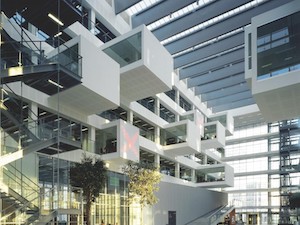
Image 1The importance of good acoustic design in buildings cannot be understated. At home and in healthcare settings it creates a more comfortable, relaxing environment. In the office it can increase productivity, and in schools and education buildings it can create an environment more conducive to learning and concentration.

Studies have shown that a good acoustic environment can reduce stress levels by up to 27% and error rates by up to 10%. Furthermore, up to a 66% reduction in performance was found when people are exposed to distracting noises.

Knauf has a wide range of acoustic ceiling and wall solutions to cater for all sector projects. Moreover, demonstrating Knauf’s thorough understanding of acoustics, we have developed a new, RIBA-approved CPD, ‘Why acoustics matter and how to specify them’.

Colour , painted on site

All Knauf acoustic boards and tiles are manufactured using gypsum, with a significant quantity being recycled gypsum. Gypsum is recognised for its advantageous acoustic characteristics, and our acoustic gypsum solutions absorb up to 90% of the sound that hits their surface. Also, gypsum tiles are more durable and need replacing less frequently, meaning less long-term maintenance is required.

Additionally, it is important to note that, when installed as a full Knauf system, you will receive a full system performance warranty.

Traditionally, acoustics have been synonymous with mineral wool solutions due to their sound absorbent quality. However, Knauf acoustic systems are able to do more than this. Knauf acoustic walls and ceilings are able to diffuse through the perforations, reflect or reverberate noise, as well as absorb sound within a room through a fleece layer.

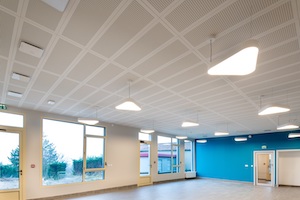
For example, Knauf Plaza acoustic ceiling tiles with Unity 3 perforation achieve up to Class A sound absorption.

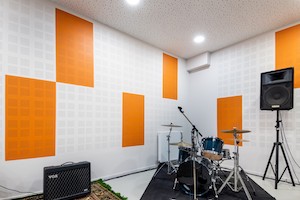
Image 3Knauf Danotile creates a high performance hygiene ceiling, suitable for rooms with high cleaning and infection control requirements. The product is great for kitchens and food preparation areas, with the white foil-covered robust surface tolerating tough cleaning and disinfection agents as well as pH levels from 2-13. Knauf Danotile is also ideal for healthcare projects designed with both patient welfare and building maintenance in mind.

Knauf acoustic solutions are not just for larger rooms either. Knauf Corridor 400 acoustic ceiling is a unique ceiling solution for narrow rooms and corridors. The gypsum ceiling, with its distinct and unified look, installed without any cross runners or suspension hangers, is a self-supporting system. Therefore, Corridor 400 acoustic ceiling is extremely quick to install; up to three times faster than a traditional T-grid ceiling in a corridor.

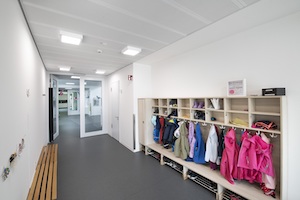
Image 4It is also worth noting that the Knauf acoustic ceiling range comes, as standard, with an innovative air-purifying technology called Cleaneo. The Cleaneo feature within the gypsum core helps to decompose the harmful volatile organic compounds (VOCs) that are emitted into a room by everyday building materials, furniture and cleaning products.

We spend 90% of our lives inside buildings, so ensuring that we have good, clean indoor air quality is vital to designing a safe building.

In addition, the Knauf portfolio provides great design freedom as they come in different finishes and can be painted.

Whether you require a demountable, non-demountable, self-supporting or suspended acoustic ceiling board or tile, Knauf has you covered. Whatever the sector and design requirements, they can all be designed to achieve a range of different acoustic performances and aesthetics. To find out more, please visit https://www.knauf.co.uk/systems-and-products/acoustic-solutions

Acoustics Within Education Explained

Building Products Index Ltd Acoustic Panels, Acoustics Leave a Comment

View the Hush Acoustics entry on BPi

Visit the Hush Acoustics Website

Acoustics in Education

Primary School case study
It is crucial for modern day education environments have good acoustics within classrooms and other learning areas. Pupils need to be able to listen clearly to their teachers to foster their learning process, and likewise teachers need to be able to clearly communicate to pupils without echoing or reverberation noise levels causing disruption. Poor acoustic performance within classrooms severely hinders the learning and teaching process.

How does noise affect educational environments?

image-01-educationThree main noise sources affect classroom environments – reverberation noise, airborne sound sources and impact sound sources. Reverberation is a common problem within classrooms and has a potentially significant impact on teachers and pupils. Background noise and group work where discussions and debates are encouraged mean that if a classroom isn’t properly soundproofed, noise levels will crescendo to uncomfortable levels and as a result will hinder any learning ability.

Nowadays there are a variety of educational methods and styles presented in the classroom, each with their own sound issues. The more traditional teacher/lecture based classroom is where a teacher is located at the front of a classroom and leads any communication or discussion. This method potentially suffers greatly from reverberation noise levels as pupils who sit toward the back of the classroom will suffer from reflected noise levels, where the teacher’s voice is at the weakest point due to reflected sound waves.

A more modern approach to teaching focuses on a more interactive based learning style where students are encouraged to discuss and work in pairs or groups. This means within a classroom, reverberation and ambient noise levels will increase dramatically, and if a classroom doesn’t have adequate soundproofing the noise levels will hamper concentration levels and learning ability.

Airborne sound sources affect classroom environments where sound travels from different rooms within a building, particularly through internal separating walls or floors. This is particularly relevant where a classroom is situated next to a music room, or a library which is next to a busy corridor.

Impact sound sources are sudden noises that come through a floor or wall construction, for example footsteps on a floor. It is imperative that impact noise is accounted for to ensure pupils’ movements in the classroom above are not heard below.

UK Building Regulations and guidance in Building Bulletin 93 require that these noises are controlled and that every room or space within an education building is designed in such a way as to achieve a certain level of acoustic performance.

What can be done to reduce noise levels?

Town houses. London, EnglandThe most effective way to reduce reverberation, airborne and impact noise levels with educational buildings is to ensure high quality acoustic products and systems are used, and more importantly, are used in the right application. All soundproofing products used should comply with UK Building Regulations Approved Document E (England & Wales), Section 5 of the Scottish Building Standards (Scotland) and Approved Part G (Northern Ireland).

In order to satisfy the requirements of the above building regulations, the Government introduced the guidelines Building Bulletin 93: Acoustic Design of Schools – Performance Standards (BB93), 2015 (latest revision). This document has been created for architects, contractors, acousticians and other professionals to ensure all new school buildings are designed and built to achieve a certain level of acoustic performance.

To ensure compliance with BB93, Hush Acoustics have developed a range of soundproofing products and systems. The Hush HD1054 Double Timber Stud Wall System is an effective system for the reduction of airborne noise sources and can be easily incorporated into early design plans. Hush Slab 100 Sound Absorber insulated the stud frames in the wall cavity and then layered with 15mm Soundblock Plasterboards. This reduces airborne noise levels considerably between classrooms and other internal spaces within an education building and importantly complies with UK Building Regulations.

image-03-hush-acoustic-wall-system-hd1054To reduce reverberation noise levels within classroom environments, one of the most simple and effective products to use is a sound absorber, in the form of the Hush Absorber range. These acoustic absorber panels have a Class A absorption rating and comply with BB93 Standards for Acoustics in Schools. The Hush Absorber range is a popular option among educational buildings as it provides a simple and effective remedial treatment, and a big advantage is that they require no building work to be carried out.

Robert Crampton, Managing Director of Hush Acoustics, reflected on a primary school that suffered from high levels of reverberation noise, “One of the worst cases of reverberation noise problems I have ever encountered was in the multi-use hall and dining area in a primary school. School assemblies were difficult for teachers to communicate effectively and also for pupils to concentrate, as reverberation noise levels meant speech clarity was poor.

We carried out a site inspection and as a result of our findings we recommended the use of our Hush Absorber Panels. We then calculated the amount of absorption material needed in order to bring the school hall reverberation levels in line with BB93 guidelines. It only took two days to install the panels and as a result there was a noticeable difference in the levels of reverberation noise. Teachers found it easier to present assemblies and there was a noticeable increase in the pupils concentration levels resulting in a more enjoyable and comprehensive learning experience.” 

How to plan for effective soundproofing

Early soundproofing advice is important for acoustics in schools, colleges and universities. Architects, contractors and developers can benefit greatly from gaining expert soundproofing advice in the early design stages of a build project. By doing this, project developers are able to get it right first time and create an education environment that is fit for purpose.

Hush provides comprehensive guidance on education build projects of any size, from a single classroom to an entire school. We explain how individual areas within an education building can be affected by sound and can give expert advice on how to reduce reverberation, airborne and impact noises.

Our easy to install systems are designed to optimise space within a classroom/teaching room for new build, refurbishment and change-of-use buildings. Hush has been involved in the design and manufacture of sound reducing products and systems for over 30 years and have worked on many projects within educational buildings.

If you need any information on Hush’s acoustic products and systems please browse the company website (www.hushacoustics.co.uk) or contact one of their experienced acoustic technicians on 0151 933 2026.