Skip to content
BPindex — The Largest Building Products Directory in the UK

Cistermiser’s Easyflush

The Summer Holidays: A Perfect Window for Schools to Upgrade Washrooms, Save Water and Cut Costs

Building Products Index Ltd Bathrooms, Hands free flush Leave a Comment

View the Cistermiser entry on BPindex

Visit the Cistermiser website

As schools across the UK prepare to close their doors for the six-week summer break, now is the ideal time to undertake essential maintenance and facility upgrades without disrupting the academic calendar. Cistermiser, the UK’s leading provider of commercial washroom water management solutions, is urging schools to use this period to modernise their washroom facilities, highlighting that upgrading to water-efficient technologies can significantly reduce water consumption, lower carbon emissions, and ease the strain on stretched school budgets.


“School washrooms endure heavy, continuous use throughout the term. In many educational settings, outdated plumbing and inefficient fixtures lead to substantial water wastage,” says Richard Braid, Managing Director of Cistermiser. “A common issue raised by student councils and site managers alike is the failure of pupils to flush toilets or turn off taps, which not only creates hygiene concerns but also drives up utility bills. Not only that, but leaky loos are costing schools thousands of pounds. All of these issues can be solved by a little planning, right now.”

“Upgrading washroom facilities is not merely about improving aesthetics; it is a strategic financial decision. By reducing water usage, schools can directly lower their utility costs, freeing up essential funds that can be redirected toward educational resources and student support. Furthermore, lowering water consumption inherently reduces a school’s carbon footprint, supporting broader environmental and sustainability targets.”

A compelling example of how to tackle these challenges head-on can be found at Cathays High School in Cardiff. A mixed-sex, multi-faith school with approximately one thousand pupils, Cathays High School faced a perennial problem: representatives from the student-elected School Committee regularly complained that boys frequently failed to flush the toilets after use.
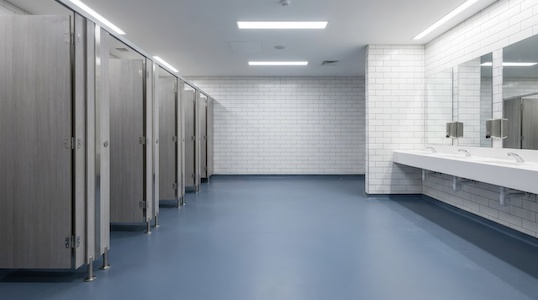
Determined to find a solution, the Site Manager, Sue Petryna, contacted Cistermiser. The team visited the school to review the issue firsthand. They recognised that a standard infrared “wave” sensor might be ignored just as easily as a manual flush handle. Working closely with their R&D Department, Cistermiser proposed the Easyflush system featuring innovative “walkaway” operation.

This “hands-free” flushing system automatically triggers a flush whenever a user gets up or walks away from the toilet. The intelligent infrared sensors operate on a dual-flush mechanism, delivering a part flush if the user leaves within 45 seconds, or a full flush if that period is exceeded. This method ensures hygiene while restricting water use to an absolute minimum.

To assist schools in understanding their potential savings, Cistermiser is offering a Free Water Survey.

“Don’t let the empty corridors of the summer holidays go to waste,” says Richard. “Book your free water survey and help your school create a cleaner, greener and more cost-effective environment for the new academic year.”

To find out more email sales@cistermiser.co.uk

For more information on water-saving solutions and how Cistermiser can help, visit www.cistermiser.co.uk
WHAT IS A LEAKY LOO AND HOW MUCH IS IT COSTING YOU?

Building Products Index Ltd Hands free flush, Uncategorized Leave a Comment

View the Cistermiser entry on BPindex

Visit the Cistermiser website

Introduction

At first glance, everything might seem fine. The toilet flushes. The floor is dry. Maintenance hasn’t raised a flag.

But behind the scenes, a silent problem could be quietly draining your budget, undermining your sustainability targets, and wasting thousands of litres of water, every single day.

Welcome to the world of the leaky loo.

What is a leaky loo?

A leaky loo is a toilet that is continuously losing water, often with no visible signs whatsoever. Unlike a burst pipe or an overflowing cistern, these leaks are entirely internal. The culprit is usually a worn fill valve, a faulty flapper, or an inefficient flushing mechanism that never quite closes properly.

The result? Water is constantly trickling from the cistern into the pan; 24 hours a day, 7 days a week, 365 days a year.

No drips. No puddles. No noise. Just ongoing, invisible water waste.

That’s precisely what makes leaky loos so costly: they’re almost impossible to detect without the right tools or expertise.

The hidden scale of the problem

A single leaking toilet can waste a lot of water:

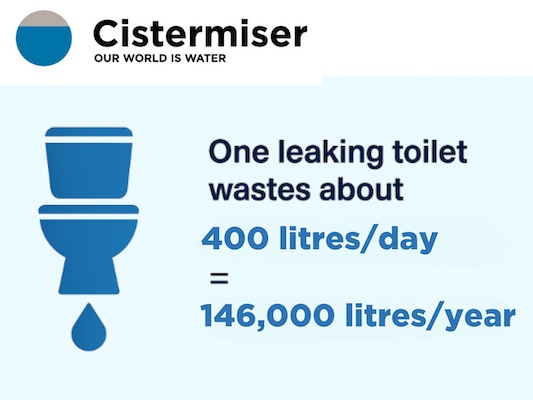
  • 400 litres of water per day
  • 146,000 litres per year

To put that into perspective, 146,000 litres is enough to fill more than 2,400 standard bathtubs. And that’s just one toilet.

Now multiply that figure across a commercial office block, a secondary school, a hospital, or a football stadium, buildings that routinely have 20, 50, or even 100+ toilets and the cumulative waste becomes staggering.

What makes this worse is the timeline. Because these leaks produce no obvious symptoms, they often go unnoticed for months, or even years. By the time they’re identified, if they’re identified at all, the damage to your water bill, and your environmental footprint, is already done.

What does that actually cost?

Water waste isn’t just an environmental concern; it’s a direct financial liability.

In the UK, water charges are typically calculated on two components: supply (the water coming in) and wastewater (the water going out). A leaking toilet contributes to both. That means every litre trickling silently into the pan is being charged twice.

For a single leaking toilet, the annual cost can reach:

  • 💸 £587 in wasted water costs
  • 🌍 0.05 tonnes of unnecessary CO₂ emissions

Now scale that up. A building with just 10 leaking toilets is haemorrhaging £5,870 per year. A site with 50? You’re looking at over £29,000 in avoidable spend, money that isn’t going toward improving your facilities, supporting your team, or meeting your net-zero commitments.

It’s no wonder facilities managers and sustainability leads are increasingly calling leaky loos one of the most overlooked inefficiencies in building management.

A simple way to think about it

If you’re responsible for a building, ask yourself three honest questions:

  1. How many toilets are on-site?
  2. When were they last properly checked for leaks?
  3. Could even a small percentage be wasting water right now?

In our experience, many buildings have never had a dedicated water leak assessment. Toilets are installed and largely forgotten, serviced only when something goes visibly wrong. But by then, the cost has already accumulated.

Even if just 10% of your toilets are leaking, the financial and environmental impact is real, measurable, and entirely avoidable.

The solution: Fix the leak, fast

Here’s the good news: this is one of the most cost-effective problems in building management to solve.

Modern sensor-operated flushing systems are engineered specifically to eliminate the conditions that cause leaky loos in the first place. They deliver precise, controlled flushes only when needed, no continuous flow, no mechanical wear from constantly cycling valves.

The benefits go beyond water savings:

  • ✅ Eliminate continuous water loss from faulty mechanisms
  • ✅ Improve hygiene with hands-free, sensor-activated operation
  • ✅ Reduce maintenance call-outs through more reliable, durable components
  • ✅ Deliver consistent flushing performance every time

Take Easyflush Direct as an example. The total outlay per unit, including installation, is approximately £523. With annual savings of £587 per toilet, you’re looking at a payback period of 11 months.

In a world where capital projects are scrutinised and ROI matters, that’s an unusually compelling case. Very few building upgrades pay for themselves within a year and deliver ongoing environmental benefits at the same time.

Why it matters more than ever

The pressure on organisations to reduce costs and meet sustainability targets has never been greater. Water efficiency is no longer a “nice to have”, it’s a measurable component of ESG reporting, procurement criteria, and operational benchmarking.

Leaky loos represent a triple problem:

  • Wasted budget that erodes operational margins
  • Missed sustainability goals that affect reporting and reputation
  • Avoidable inefficiency that reflects poorly on building management standards

The encouraging reality is that fixing them is one of the simplest, fastest, and most impactful steps you can take to improve building performance, without major disruption or capital outlay.

Not sure if you have a leaky loo?

That’s exactly where Cistermiser can help.

We offer free professional water surveys specifically designed to identify hidden leaks, quantify waste, and give you a clear picture of exactly where savings can be made, with the data to back it up.

Whether you manage a single site or a national estate, our team can help you uncover what’s really happening behind the cistern.

Ready to find out how much you could save?

If you want to:

  • Reduce water bills with evidence-based improvements
  • Improve operational efficiency across your estate
  • Hit sustainability and ESG targets with measurable water savings

 Book a free water survey with Cistermiser today and turn a hidden problem into a clear opportunity.

Cistermiser’s EasyflushEVO prevents ‘leaky loos’ – saving thousands of litres of water

Building Products Index Ltd Bathrooms Leave a Comment

View the Cistermiser entry on BPindex

Visit the Cistermiser website

Cistermiser’s EasyflushEVO toilet flushing valve prevents ‘leaky loos’, saving significant volumes of water in commercial and public sector buildings. It’s a straightforward, cost-effective solution that is ideal for new or retrofit installations.

According to Waterwise, between five and eight per cent of UK toilets are leaking. These ‘leaky loos’ are wasting as much as 400 million litres of clean, fresh water every day across both non-domestic and domestic buildings. It is estimated that a third of commercial washrooms have at least one leaky toilet – each could be wasting between 215 and 400 litres of water on average per day. As well as having a detrimental impact on the UK’s precious water reserves (which are under pressure from climate change, population growth and rising water use), leaks also result in higher utility costs – just six leaking toilets could increase a building’s water bill by £2,500 a year.

A large proportion of ‘leaky loos’ are dual flush toilets fitted with drop flush valves. While dual flush toilets were designed to help reduce water consumption (in theory, the smaller, part flush should use four litres of water and the larger, full flush should use six litres), unfortunately some models can leak. The issue is that drop flush valves will usually start to degrade over time, resulting in leaks. The seal on a drop flush valve tends to be situated below the cistern’s water line, and limescale deposits and debris (commonly found in cistern water) can cause degradation, as can chemicals if they are also present in the water.

Unfortunately, it is not easy to detect leaks, and they can be present for some time before they are identified. In fact, research suggests that a leak needs to reach around 300 litres of water a day before the issue is identified  (this is the point at which the leak becomes audible or more visible  . It is therefore essential to prevent leaks occurring in the first place – but this doesn’t mean that dual flush toilets shouldn’t be specified. The issue can be quickly resolved by selecting  an appropriate  dual flush flush valve  initially .

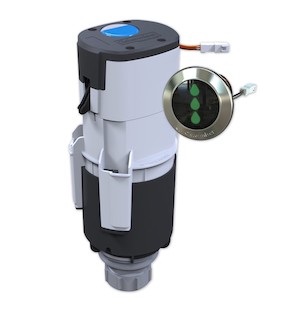
The revolutionary EasyflushEVO siphonic flushing valve from Cistermiser is engineered to eradicate water leakage from dual flush toilets. Unlike with drop valves, EasyflushEVO does not have a flush seal below the water line, so it will not leak due to debris, scale or degradation of the seal. It is ideal for new applications or can be easily retrofitted, in either a duel flush or single flush configuration. Each unit can save up to 146,000 litres of water per year. It’s also a cost-effective solution – a return on investment can be achieved in just seven months.

There are three variations of EasyflushEVO available: an EVO 1.5” flushing valve, an EVO 2” flushing valve and EVO CISTERN – a complete flushing cistern kit, which includes an EasyflushEVO flushing valve, a fill valve and a concealed cistern with a 1.5” flush pipe outlet and flush cone.

EasyflushEVO’s unique patented design means no other solution on the market can address water wastage from ‘leaky loos’ in the same way. It also has WRAS and Kiwa UK Regulation 4 product approvals, has won multiple industry awards and is installed in some prestigious projects across the UK.

For more information on EasyflushEVO, please visit www.cistermiser.co.uk.

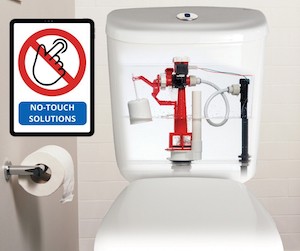
No-Touch Toilet Flushing Solutions

Building Products Index Ltd Toilet Flush Leave a Comment

View the Cistermiser entry on BPindex

Visit the Cistermiser website

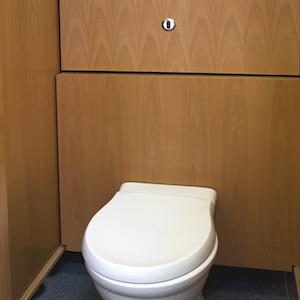
BPi Newsletter Cistermiser Easyflush no-touch solutionsBPi Newsletter Cistermiser Easyflush Direct Walkaway toilet flushing infrared sensor for commercial bathroom copyInfrared technology has started to consign traditional toilet flush handles to history, firstly in commercial washrooms (with practical no-touch solutions such as the mains-fed Easyflush Direct from Cistermiser) and now in domestic bathroom settings. Tiny young or arthritic elderly hands might find lever handles difficult to crank or fiddly dual-flush mechanical push-buttons tricky to use. To overcome these problems, infrared sensor-activated WC flushing valves, such as Cistermiser’s Easyflush combined flush and filling valve, can be installed. With options for close-coupled or concealed cistern-fed installs, solutions are programmable in a variety of ways, giving full control over the volume of water used and whether the toilet flushing is activated by ‘touchless’ operation (with a wave of the hand), or ‘occupancy sensing’ operation (by simply standing up and walking away from the WC).

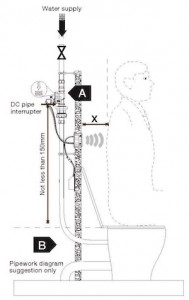
BPi Newsletter Cistermiser Easyflush Direct mains-fed toilet flushing schematicPositioning of IR sensors should be carefully considered during installation, to optimise no-touch toilet activation. Easyflush Wave sensors can be fitted onto front, side or most commonly the top of a close-coupled cistern (as mechanical push-button devices), or conveniently wall-mounted to one side of the toilet at typically 300-400mm distance from the centre line of the pan. Flush operation is activated by the user bringing their hand close to the infrared sensor. A dual flush mode enables the user to select either a part flush or full flush by the length of time their hand is held in front of the sensor.

Easyflush Walkaway occupancy sensors are best fitted directly centrally, just above the close-coupled cistern, so that the user’s proximity movement will always be detected. Toilet flushing is normally activated by the user standing up and leaving the cubicle, although it can also be activated by the user bringing their hand toward the sensor. Dual flush modes are factory-programmed to deliver a part-flush if the user departs from the cubicle within 40 seconds, or a full-flush if the user departs after 40 seconds or more have elapsed.