Skip to content
BPindex — The Largest Building Products Directory in the UK

trench heating

BRAND NEW CPD: Welded Wedge Wire Grilles – What, Where and How to Specify

Building Products Index Ltd architectural grilles, Drainage Leave a Comment

View the INTRAsystems entry on BPindex

Visit the INTRAsystems website 

  • Grilles CPD 12May21 copyBrand new CPD from INTRAsystems
  • First open-access session 12th May at 12noon

INTRAsystems is delighted to announce the launch of their BRAND NEW CPD, ‘How to Specify Welded Wedge Wire Grilles’ with their first live, open-access session confirmed for 12th May.

This versatile material offers a wealth of possibilities within construction and design.

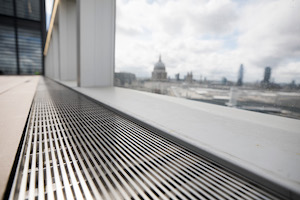
INTRAgrille, One Bartholomew Close (8)From heavy duty applications, such as trench heating /drainage covers, balustrades and walkways, to more lightweight uses such as service screening and suspended ceiling panels, welded wedge wire grilles are a stunning addition to any project.

With such variety and flexibility comes a range of technical considerations, so this brand new CPD is essential viewing for anyone involved in specification.

INTRAgrille, One Bartholomew Close (47) low resDuring the 1-hour presentation, you will learn everything you need to know to successfully specify welded wedge wire grilles for a wide range of interior and exterior applications.

The session provides you with a complete understanding of this versatile material, covering product construction, fixings and finishes, specification options and creative applications as well as performance ratings, standards, and sustainability factors.

By the end of the session, you will have a complete understanding of:

•    Types of grilles and gratings- what is welded wedge wire?
•    Configuration options and considerations for drainage, airflow and aesthetics
•    The different materials and finishes, when to use them and why
•    Applications and benefits
•    Sustainability and performance
•    Design possibilities and product innovation

All backed up with real-life case studies and example specifications – plus a Q&A at the end to answer questions specific to your learning needs.

Online, Inhouse, Open-access

As well as a series of open-access presentations, starting from 12th May, INTRAsystems can deliver private sessions online or inhouse to suit.

INTRAsystems
www.intrasystems.co.uk
+44 (0) 1425 472000
enquiries@intrasystems.co.uk

The demand for co-working spaces is hotting up

Building Products Index Ltd Heating, Ventilation Leave a Comment

View the Jaga entry on BPindex

Visit the Jaga website

co working space 1The demand for co-working spaces is increasing. Across Central London alone, flexible workplace providers have taken over 21% of office space in 2017, while competition in the regional cities is intensifying.

In response to such growth, industry stakeholders are rapidly examining their approach to designing and specifying equipment for modern workplaces. Unlike traditional offices, co-working spaces are not always occupied by the same amount of people, or indeed fully occupied at all. As a result, demand patterns are likely to be different, as the entire premise of flexible working centres on not having a 9-5 schedule.

So, what are the key considerations when specifying heating equipment for a co-working office?

Flexible, energy efficient heating

Co-working spaces are operationally more efficient than a typical office: facilities and staff are shared between a larger number of members, keeping overheads and other costs lower. This drives the use of more intelligent, automated technology, such as sensor-activated lighting, or smart thermostats. The advantage of such measures is that they can also decrease energy usage, reducing bills as well as environmental impact.

An aspect which is often overlooked is the technology used to emit heat. Paired with an efficient heat source and controls, the right radiators can really boost a building’s green credentials.

co working space 4Low water content radiators contain a tenth of the water compared to a standard steel panel radiator, so they waste less heat and react at least three times faster to fluctuations in ambient temperature. This means that they heat up almost immediately if the temperature falls below the set level and stop emitting heat as soon as that same level is reached. BRE tests show that a switch to low water content radiators can deliver energy savings of up to 15% compared to standard steel-panel radiators.

Another innovative, yet easily deployed, radiator technology for managers to consider is fan assisted DBE (Dynamic Boost Effect), which improves airflow and boosts heat output by drawing air over the element – increasing the efficiency of the radiator and helping to quietly circulate air around the room.

Whilst the DBE unit maintains rapid, effective and accurate room comfort conditions, it can also supply a quick boost of heat if required.

Ventilation

co working space 3People who work in well-ventilated offices with below-average levels of indoor pollutants and carbon dioxide (CO2) have significantly higher cognitive functioning scores—in crucial areas such as responding to a crisis or developing strategy—than those who work in offices with typical levels.

Conventional ventilation systems are not well suited to co-working spaces with their varying occupancy rates as there is not a consistent pattern in CO2 levels. Of course, vented windows provide a form of natural ventilation, but as many offices are in heavily polluted inner-city areas, may not be the most pleasant solution.

This is where demand control ventilation comes in. These systems are fitted with intelligent sensors that detect CO2 and only begin filtering the air when levels get higher than a specified point. This is the most efficient and comfortable way of ventilating a building as energy is only used when necessary.

Jaga’s Oxygen is a demand-based ventilation system that can be integrated with Low-H2O  radiators for a hybrid heating and cooling system.

Aesthetics

co working space 2To attract co-workers into a space, the look and feel of a building is important. Glass façades are incredibly popular in modern offices as they look attractive and let in plenty of natural light. But they can be a specifier’s worst nightmare, as they are not very thermally efficient, meaning internal temperatures can become freezing in the winter and boiling in the summer. Also, they’re quite tricky to mount a traditional radiator on!

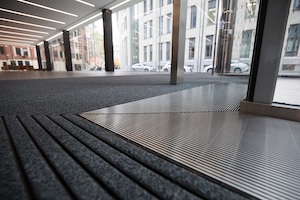
Thankfully, trench heating can help with temperature control issues in floor-to-ceiling glass environments by creating a curtain effect. Its subtle design is flush with the floor and can be customised with dozens of material options, to ensure the heating solution adds to the design rather than detracting from it.

With the popularity of co-working only set to increase, specifiers need to be aware of the technologies available to help foster an environment which is comfortable, harmonious and conducive to productivity.


 

How to choose the right glazed façade heating system

Building Products Index Ltd Heating Leave a Comment

 View the Jaga Heating Products UK entry on BPI

Visit the Jaga Website

Untitled
7 More, PWC Building, London

I don’t believe any other building material has seen such a huge increase in use over the last few decades, as glass. Today, it seems like every new build uses glass as the preferred choice for the façades – and with good reason. Glass is a fantastic way to utilise natural light which reduces electricity consumption, it harnesses the solar comfort of the sun and insulates interiors from noise pollution. Not to mention the pleasing appearance of clean glass lines.

However, glass is notoriously bad at heat retention and buildings that are made up of glazed façades can experience high levels of heat loss – making warming the building a challenge. Additionally, glazed façades are extremely vulnerable to condensation build up. In order to control and prevent condensation and heat loss, the heating and ventilation in the areas where glazed façades are used, needs to be thoroughly considered.

 What is the purpose for the façade heating?

When selecting your façade heating system, an important aspect of design that needs to be considered is the purpose of the façade heater.

Façade heating systems can be used for different heating purposes. They can be designed to provide effective spacing heating, mitigate heat loss, eliminate condensation or can provide cooling and ventilation – or even be used for a combination of all of them. The intention of use will affect the preferred solution and will need to be considered at early design stages.

What are the solutions?

2
Sky Believe in Better Building

It is generally considered that trench heating is the ideal solution for façade heating.  There is a certain amount of truth to this as it is a “hidden” solution that is the most versatile and can provide all preferred heating abilities – including glazed façade and space heating.

Whether it is the range of heights, widths and lengths, the option of grilles, or even cooling and ventilation, you will almost certainly be able to find a trench heater to give you the right solution.  And of course one of the biggest

advantages of trench heating in that it doesn’t take up wall space and can therefore be easily installed in front of full height (floor-to-ceiling) glazing, with no impact on visibility.

3
The Edge, Amsterdam

However, as versatile as a trench radiator can be there are still times where trench heating will not be viable for certain applications. These include when floor voids are either too shallow for trench heating or are completely solid, or where construction costs for creating trench channels are prohibitive.

In these instances, low-level freestanding perimeter heating is the ideal solution to provide effective, glazed façade and space heating, and can even meet LST requirements.

What is the best approach?

The use of glass façades for commercial and domestic projects is only going to increase. It is important at the very beginning of the design stages, to consider how these façades, and the space they enclose, are going to be heated.

Working closely with your heating systems provider will ensure the most effective solution is installed. On numerous occasions we have been able to offer much appreciated advice on how to design in mitred corners or curved trenches for best possible aesthetic effect and heat output. Or offer recommendations where trench heating is preferable to low level perimeter heating and vice versa, or how to make a trench system part of a building’s cooling as well as heating strategy.

4For more information about how to choose the perfect glazed façade heating system for your project, download our free Façade Heating eGuide.

5Jaga also offers a comprehensive RIBA and CIBSE approved CPD seminar looking at façade heating techniques, challenges and appropriate solutions, download full details here


Jaga Heating Products – Trench Heating – the Answer to Heat Loss through Glass Façades

Building Products Index Ltd Glass Leave a Comment

View the Jaga Heating Products UK entry on BPI

Visit the Jaga Heating Products UK website

Phil Mangnall, National Sales Manager of Jaga Heating Products UK, discusses why trench heating has become an increasingly viable heating option across numerous applications – from the commercial, public and industrial sectors through to self-builders and homeowners.

UntitledGlass façades are a sign of our architectural times. With countless high-rise buildings being erected in our cities with every passing day, it has become surprising to see one which doesn’t feature a predominantly glass exterior.

But it is not just with these commercial mega-structures that glass façades have become the norm. Glass is increasingly common in contemporary council buildings, galleries, museums, schools, universities and more. Watch an episode of Grand Designs and it is clear that the material’s popularity is rising in residential and self-build scenarios too.

Quite simply, we love natural light in our buildings and glass is the obvious answer; the fact that it provides a desirable aesthetic dimension only strengthens its case. However, its many positive attributes are counter-balanced by one major flaw: glass façades are a source of significant heat loss.

It is for this reason that the Jaga team are almost continuously involved in projects focused around our trench heating technology, helping to prevent heat loss through glass façades.

As a technology, floor trench heating is the most practical form of glazed façade heating, and there are plenty of radiator and grille products available that can be fine-tuned for use in different scenarios.

Positioned parallel to the glass façade, it performs through creating convection currents designed to mitigate heat loss, prevent condensation and, of course, provide effective space heating that ensures comfortable temperatures for building occupants. In terms of energy, not only do they cut the unnecessary loss of heat, but with our Jaga Low-H₂O heat emitters they can dramatically cut the energy required to heat the building in general.

The added advantage is that trench heating is a discreet solution – or ‘hidden’ – because it is housed within the floor. This saves on valuable floor space, prevents obstruction of the façade, and with the prevalence of minimalist interior design nowadays, visually, they are barely noticeable.

Whatever the application, whatever the heat source, we strive to be as flexible as possible. It might be the full trench heating package for preventing heat loss while providing space heating; it might be trench heating to prevent heat loss whilst working in conjunction with an existing heating system. Furthermore, if there are unique construction or logistical challenges within a customer’s building, tailor-made products and services are available to help overcome the obstacles.

UntitledIf you would like to find out more about our solutions, you can download our Trench Heating eGuide or take a look at our range of Trench Heating Products.

Further information: Jaga Heating Products UK Ltd, Orchard Business Park, Bromyard Road, Ledbury, Herefordshire HR8 1LG. Tel: 01531 631533. Fax: 01531 631534. E-mail:jaga@jaga.co.uk. www.jaga.co.uk