Skip to content
BPindex — The Largest Building Products Directory in the UK

Fastening solutions

Greater anchoring versatility through modular design

Building Products Index Ltd Fastening Systems Leave a Comment

View the EJOT entry on BPindex

Visit the EJOT website

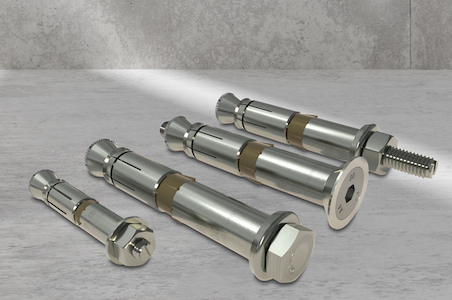
LIEBIG Superplus BLS offers versatility thanks to its modular design and range to suit numerous anchoring applications.

Whilst there is no one size fits all approach to concrete anchoring, by adopting a modular approach to anchor design EJOT has made it possible to use a single product for multiple different purposes on the same project.

The LIEBIG Superplus BLS is renowned across the world for its heavy duty performance capabilities. But for many engineers and specifiers, the anchor’s appeal is equally due to its versatility. Through a modular design, one product can be tailored and specified to meet multiple different applications ranging from garage equipment installation to mechanical and electrical supports.

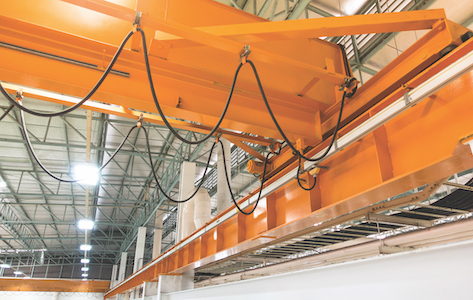
LIEBIG Superplus BLS is ideal for anchoring of Industrial cranes and heavy machinery.

The key to the versatility of Superplus BLS is the ability to choose different variants of the core parts of the anchor. The length and diameter of the threaded bolt and the distance sleeve can be sized within a wide range and the head styles can be chosen to suit the specific application requirements.

It all adds up to an application-specific anchoring solution that can be configured in a way that is normally associated only with 100% bespoke anchors, which are notoriously costly in small volumes and incur long lead times. From a “kN per £” perspective, this makes Superplus BLS amongst the most competitive concrete anchoring solutions available.

EJOT’s ability to provide this level of versatility with the Superplus BLS comes down to the way its UK manufacturing facility is set-up. LIEBIG anchors are assembled at its UK’s factory near Leeds, where production is designed with agility in mind to accommodate different volumes of anchors to meet customer needs at relatively short notice. And for UK customers, the additional benefit of local supply means less risk of international transport delays.

The design allows for its core elements, the threaded bolt and the distance sleeve, to be sized within a wide range and the head styles can be chosen to suit the specific application requirements.

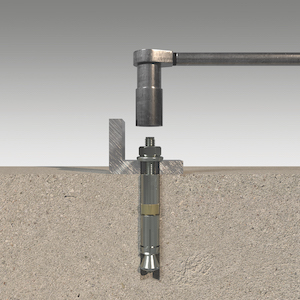
A consistent modular design applies to all Superplus anchors in the range, as well as offering the platform for ‘specials’. Whichever option is chosen, they all feature the innovative self-undercutting cone with teeth to create the undercut as it is drawn upwards when torque is applied during installation. No special tools are needed for creating the undercut, which speeds up the fitting process and reduces the potential for errors.

The core Superplus BLS anchor consists of a threaded rod with integral hex head. This is designed for through-fix post-installed application scenarios where installation is through the in-situ baseplate. This suits many different applications extremely well, especially given that the product is available in Grade 8.8 carbon steel, zinc plated, or A4-80 stainless steel for additional corrosion-resistance.

Beyond the standard Superplus BLS options, the product’s versatility is further demonstrated in some of the recent ‘special variants’ created by EJOT. These include the LPA (Lightning Protection Anchor) where rebar is known to attract and transmit an electric current flow through as a means to direct the current to earth.

This high level of versatility, coupled with superior anchoring performance, ease of installation and flexibility to accommodate site circumstances, makes Superplus BLS a solution that fits with the construction industry’s ambitions to build more efficiently and to ever higher standards.

Find out more at https://www.ejot.co.uk/LIEBIG_BLS.

EJOT launches next generation BA Plus through-bolt range

Building Products Index Ltd Fastening Systems Leave a Comment

View the EJOT entry on BPindex

Visit the EJOT website

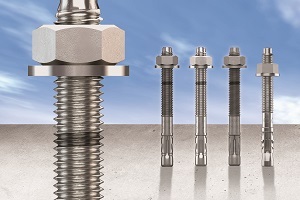
Throughbolt-RangeFastening technology specialist EJOT has upgraded its range of ETA-approved through-bolts – also known as anchor bolts or wedge anchors – with the launch of its new BA Plus range of Option 1 anchors, suitable for both cracked and non-cracked concrete applications.

The EJOT BA Plus range is a new generation of higher performing through-bolts which builds on the strengths of its established BA range to deliver additional benefits and new application potential. And, in addition to concrete, these torque-controlled expansion anchors are also suitable for installation in other hard base materials including natural stone.

The design of BA Plus allows the required installation torque to be achieved with 30-50% fewer revolutions than previously, and new M8 and M10 through-bolts can now be used for anchoring in to concrete which is up to 20mm thinner. The risk of on-site errors is minimised with a setting depth clearly marked to the thread and anchor length letter coding marked on every bolt head.

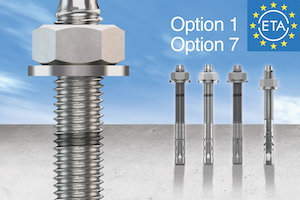
Throughbolt-Range-ETAThe BA Plus range provides through-bolts for all the most typical cracked and non-cracked concrete applications ≥ C20/25 up to the seismic Option 1 performance. Backed with the independent assurance of European Technical Assessments (ETAs), the range offers a dependable solution for numerous applications including steel structures, column base plates, heavy duty racking, cable racks, handrails and facades.

When specifying outside standard parameters EJOT provide on-site testing by a qualified EJOT engineerZinc plated, hot dip galvanized, and A4 stainless steel BA Plus through-bolts are available, providing a solution for a wide range of applications including harbours and tunnels where the highest level of resistance to corrosion is required. Its design ensures easy installation, with no risk of damage to the thread when the bolt is hammered into position and an embedded sleeve that expands reliably as the bolt is tightened to the required torque. The M10 and M12 options are available in two different anchorage depths for extra versatility.

Richard Bowhay, Sales Manager for Building Fasteners at EJOT UK said: “The BA Plus represents an important enhancement in the performance capabilities of our through-bolts and gives installers a reliable and highly secure anchor solution for every type of concrete application – backed by the third-party assurance of ETA approval. It demonstrates collectively, the objectives of our technical teams worldwide in their capacity to regularly assess if and how we can advance the performance of construction fixings to give architects and building owners total peace of mind, as well as improving efficiency for installers.”

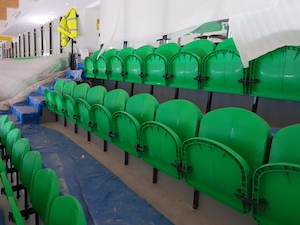
EJOT's Option 1 through-bolt range covers standard to seismic applicationsThe BA Plus range is complemented by EJOT’s new range of through-bolts for Option 7 non- cracked concrete applications, BAC-NC, which provides a class-leading anchor for many other applications including warehouse racking and stadium seating, backed by the third party assurance of an ETA.

Full details about the Option 1 BA Plus range and the Option 7 BA-C NC through-bolt are available at www.ejot.co.uk, where the new brochure can also be requested.

As a global leading in construction fastening solutions, the EJOT UK team offers a wealth of technical support and specialist guidance to specifiers and installers to ensure they can achieve the right result when anchoring into cracked and non-cracked concrete every time. To contact technical support, email EJOT UK via info@ejot.co.uk or call 01977 687040.

STRUCTURAL ANCHORING – FINDING THE RIGHT SOLUTION

Building Products Index Ltd Fastening Systems Leave a Comment

View the EJOT entry on BPindex

Visit the EJOT website

Selection of a structural anchor should be based on the performance needed for each application but how much is the process driven by previous specifications or brand?

Library-SiteThe variety of off-the-shelf anchors and fixings available to structural engineers has grown significantly in recent years through ever more complex designs, and there is also the option of bespoke solutions. Knowing what’s out there can be as much of a challenge – and few would dispute the possibility of specification changes on site.

“Engineers will commonly go through a technically approved route for design but the selection is often based on personal preference and previous experience rather than the unique parameters that each new application presents,” says Liebig specification specialist Paul Papworth.

“There are several reports from the Standing Committee on Structural Safety (SCOSS) that point to poor selection or design of fixings, as well as specification change. The problem running with previous designs is that the application criteria may not be exactly the same, so an in-depth check and some form of calculation is essential.”

To understand the factors driving the choice of anchor in the UK market, Liebig’s parent company EJOT worked with the New Civil Engineers Journal to carry out an industry-wide survey. The results point to many respondents favouring brand loyalty over application specifics, despite a number of routes to design.

Design tactics

shutterstock_57862405 copyMost respondents – 45% – use a mix of hand calculations, software and technical guides to aid their design but 40% prefer to use software as their only approach to design. None of the respondents use technical guides from manufacturers as their only source of information for design. However, the availability of technical guidance and support from manufacturers and calculation software are the biggest factors affecting the choice of solution. Proof of suitability through onsite testing and case studies are also key factors.
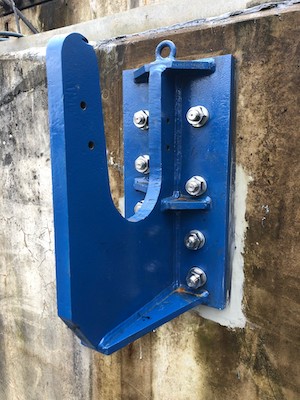
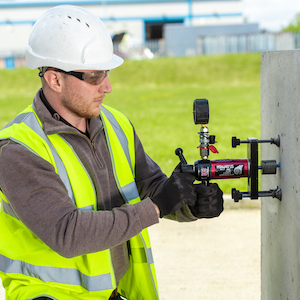
No second chances. Anchors in nuclear dockyard applicationPaul Papworth believes that manufacturers data should be sufficient for many standard design requirements such as an anchor that isn’t close to an edge, not located close to another anchor and in conventional concrete that has a prescribed compressive strength. It is when designs go outside the standard parameters that additional calculations should be essential. “The anchor should be designed and tested to European Technical Approval (ETA), so it should therefore be possible to compare different options from different manufacturers even without proprietary software,” explains Papworth. “However, some engineers maintain that using traditional concrete capacity design methodology that predates ETA, offers more flexibility where the application cannot be met by the ETA approach alone.”

Some projects demand that the right solution is fitted first time with no second chances to find an alternative. Papworth says that some manufacturers still use concrete capacity design data – or even data expanded beyond the ETA approach in their software so users need to be aware of how the designs are being evaluated and generated.

“As with any proprietary software, engineers need to verify the output using their own calculations,” he urges. Many respondents agreed with this call and one said: “Complex designs can be challenging to assess and often call for engineers to use hand calculations to check the design and interaction with other adjacent fixings too.

“Designers need to engage with anchor manufacturers with a more holistic approach from concept through to installation. This would ensure that the correct technology and the most cost-effective solution is identified, correctly designed and equally as important, correctly installed.”

Mechanical or resin?

Few respondents report getting the design right first time though – 19% of respondents said that it never happens, while 64% say that it does occasionally happen.

Resin bonded anchors are often a main solution that designers choose with 54% calling that their preferred option. 40% use mechanical fixings as their “go to” solutions. Undercut anchors were the least popular option with only 6% describing that method as their preferred option. The preferred fall-back was mechanical fixings with almost 43% saying this was their second option and 38% opting for resin bonded fixings as their fall-back.

“There is definitely less reticence to using resin fixings now –– but there will always be a strong preference to go for a mechanical fixing and the choice largely depends on specific performance demands. Resin anchors are unable to immediately take up the action load due to curing times and the higher risks associated with their reduced tolerance for installer error are also considerations,” says Papworth.

One respondent told NCE: “People often specify resin fixings but there is a good place for mechanical fixings too. There is no real logic for the mentality to choose one over the other.”

If the desired result isn’t achieved through the initial design, most respondents (47.5%) said that they would look again at the design or change the type of fixing (56%) rather than explore bespoke or non-standard options.

Bespoke Solutions

Lead times, absence of technical data and stock availability do not seem to be factors in driving designers away from bespoke solutions. Perceived cost and even lack of awareness that the option is even available seem to be the main issues here.

“Bespoke solutions come into play when the design and application parameters do not allow for a standard off the shelf solution to be used,” says Papworth. “Around 5% to 10% of applications lend themselves to a bespoke design. The perception that this carries a high price tag and long lead time puts designers off from exploring this route – and some don’t even know the option exists – but given the modular design of many high performance mechanical anchors it is no longer the case. By raising awareness, manufacturers can create demand by delivering what the customer needs rather than simply focusing on what can be produced in volume. Involving a manufacturer in the early stage of a design can save a significant amount of design and installation time, reduce material costs and increase safety.”

Specification changes on site
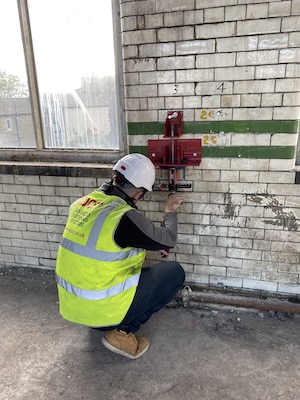
On site shear testing will substantiate calculations made off site.One respondent noted that careful specification can go out of the window once work moves onto site when contractors may use an alternative anchor on grounds of costs or buildability.

Papworth agrees: “The approach tends to be design-led until cost is factored in and that is often when changes in specification can occur.”

Product availability is the main factor driving changes to specification according to more than 47% of respondents, while a further 31% said that cost is a driver too.

Installation can also bring challenges and Papworth believes that more training is needed to avoid issues on site. “Designer error does happen but the major cause of failure is errors in installation and the problem can be amplified by change of specification” he says.

The Construction Fixings Association (CFA) has published guidance on this subject with procedures to avoid problems that are a knock-on of specification change.

According to Papworth, specification change is often an inevitability but using CFA guidelines can bring benefits. “It is also part of the anchor manufacturer’s role to support these guidelines and in doing so be able to contribute positively to the industry,” he adds.

Nonetheless, having a qualified engineer is critical to interpreting the performance requirements into the design and specification change often occurs without the designer being involved in the decision making.

“You may have an anchor that performs the same in published data for tensile and shear load but when it comes to the seismic qualification, the ability to perform close to the edge of concrete or in a fire load condition, they may be quite different,” explains Papworth.

“Resin anchors were seen as a problem solver 20 to 30 years ago and now it is just part of the toolbox. The development was driven by poor base materials as it doesn’t create the expansion forces typically associated with mechanical expansion anchors but they are simple to use.

“They can, however, bring their own problems in terms of things going wrong – it is essential that the fixing hole is clean and dry otherwise significant reduction factors have to be considered at the design stage. Mechanical anchor holes also have to be cleaned out but it is less critical compared to resin since they do not rely on adhesion.

“All anchors, whether resin or mechanical, need to be correctly set using a torque wrench which is a crucial element of how an anchor performs but often overlooked at the point of installation.”

Papworth says that in some instances anchor manufacturers are even moving away from providing standard anchoring design software and moving towards providing whole application software, giving the option to design baseplate and anchor within the same package.

“I feel that it can unnecessarily complicate the design and add to whole application costs” he adds.

While there are many different approaches to design and many more solutions available on the market, it is more essential than ever that designers understand what they are trying to achieve before starting on the specification choice. According to Papworth, once the specification is set there needs to be greater governance to ensure this is followed through onto site too in order to achieve the best outcome.

The Liebig brand has for years been synonymous with quality, performance and ease of installation, gaining respect from specifiers and contractors alike. Many of the original flagship products remain at the forefront of today’s anchoring technology.

The survey gives an in-depth look across all factors of specification and selection of anchoring technology.

To view the survey results visit our website at https://www.liebig.co.uk/news/

Liebig offer a vast array of Anchoring products from off the shelf to complete bespoke solutions to ensure your engineering requirements are met and surpassed.

Contact us for application support, design advice and calculations or literature and technical assistance on Tel: 01977 687 040 or email us at: liebig@ejot.co.uk

Technical data sheets and brochures are available from our website here: https://www.liebig.co.uk/tech-specs/



EJOT to introduce ‘super self-tapper’ for heavy-duty applications

Building Products Index Ltd Fastening Systems Leave a Comment

View the EJOT UK entry on BPindex

Visit the EJOT UK website

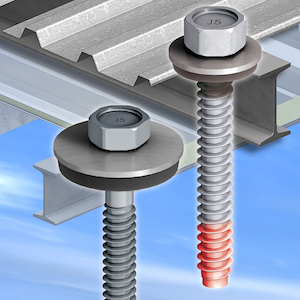
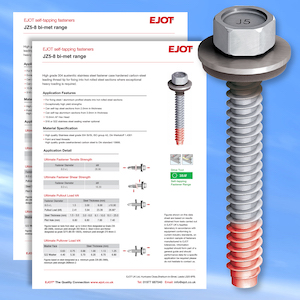
JZ5-8.0-is available with two washer sizesEJOT will be adding a new bi-metallic self-tapping fastener to its range which will provide a genuinely unique site solution for heavy-duty load applications, when fastening into higher yield-strength steels.

The global manufacturer has had huge success, and is seen by many as the market-leader where welded bi-metallic drill-point technology adds a seriously strong cutting edge to its self-drilling products. Now, the Group’s product development team has utilised this expertise to create the EJOT® JZ5-8.0 self-tapping range.

The new product is manufactured from high grade 304 stainless steel but unlike other self-tapping fasteners, the JZ5 has ‘lead-tapping threads’ that are made from case hardened carbon steel. This unique integration allows the JZ5-8.0 to significantly outperform standard self-tapping solutions.

Testing at EJOT's Applitec Centre

Tagged by the EJOT UK sales team as the ‘Super Self-Tapper’, the new fastener has returned shear strengths of over 15kN and tensile strengths of more than 26kN in tests conducted at the EJOT Applitec laboratory at UK’s manufacturing centre in Yorkshire. But what makes the fastener unique is its capability to tap into high strength steels such as S-355 grades.


JZ5 Test data is available from EJOT's national team of Sales EngineersEJOT will be supplying the JZ5-8.0 fastener to the UK market in lengths of 60, 80 and 100mm with other lengths in development and close to release. The option to include a 16mm or 22mm stainless steel washer opens up wide-ranging application potential. Obvious solutions include rainscreen and façade installation where securing exceptional façade loading to helping hand brackets is critical. Similarly where composite decks are required to transfer high loading to steel substructures, the new fastener will present a fast, reliable and cost-effective option.

EJOT’s national team of Sales Engineers will provide more information and technical support. Specifiers interested in obtaining more information should contact the company’s Customer Service team on 01977 687040 or email sales@ejot.co.uk.

New EJOT Guides review Best Practice for installation of self-drilling fasteners

Building Products Index Ltd Fastening Systems Leave a Comment

View the EJOT entry on BPindex

Visit the EJOT website

From contractor to installer, whoever is purchasing building fasteners from within the project chain is linked to the overall investment of the complete building system. Modern technical fastening products are engineered components in their own right and when installed correctly they provide high strength load performance, safe and secure joints, environmental longevity and many other application benefits.

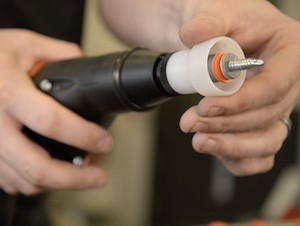
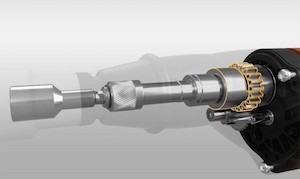
Setting a screw gun nosepice according to differing panel thicknessesThe demands that go hand in hand with today’s construction industry require manufacturers of all contributing components to be vigilant, knowledgeable and fully transparent.  As original fastening manufacturers EJOT is in a strong position to monitor such technical demands. Research and Development is key and with EJOT’s global market interests spanning sectors such as aerospace, automotive, seismic and nuclear construction, cross-pollination of technical knowledge can and has created cutting-edge solutions for many building and construction fastening products.

If knowledge is the cornerstone to specification, sharing knowledge is of course the responsibility of the manufacturer. With reference to the correct deployment of technical fasteners, ‘best practice’ also implies the need for contractors to see the entire installation process through, yet this can break down if everyone actively involved in the chain is not fully aware of the technical properties that a modern fastener is engineered to deliver.

Seeing first-hand such varying levels of technical awareness, EJOT UK has produced the first in a new series of video and printed guides. Here, the company’s technical wing ‘EJOT Applitec’, reviews best installation practices relating to self-drilling fasteners. The Yorkshire based manufacturer is keen to convey how vast choice of drive tools through to installation techniques can affect the end result and how combinations of torque, loading and installation speeds are absolutely vital.

2 - This screw gun has a clutch mechanism to safeguard against over-drivingFor example, market-wide installation tools range from dry-lining guns through to impact drivers which are all compact and relatively inexpensive. Yet unlike professional screw guns, the general mechanics of these devices will often mean they can apply an unnecessary and uncontrollable amount of torque to fasteners that need to be installed to precise settings. Many of these tools have no clutch mechanism to safeguard against over-driving and whilst it may be possible to achieve a correctly installed fastener using such drivers, at best the installer is doing so by ‘guesswork’ – which simply cannot be relied upon across the installation of several thousand fasteners. The same concerns apply across the huge variety of fasteners and applications that the industry now demands. The clear risk here is that the original construction investment is at best diluted, with reputations and overall responsibilities in sharp focus should performance integrity be lost.

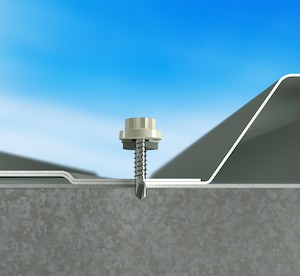
3 - EJOT's guide addresses aspects from correct installation speeds to washer compressionThe guide also illustrates how to achieve correct settings that relate directly to the different type of the materials being joined, the easiest way to achieve and determine successful application, and finally how to monitor safe and correct installation throughout the project’s schedule.

Brian Mack is Technical Business Development Manager for EJOT in the UK:

“The information we are producing here shows that we don’t just sell fastening products. The responsibility goes much further than that and we are working alongside other manufacturers to develop responsible technical information that supplements in greater detail the contributions we make collectively, to information circulated by recognised industry flag bearers such as the NFRC and the MCRMA”.

To further endorse the company’s commitment to Best Practice, EJOT UK has sponsored the NFRC’s industry-wide reference manual, known as ‘The Blue Book’. Managing Director Robert Hardstaff said:

“EJOT UK shares the NFRC’s philosophy of quality and excellence within the construction industry. We are therefore delighted that as NFRC Industry Technical Partner, our sponsorship will help to support this industry-wide platform for best practice.”

More information about accessing EJOT’s technical guide is now available at

https://www.ejot.co.uk/applitec-best-practice-screw-gun

New EJOT Guides review Best Practice for installation of self-drilling fasteners

Building Products Index Ltd Fastening Systems Leave a Comment

View the EJOT entry on BPindex

Visit the EJOT website

From contractor to installer, whoever is purchasing building fasteners from within the project chain is linked to the overall investment of the complete building system. Modern technical fastening products are engineered components in their own right and when installed correctly they provide high strength load performance, safe and secure joints, environmental longevity and many other application benefits.

The demands that go hand in hand with today’s construction industry require manufacturers of all contributing components to be vigilant, knowledgeable and fully transparent.  As original fastening manufacturers EJOT is in a strong position to monitor such technical demands. Research and Development is key and with EJOT’s global market interests spanning sectors such as aerospace, automotive, seismic and nuclear construction, cross-pollination of technical knowledge can and has created cutting-edge solutions for many building and construction fastening products.

3 - EJOT's guide addresses aspects from correct installation speeds to washer compressionIf knowledge is the cornerstone to specification, sharing knowledge is of course the responsibility of the manufacturer. With reference to the correct deployment of technical fasteners, ‘best practice’ also implies the need for contractors to see the entire installation process through, yet this can break down if everyone actively involved in the chain is not fully aware of the technical properties that a modern fastener is engineered to deliver.

Seeing first-hand such varying levels of technical awareness, EJOT UK has produced the first in a new series of video and printed guides. Here, the company’s technical wing ‘EJOT Applitec’, reviews best installation practices relating to self-drilling fasteners. The Yorkshire based manufacturer is keen to convey how vast choice of drive tools through to installation techniques can affect the end result and how combinations of torque, loading and installation speeds are absolutely vital.

2 - This screw gun has a clutch mechanism to safeguard against over-drivingFor example, market-wide installation tools range from dry-lining guns through to impact drivers which are all compact and relatively inexpensive. Yet unlike professional screw guns, the general mechanics of these devices will often mean they can apply an unnecessary and uncontrollable amount of torque to fasteners that need to be installed to precise settings. Many of these tools have no clutch mechanism to safeguard against over-driving and whilst it may be possible to achieve a correctly installed fastener using such drivers, at best the installer is doing so by ‘guesswork’ – which simply cannot be relied upon across the installation of several thousand fasteners. The same concerns apply across the huge variety of fasteners and applications that the industry now demands. The clear risk here is that the original construction investment is at best diluted, with reputations and overall responsibilities in sharp focus should performance integrity be lost.

Setting a screw gun nosepice according to differing panel thicknessesThe guide also illustrates how to achieve correct settings that relate directly to the different type of the materials being joined, the easiest way to achieve and determine successful application, and finally how to monitor safe and correct installation throughout the project’s schedule.


Brian Mack is Technical Business Development Manager for EJOT in the UK:

“The information we are producing here shows that we don’t just sell fastening products. The responsibility goes much further than that and we are working alongside other manufacturers to develop responsible technical information that supplements in greater detail the contributions we make collectively, to information circulated by recognised industry flag bearers such as the NFRC and the MCRMA”.

To further endorse the company’s commitment to Best Practice, EJOT UK has sponsored the NFRC’s industry-wide reference manual, known as ‘The Blue Book’. Managing Director Robert Hardstaff said:

“EJOT UK shares the NFRC’s philosophy of quality and excellence within the construction industry. We are therefore delighted that as NFRC Industry Technical Partner, our sponsorship will help to support this industry-wide platform for best practice.”

More information about accessing EJOT’s technical guide is now available at

https://www.ejot.co.uk/applitec-best-practice-screw-gun