Skip to content
BPindex — The Largest Building Products Directory in the UK

Project 80

Meeting the Future Homes Standard with H+H aircrete

Building Products Index Ltd Blocks, Concrete Leave a Comment

View the H+H entry on BPindex

Visit the H+H website

H+H’s unwavering commitment to energy-efficient building solutions and a fabric first approach aligns neatly with the aims of the Future Homes Standard.

A fabric first approach will be fundamental to meeting the requirements of the 2025 Future Homes Standard, for which the government published its consultation on 13th December 2023. Backed by a commitment to energy efficiency and reducing the carbon emissions of new homes, the consultation on the Future Homes Standard suggests u-Value for walls remains at 0.18W/m2K and that new homes will use low-carbon heating and be ‘zero-carbon ready’.

This methodology prioritises minimising heat loss by ensuring the building envelope meets the highest standards. To put it simply: housebuilders will need to pursue a fabric first approach by specifying high performing fabric materials from the outset.

Project 80
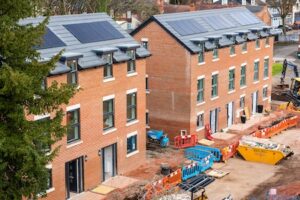
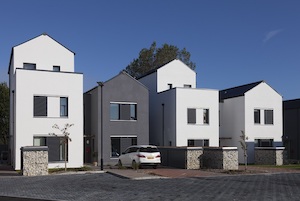
H+H is proud to have been involved in Project 80, a pioneering development by Midlands Heart Housing Association, which showcases homes already built to the Future Homes Standard using aircrete. These homes, monitored and evaluated for performance, demonstrated a 70% carbon reduction when combining heat pumps and PV panels in masonry structures.

Insights gleaned from Project 80 are invaluable, offering a blueprint for achieving an impressive 80-90% carbon emissions reduction. Increased insulation, enhanced window specifications, improved airtightness, and strategic education on effective heating and ventilation are just some of the strategies identified.

H+H’s participation in Project 80 is a testament to its dedication to a fabric first approach. H+H aircrete blocks contribute to the construction of energy-efficient, airtight buildings, enhancing the performance of technologies like underfloor heating and air source heat pumps. These innovations were integral to the success of the first 12 homes in Project 80.

H+H fabric first projects
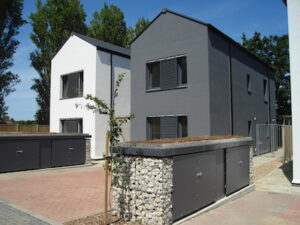
H+H has a track record of working collaboratively to help developers achieve ever higher fabric performance standards, including projects which also employ Modern Methods of Construction. For example, the Cameron Close Passivhaus development for Southern Housing and the Norton Farm development for Bromsgrove District Housing Trust.

For the Cameron Close development of 16 semi-detached Passivhaus homes on the Isle of Wight, H+H worked with the scheme’s developer on the application of Thin-Joint blockwork. In this instance, H+H’s 200mm thick Celcon Plus Blocks have been used to construct Thin-Joint aircrete, load-bearing walls. Apart from accelerating the construction process, the Thin-Joints play a role in enhancing the residences’ airtightness, thereby improving their overall energy efficiency.

At the Norton Farm development, H+H’s Vertical Wall Panels have been used to speed the construction of the building’s energy efficient fabric. H+H’s Vertical Wall Panels, part of its i-House MMC system, have been used to construct 164 units.

The Vertical Wall Panels are manufactured in aircrete to the storey height of a standard house. Use of the Vertical Wall Panel system on this project enables the external brick or rendered-block facade to be taken off the critical path. More importantly, the Vertical Wall Panel system is a key element in creating an insulated, airtight building envelope.

As we approach the 2025 Future Homes Standard, adopting a fabric-first construction philosophy, supported by materials like aircrete, will pave the way for sustainable, low-carbon housing.

Call us to discuss your housing project on 01732 880111 or email iot@hhcelcon.co.uk. www.hhcelcon.co.uk
SUSTAINABILITY AND THE 40-YEAR MORTGAGE

Building Products Index Ltd Blocks, Concrete Leave a Comment

View the H+H UK Ltd entry on BPindex

Visit the H+H UK Ltd website

Jenny Smith-Andrews, Head of Marketing at aircrete manufacturer H+H, outlines the arguments for a building method that focuses on the long term.

Passivhaus
Aircrete makes the perfect structure for certified Passivhaus homes

The arguments around what constitutes sustainable building practice continue to shift focus. Back in 2007 the emphasis was on zero carbon in use for new homes. In 2022 much more attention is being placed on embodied carbon and the race is on for manufactures to decarbonise their businesses.

Both objectives are hugely important, of course, and H+H has demonstrated its ability to deliver on the first and now has a robust plan to deliver on the second.  However, we would argue that there is an important third: the need to consider the long term.

It has always seemed strange to me that there is so little attention paid to how long a building should be expected to last. Most guidelines seem to anticipate a sixty year design life but surely this is insufficient?

Replacement rates

Modern Method
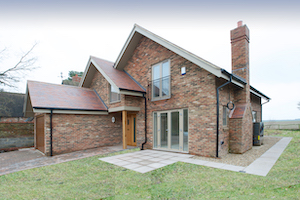
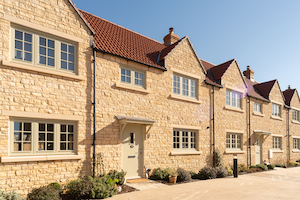
Stone clad to suit the local style, these houses are based on modern Thin-Joint construction

In the UK we demolish about 9,000 homes per year. If we continue to replace the current housing stock at this speed, we would need every house built today to last not sixty years but several hundred.

This is not new information, but in this context it is odd that lightweight housebuilding systems are encouraged, based on their ability to meet speed of build and energy efficiency standards, with no apparent focus on longevity.

The crunch may come with the financial model. With house prices in 2021 averaging £198,000, mortgage finance is essential for most first-time buyers, and the length of available mortgage terms is rising.

Mortgage terms and housing durability

Low carbon home
this new home, built with underfloor heating and an air source heat pump is a glimpse of the future.

The English Housing Survey finds that 45% of first-time buyers in 2018-2019 had a mortgage of 30 years or longer and 40-year mortgages are becoming increasingly common. 2021 saw one company launching a 40-year fixed term mortgage.

What this essentially means is that to be attractive to buyers your home needs to be pretty sure to have a service life comfortably longer than a normal mortgage term.

Not surprisingly, H+H has always argued that masonry homes, designed to last for one hundred plus years, are the best long-term option in terms of financial security.  We would also argue that the most sustainable homes are surely those which last a very, very long time.

Meeting the immediate

078 H+H
a modern material to last for centuries

Right now, with the pressure to increase the volume at which we build new homes, the priority for builders is to ensure that familiar building methods can meet current building standards.

The latest collaborative project to involve H+H aircrete is Project 80, a research project designed to demonstrate how masonry building methods will meet the Future Homes standard, requiring a reduction of 75% – 80% over current building regulations.

Sustainable building – a holistic view

The arguments around what constitutes sustainable building will continue and the wisest course is surely not to focus on one performance aspect in isolation but to consider the bigger picture and take a holistic view.

For H+H this means building energy efficient homes whose creation involves the minimum possible immediate environmental impact and which will continue to provide a resilient, dependable asset for generations.

To find out more about aircrete from H+H, visit our website at www.hhcelcon.co.uk