
Skip to content
BPindex — The Largest Building Products Directory in the UK

Roof Hatches

Key Considerations When Specifying Ladders

Building Products Index Ltd Roof Hatches Leave a Comment

View the Bilco UK entry on BPindex

Visit the Bilco UK website

Tony Stevens, Technical Estimator at Bilco UK, outlines some of the key factors to be considered when specifying ladders for accessing a roof area.

Where is the ladder going to be used?

If the ladder is required to gain access to the roof and to be mounted externally it will require a safety cage and guard rail to enter the roof safely.

What is the ladder going to be used with?

You need to have a clear understanding of the type of access product the ladder is going to be used with.

For a small hatch, such as the Bilco E-50TB, which has internal dimensions of 915mm x 915mm, a fixed vertical ladder should be specified. A retractable ladder would not be recommended for the E-50TB as the ladder angle would hinder access when you get close to the hatch.
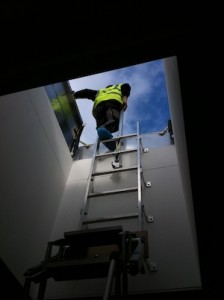
Dean Close School 023Where frequent access to the roof area is required for maintenance personnel, tools and equipment a companionway roof hatch, like the CS-50TB which is a larger elongated access hatch, is generally required.  In this instance a companionway ladder or a retractable ladder can be specified (the maximum size for companionway would be 2440mm and 1500mm for retractable).

The companionway ladder is a 75 degree angled, rigid ladder providing permanent access to the roof hatch.

Retractable ladders are ideal for use in areas, such as schools and hospitals, where the floor space must be kept clear. They can be mounted above a ceiling and be offered with additional vertical backboards with steps and a handrail. They can also be supplied with fire rating.

Where access is required to the roof area via a smoke ventilator, like the Bilco ESW-50REM, a retractable ladder is not an option.  The very nature of the mechanism of a retractable ladder would prevent the flow of smoke through the vent.  It would therefore be counterproductive to use a retractable ladder with a smoke vent, although we have seen this specified on more than one occasion!

The only recommended ladder for use with a smoke ventilator is a fixed vertical ladder, due to the small footprint of this type of ladder.

Ladder Height

Knowing the height of the floor to underside of roof access hatch that you wish to access may seem incredibly obvious, but you may be surprised by the number of ladders that are specified either too short or too long for the height required!

Roof Void Height

When specifying a retractable ladder it is essential that you know the height of the roof void – the space between the ceiling and the roof. This is to ensure the ladder box liner will fit inside the space once retracted.

What happens if you get the specification wrong?

If you specify a small hatch for use with either a companionway ladder or retractable ladder it will be difficult to access, so it will not be functional.

If you specify a large length hatch, it will be difficult to access from a fixed vertical ladder. The worker will have to overstretch to open and close the hatch, putting themselves into an unsafe position.

If you specify a retractable ladder with a smoke ventilator you will compromise the integrity of the smoke ventilator by blocking the flow of smoke.

To conclude, specifying ladders might seem like a straightforward aspect of a building project but the health and safety and functionality implications are far reaching.  Always ensure you specify the right type of ladder and hatch that will provide the safest and easiest access to the roof area.

If you need some help with specifying the right ladder to use for roof access please contact Tony – tony.stevens@access-360.co.uk.
6 reasons why the specification is so important within construction

Building Products Index Ltd access covers Leave a Comment

View the Howe Green entry on BPi

Visit the Howe Green website

“In our experience, you cannot underestimate the value of a comprehensive specification. It has the ability to minimise risk and uncertainty, improve compliance, as well as saving time and money.”

James Fisher, MD Bilco UK & Howe Green

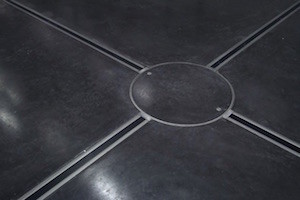
Circular Access Cover insitu copyCall into either of our offices in Bury St Edmunds or Ware and we guarantee you will hear the “S” word before the kettle has finished boiling to make you that welcoming cuppa!

The specification, and being specified, is fundamental to our ongoing success. Everyone in our team knows and understands that fact.  And, they fight hard to ensure that the Bilco and Howe Green brands are in the frame whenever it comes to the specification of roof hatches, smoke vents, safety ladders, floor doors and floor access covers.

When you are a well-established brand with a track record for quality products and innovative solutions it is easier to get your product specified.  Throw into the mix the depth and breadth of speciality access expertise within our team and you can tick another box off the credentials that architects, specifiers and building services professionals are looking for when it comes to deciding which products to specify.

Why is the specification so critical in our industry?

There are many reasons why buying decisions are based on specification but in our experience these can be distilled into 6 main areas:-

  1. Clarity

Developing a specification provides clarity and precision on exactly what is required. A good specification will have taken into account the desired performance, suitable material, usage of the product, aesthetic appearance, installation environment, life expectancy, life cycle impact and cost.

  1. Minimise risk

An accurate specification helps to minimise the risk of dispute and the potential for legal action on a project further down the line if anything goes awry. As it is an intrinsic part of the contract documentation the specification is legally binding in the event of any dispute or litigation. According to a report by Arcadis the “ value of disputes within the UK construction and engineering industry grew by around a third during 2016 to an average value of £27 million.”

  1. Improve compliance

Statutory compliance is essential to avoid legal implications and penalties. For example the specification can outline which Building Regulations or Health and Safety legislation with which a product needs to comply.

  1. Peace of mind

Given the level of disruption caused when something goes wrong with a project, in terms of time and money, it is surprising that there are still those in the construction sector who do invest in producing a detailed specification. An accurate specification provides an audit trail for a project and can provide peace of mind for stakeholders. The end client has the assurance that due diligence has been followed in the selection of the product.

  1. Enhanced efficiency

A clear and accurate specification enhances efficiency in all aspects of a construction project – from improving channels of communication to providing clear instructions to the team responsible for the delivery of the project.

  1. Saves time and money

Accurate, well-constructed specifications make life easier for everyone involved in a project.

A right first time approach ensures that costly errors and delays can be avoided.

Need some help with your specification?

Pick up the phone and talk to our technical team, we are always happy to help.  If you are specifying roof hatches, smoke vents, safety ladders or floor doors then please speak to the Bilco technical team on 01284 701696.

If you require help with specifying floor access covers, wall hatches, linear drainage, tree grilles or bespoke architectural metalwork then you need to speak with the Howe Green technical team on 01920 463230.

Alternatively take a look at the Downloads and External Resources sections of our product pages to access BIM Objects, NBS Specifications, CAD Drawings, Submittal Drawings, Technical Data Sheets, Installation Guides and Brochures.


KEE SAFETY PROVIDES SAFE ACCESS WITH SELF CLOSING SAFETY GATES

Building Products Index Ltd Uncategorized Leave a Comment


View the Kee Safety entry on BPI

Visit the Kee Safety Website

View the Kee Safety Video

Kee Safety, a global supplier of fall protection equipment and safety railing systems, has launched Kee Gate, a range of self-closing safety gates, which provides industrial workers with a safety solution when working at height and on ground level.

kee-gate-1Designed to work both internally and externally, on ladder and stair access points, roof hatches, walkways and roof tops, Kee Gate, ensures maintenance, inspection and warehouse staff can fulfil their job, follow best practices and comply with current safety standards, without putting their safety at risk. Kee Gates are spring loaded so can automatically close behind the user, providing an added level of security and overcoming the potential for human error. This type of system is the preferred solution to chains, bars or sliding tubes, as these traditional forms of protection can lead to a hazardous void, when used incorrectly.
kee-gate2-1Kee Safety self-closing safety gates are available in galvanised steel and if required can be powder coated in safety yellow. The safety gate is available with standard ‘U’ bolts for fixing to uprights of 33.7, 42.4 and 48.3 mm diameter, enabling the gate to be fixed quickly to existing supporting structures, posts or stringers. An additional fixing pack is provided which allows the gate to be fixed to square, flat or angle uprights. Easy to install on all types of handrails or to retro-fit existing structures, such as galvanised handrails and roof edge protection systems, Kee Gate is 1 metre wide. Designed to be trimmed on-site, this solution saves companies the time and money it takes to fabricate their own gates.

Kee Gate is compliant with the requirements of EN 13374 Class A, EN ISO 14122 Part 3 & Part 4 and is CE marked to EN 1090. The range is also compliant with international standards, meeting OSHA, O.B.C and I.B.C requirements. The system has undergone extensive testing to ensure total reliability of the gates. These include salt spray testing to ASTM B117-11 Neutral solutions over 200 hours to assess the coating’s corrosion resistance, life cycle testing to BS 6375-2:2009 Clause 6.5 – Opening and closing of Gate through 90 degrees 50,000 cycles and Abuse Testing where 9 x 25kg weights were suspended from the gate to test what happens if pressure is applied. This ensures durability, superior corrosion resistance and defence against signs of wear.

For more information, please visit www.keesafety.co.uk