
Skip to content
BPindex — The Largest Building Products Directory in the UK

Radiator

HEAT PUMP COMPATIBLE RADIATOR INNOVATION DOUBLES HEAT OUTPUT AND PROVIDES COOLING

Building Products Index Ltd Radiator Leave a Comment

View the Jaga entry on BPindex

Visit the Jaga website

Jaga UK, a leading manufacturer of heating, cooling and ventilation solutions designed with the environment in mind, has just launched pioneering hybrid radiator technology for the UK market.

Dynamic Boost Hybrid (DBH) has been specially developed to boost heat outputs and provide light cooling with renewable energy systems such as heat pumps and solar energy. It replaces Jaga’s well-known Dynamic Boost Effect (DBE) product.
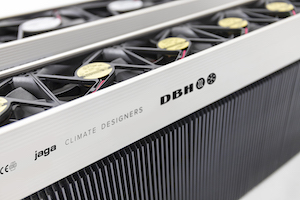
Jaga's Dynamic Boost Hybrid technology inside the radiator doubles the heat outputThe DBH technology utilises small electric thermal activators placed on top of the heat exchanger inside the Jaga Low-H2O radiator to force convection. This significantly boosts the radiator output by two to three times without increasing its size.

“When paired with a heat pump or other low flow temperature system, most emitters require a large surface area to sufficiently heat the room,” said Phil Mangnall, managing director, Jaga UK. “DBH allows you to substantially reduce the size of the radiator, freeing up valuable wall space and improving the aesthetics of the room. The system is almost inaudible and works with the majority of wall-mounted, free-standing, and trench solutions.”
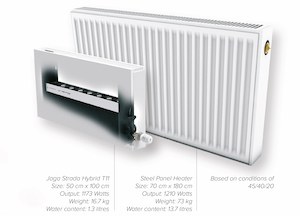
Strada Hybrid ComparisonGiving users more control over individual room temperatures, DBH further reduces the need for unnecessary heating and overheating, significantly cutting energy consumption and bills. Easily installed during new construction or added during building retrofits, units can be programmed to run to their own automated schedules or set to respond to direct input. The DBH activators are triggered automatically whenever hot water flows through the heat exchanger and once the room reaches the desired temperature, water stops flowing through the heat exchanger and the DBH activators turn off, keeping energy consumption low.
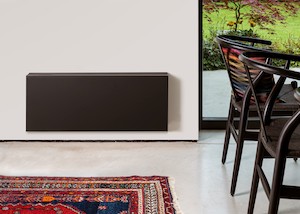
Jaga's Heat Pump Compatible Strada Hybrid Radiator GraphiteThe key point of difference between DBH and Jaga’s former DBE technology is the ability to provide light cooling (non-condensing) with any heat pump that can supply cooling water. And if there is no cooling water, Breeze mode, where with the activators operate irrespective of water temperature, offers light air movement, ideal for a UK climate.

“As the demand for cooling increases, we wanted to come up with a more environmentally friendly, energy-efficient solution that can be easily retrofitted and doesn’t cost the earth,” said Mangnall. “Updating our proven DBE system to also provide light cooling, was the obvious solution and has already proven to be a huge success in Europe and other parts of the world. We’re pleased to be able to now offer DBH to the UK market in line with the rapid rollout of renewable energy systems to help reduce the environmental footprint of buildings across the country.”

For more information, please visit www.jaga.co.uk/dbh


ABOUT JAGA UK

Jaga are pioneers in designing innovative, ecologically sustainable heating, cooling and ventilation systems using less energy and fewer raw materials.

Zehnder’s new Zmart Flex Radiator provides the Solution to Corrosion

Building Products Index Ltd Radiator Leave a Comment

View the Zehnder entry on BPI

Visit the Zehnder website
zehnder_zmart_600-1000_ral9016_office_udo_003_boeCorrosion in radiators is an all-too common problem, causing many commercial premises to suffer from under-performing heating and then the disruption and expense of maintenance and repairs. Now, however, Zehnder has come up with a solution by introducing radiator components formed from polymers instead of metal. Unlike conventional, pressed steel radiators, the new Zehnder Zmart Flex distributes warmth via a polymer heating register and comprises a network of plastic tubes behind an aluminium front casing. This first-of-a-kind technology heralds a new era of lighter and longer-lasting radiators.

This is the biggest innovation in radiator design since bulky cast iron radiators were replaced by sleeker pressed steel models in the early 1970s, but the plumbing and heating industry has already been using polymer components, of course, for more than three decades. In pipes, pipe elbows, compression fittings, and connectors, polymers have proven capable of distributing hot water perfectly well. And now Zehnder’s research and development has proven that the hard-wearing polymer polybutane works just as well inside a radiator.

zehnder-zmart-radiator_polymer-registerPolymer components became popular in plumbing, in comparison with the traditional copper alternative, because they are easier to install and maintain, less prone to pitting and lime-scale, totally resistant to corrosion, and more durable. Those same advantages are true when polymer is used instead of steel for the heating register inside a radiator. Even when installed within a system with poor water quality, the performance is not impaired.

As well as being unrivalled in its corrosion-resistance, the Zmart Flex is 60% lighter than steel alternatives, which means it can be more easily transported and lifted, and can be positioned and installed by a single person. With the added advantage of patented 360⁰ flexible flow and return tubes that connect to any valve arrangement and give the freedom to fit wherever there’s pipework, the Zmart has been shown to consistently reduce installation times by 30%.

Innovative Zehnder Zmart Flex Heralds a New Era in Radiator Technology

Building Products Index Ltd Radiator Leave a Comment

View the Zehnder entry on BPI

Visit the Zehnder website

With a technical innovation brilliant in its simplicity, the new Zehnder Zmart Flex radiator improves upon conventional radiator design, durability and ease of installation. Its first-of-a-kind technology heralds a new era of lighter, longer-lasting and more environmentally friendly radiators.

Zehnder Zmart radiator_Polymer register UntitledUnlike conventional, pressed steel panel radiators, Zehnder Zmart Flex distributes warmth via a polymer heating register. This is a clever new concept which uses proven technology: for three decades now, plastic piping has been an effective and dependable manufacturing material for other plumbing and heating products.

The result is a flat panel radiator unrivalled in its corrosion-resistance and 60% lighter than steel alternatives. Being lightweight, the Zehnder Zmart Flex is more easily transported than pressed steel panel radiators and can be comfortably lifted, positioned and installed by a single person. With the added advantage of patented 360⁰ flexible flow and return tubes that connect to any valve arrangement and give the freedom to fit existing pipework, the Zehnder Zmart Flex has been shown to consistently reduce installation times by 30%.

Ideal for a wide range of residential and commercial installations, and with classically timeless looks, the Zehnder Zmart Flex is available in 63 sizes, with external dimensions varying from 360mm to 750mm in height and 400mm to 1500mm in length and with heat outputs ranging from 124 W/btu to 2621 W/btu. The polymer heating register achieves comparable thermal outputs to a steel radiator of similar size. The heating register has proven, in accelerated testing under laboratory conditions, to have a life expectancy in excess of 50 years whilst running at system temperatures of 80⁰ C. There’s a 10-year warranty for components, even when fitted to an existing system.

The Zehnder Zmart is suitable for use with renewable energy sources and is itself environmentally-friendly. Its carbon footprint is typically 8% less than conventional radiators and by requiring less energy and fewer resources to manufacture, transport, operate and dispose of, its environmental impact can be expected to be 20% lower.

For more information about the innovative new Zehnder Zmart Flex range please visit www.zmart.zehnder.co.uk