Skip to content
BPindex — The Largest Building Products Directory in the UK

Radiators

Jaga UK launches super slimline fan convector: Briza Net Zero

Building Products Index Ltd Heating, Radiators Leave a Comment

View the Jaga entry on BPindex

Visit the Jaga website

Jaga has launched a state-of-the-art range of sleek and slimline fan convectors designed to enhance the efficiency and versatility of heat pumps and low-temperature heating systems.

The Briza Net Zero range is ideal for modern buildings where both cooling and heating are essential. When paired with a heat pump, these units offer an energy-efficient and climate-friendly alternative to air conditioning, with both light and deep cooling (non-condensing and condensing) options for year-round comfort in the UK’s variable climate.

Compact and stylish, Briza Net Zero units feature a sleek design that seamlessly integrates into modern interiors. The XS model, at just 85mm deep, is one of the slimmest fan convectors on the market, making it perfect for spaces where size and aesthetics are paramount.


Recognising that heat pumps are most efficient at lower system design temperatures; the Briza Net Zero range has been optimised for this purpose. At flow and return temperatures of just 35/30°C (room temp 20°C), the Briza M Net Zero BASE-Line, Jaga’s most powerful model yet, delivers a heat output of up to 2110W and a deep cooling output of up to 2575W at 7/12°C (room temp 27°C). This makes it an ideal choice for maximising system efficiency whilst maintaining indoor comfort.

The range is versatile in both installation and control, with various sizes and colour options, and the flexibility to be wall or ceiling mounted. This adaptability makes it suitable for a wide range of projects.


Designed with sustainability in mind, the units feature a built-in EC motor for low energy consumption and an extended service life. The recyclable aluminium and copper heat exchanger, with hydrophilic coating, enhances cooling performance while minimising environmental impact.

Get in touch

To find out more, visit

https://netzero.jaga.com/uk

THE BENEFITS OF BALANCING

Building Products Index Ltd controls, Heating Leave a Comment

View the Danfoss entry on BPindex

Visit the Danfoss website

Correct balancing of heating systems not only optimises heating system efficiency it also helps reduce heating costs for homeowners.

Hydronic balancing is the process of optimising the flow of water in a hydronic heating system by balancing the system pressure and so ensuring that water flows equally to individual radiators. This helps prevent over or under supply to radiators occurring. Apart from the discomfort factor an unbalanced system is less efficient, resulting in potentially higher fuel bills for already hard-pressed consumers.

If a customer complains of cold radiators some installers may consider increasing the pump speed or adjusting the boiler thermostat to a higher temperature setting. Although a seemingly quick fix compared with balancing this may not solve the problem and will increase the system’s energy consumption even further.

Basic principles

Tests conducted independently at the Salford University Energy House showed that without effective control and balancing boilers will operate in condensing mode for around 5% of the time, whereas with, it’s closer to 80% of the time. However, despite these efficiency benefits, and being considered best practice, balancing is sometimes neglected during the installation and commissioning of domestic heating systems. This could be down to lack of knowledge or confidence – or because of the time it can take using traditional methods. Whatever the reason, let’s start by looking at the method most installers will be familiar with – adjusting the lockshield valves on each radiator to ensure each radiator receives the correct flow of hot water to heat the space in which it is fitted. This process can be very time-consuming: firstly, air must be removed from the system by bleeding the radiators. The heating is then turned off and radiators left to cool down before the heating is turned back on. TRVs (if fitted) are then set to the fully open position, and the lockshield valves, by turning them anti-clockwise. The installer checks by touch which radiators get hottest quickest. Return valves on the hottest radiators will probably need to be restricted by 50% or 60% to start with, however, to balance a poorly designed system it may be necessary to close a valve more than 80%.

Learn how the RAS-B2 can increase comfort and reduce energy costs for homeowners here – https://youtube.com/watch?v=ZOVLiTjScmU&feature=shares

Dynamic solution

An accurate flow limiter with a pre-setting function is an alternative static balancing solution whereby the installer calculates the flow required for each radiator and adjusts to ensure the required amount of water is delivered. Although more accurate than a lockshield valve this form of balancing is only optimised for the coldest days (winter) when the heating system is operating at full (design) load. This means flow could be unnecessarily high on milder days (spring/autumn). If TRVs are fitted the room temperature can be controlled, but flow through the radiators will be the same, resulting in over-delivery and wasted energy.

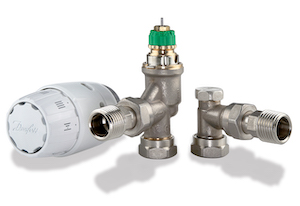
A dynamic solution like the new Danfoss RAS-B2 functions as both a flow limiter and dynamic pressure valve. It limits flow through the TRV but does this independently of pressure fluctuations, so it is optimised for all days. The valve’s built-in differential pressure controller ensures that pressure drops over the valve remain at a constant level, which means flow through the valve is maintained at both full and partial loads.

Quick and easy balancing

As well as improved comfort, the RAS-B2 can enhance system efficiency as it ensures a lower return temperature (condensing boiler efficiency is best at below a return temperature of 55o C) and the pump can run at a lower speed and so consumes less electricity. Furthermore, because pre-setting of the desired flow is done on the RAS-B2 valve, rather than on the lockshield, installers could save up to two hours of working time and correctly balance a system in a fraction of the time it would normally take. And balancing can be made even easier by using the Danfoss Installer App when fitting RAS-B2 valves. This handy tool provides an interactive guide to calculating, recording and documenting the correct flow and subsequent setting for each radiator on a smartphone or tablet.

Discover more on how heating professionals can help consumers increase the efficiency of their heating systems here.

EFFICIENT LST RADIATORS ENABLING LOW CARBON HEAT

Building Products Index Ltd Heating, Radiators Leave a Comment

View the Jaga entry on BPindex

Find out more about Jaga’s Dynamic Boost Hybrid

View Jaga’s range of Low Surface Temperature Radiators

THE UK’S SAFEST RADIATORS

Jaga's Tempo LST Hybrid Radiator for Heating and CoolingLow Surface Temperature (LST) radiators are relied upon to provide safe, high-efficiency heating in places where safety is paramount. They are the go-to choice for facilities such as hospitals and healthcare settings, care and nursing homes, schools and nurseries, prisons and public buildings to prevent vulnerable people from burns and injuries caused by coming into contact with the radiator.

LST radiators work by convecting heat from the emitter, with a small air gap between the emitter and the surface of the radiator casing to prevent the casing ever getting hotter than 43°C.

They are designed with numerous other safety features such as antibacterial coatings, rounded corners and grilles, chamfered front and side panels, casing locks, anti-ligature grilles, pencil-proof grilles and arthritic TRV adaptors. And leading LST manufacturers, such as Jaga, ensure they are designed to conform to the NHS Estates Health Guidance on surface temperature and casing design.

But how are LST radiators keeping up with the times and the demand for high heat output at low flow temperatures?

FUTURE PROOFING FOR LOW CARBON HEAT

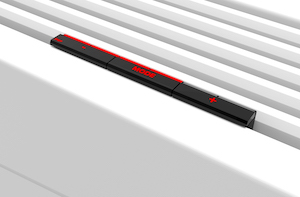
Jaga's Tempo LST Hybrid Radiator - Control Panel in Heating ModeJaga’s newest innovation for LST radiators is a key enabler for low carbon heat.

As a leading designer and manufacturer of innovative, ecologically sustainable heating, cooling and ventilation systems, Jaga has been at the forefront of the LST radiator market for many years, supplying hundreds of schools and healthcare facilities across the country with safe, powerful, energy-efficient heating.

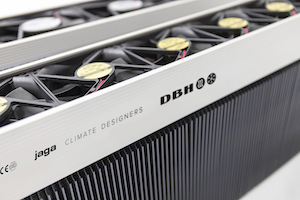
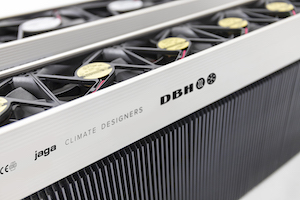
Jaga's Dynamic Boost Hybrid technology inside the radiator doubles the heat outputTo meet the rapidly increasing demand for higher heat output at lower flow temperatures, Jaga has recently launched a revolutionary innovation for radiators – Dynamic Boost Hybrid (DBH). DBH is an electric booster set that sits inside the LST radiator. It uses small, quiet thermal activators to increase airflow and boost heat output by two to three times without increasing radiator size. It means there’s no need to install large LST radiators when switching to a heat pump system. In fact, they can be even smaller.

This game-changing innovation makes Jaga LST radiators completely future proof. If a building is still being heated by a gas boiler, standard Jaga LST radiators can be installed now, and when the time comes to switch to a heat pump, DBH can easily be retrofitted, enabling the switch over to an emission-free installation at any time without having to make any changes to the radiators, heat distribution or pipes.

WHAT MAKES A HYBRID RADIATOR?

Not only do Jaga’s LST Hybrid radiators provide powerful heat with low energy consumption, they cool too. DBH can automatically switch between heating and light cooling modes, providing the heating system can supply cooling water.

This method of non-condensing cooling is much more environmentally friendly than air conditioning, using less energy and no F-gas, so it’s a perfect solution for a comfortable indoor climate all year round.

GET IN TOUCH

To find out more about Jaga’s range of safe and efficient LST Hybrid radiators, get in touch with team via their website jaga.co.uk.

ABOUT JAGA UK

Jaga are pioneers in designing innovative, ecologically sustainable heating, cooling and ventilation systems using less energy and fewer raw materials, ensuring a better indoor climate without damaging the outdoor climate.

HEAT PUMP COMPATIBLE RADIATOR INNOVATION DOUBLES HEAT OUTPUT AND PROVIDES COOLING

Building Products Index Ltd Radiator Leave a Comment

View the Jaga entry on BPindex

Visit the Jaga website

Jaga UK, a leading manufacturer of heating, cooling and ventilation solutions designed with the environment in mind, has just launched pioneering hybrid radiator technology for the UK market.

Dynamic Boost Hybrid (DBH) has been specially developed to boost heat outputs and provide light cooling with renewable energy systems such as heat pumps and solar energy. It replaces Jaga’s well-known Dynamic Boost Effect (DBE) product.

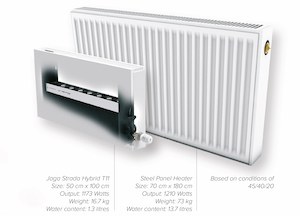
Jaga's Dynamic Boost Hybrid technology inside the radiator doubles the heat outputThe DBH technology utilises small electric thermal activators placed on top of the heat exchanger inside the Jaga Low-H2O radiator to force convection. This significantly boosts the radiator output by two to three times without increasing its size.

“When paired with a heat pump or other low flow temperature system, most emitters require a large surface area to sufficiently heat the room,” said Phil Mangnall, managing director, Jaga UK. “DBH allows you to substantially reduce the size of the radiator, freeing up valuable wall space and improving the aesthetics of the room. The system is almost inaudible and works with the majority of wall-mounted, free-standing, and trench solutions.”

Strada Hybrid ComparisonGiving users more control over individual room temperatures, DBH further reduces the need for unnecessary heating and overheating, significantly cutting energy consumption and bills. Easily installed during new construction or added during building retrofits, units can be programmed to run to their own automated schedules or set to respond to direct input. The DBH activators are triggered automatically whenever hot water flows through the heat exchanger and once the room reaches the desired temperature, water stops flowing through the heat exchanger and the DBH activators turn off, keeping energy consumption low.

Jaga's Heat Pump Compatible Strada Hybrid Radiator GraphiteThe key point of difference between DBH and Jaga’s former DBE technology is the ability to provide light cooling (non-condensing) with any heat pump that can supply cooling water. And if there is no cooling water, Breeze mode, where with the activators operate irrespective of water temperature, offers light air movement, ideal for a UK climate.

“As the demand for cooling increases, we wanted to come up with a more environmentally friendly, energy-efficient solution that can be easily retrofitted and doesn’t cost the earth,” said Mangnall. “Updating our proven DBE system to also provide light cooling, was the obvious solution and has already proven to be a huge success in Europe and other parts of the world. We’re pleased to be able to now offer DBH to the UK market in line with the rapid rollout of renewable energy systems to help reduce the environmental footprint of buildings across the country.”

For more information, please visit www.jaga.co.uk/dbh


ABOUT JAGA UK

Jaga are pioneers in designing innovative, ecologically sustainable heating, cooling and ventilation systems using less energy and fewer raw materials.

Ready, set…EPC

Building Products Index Ltd Heating, Radiators Leave a Comment

View the Jaga entry on BPi

Visit the Jaga website

jaga-epc-20161014EPC Ratings, why does this matter? The government estimates that almost one-in-five commercial properties currently hold the lowest ratings of F or G. EPCs are legally required for all public and private buildings and assign an efficiency rating from A to G.  So, are you ready for the new rules?

The built environment has been identified by government as a major contributor to Greenhouse Gas (GHG) emissions, contributing around 34 per cent of the UK total.

Non-domestic buildings account for nearly 25 per cent of the UK’s overall carbon emissions and heat in buildings accounts for a substantial proportion of this. As more are built and refurbished, the installation of energy efficient, cost-effective products must be a top priority – especially if the UK is to meet the ambitious carbon reduction targets for 2020 and 2050.

So, are you ready for the new rules?

The regulations will first apply to new domestic and non-domestic lettings and lease renewals from April 2018, to be followed by all existing non-domestic leases by 1st April 2023.

However, savvy building managers are taking steps to not only meet this minimum standard but to exceed it in preparation for a likely future tightening of the regulations.

Here we take a look at the steps you can take to upgrade to your heating system and boost building energy efficiency ratings in the process.

New tech

 The latest heating technology can help you achieve some easy wins when it comes to energy efficiency and heat emitters should be a first port of call. When compared to other heating upgrades, such as replacing an old boiler, switching your radiators to more efficient models is relatively low cost and can be done fairly quickly.  Low-mass, low water content radiators contain a tenth of the water compared to a standard steel panel radiator, resulting in a faster response time and providing up to a 16 per cent reduction in energy costs. Buildings which are fitted with this technology also produce much lower carbon emissions due to the reduced energy used, helping designers and  engineers meet their carbon reduction targets.

Another innovative radiator technology is fan assisted DBE (Dynamic Boost Effect).

This improves airflow and boosts heat output, allowing Jaga radiators to work efficiently with sustainable low-flow temperature systems, such as heat pumps.

Heat pumps are estimated to reduce electricity use (and cost) for heating by around 50 per cent compared to electric resistance heaters. They are extremely efficient and, when utilised properly, can also provide excellent thermal comfort. With added support from the Renewable Heat Incentive (RHI) tariff payments for ground source and air source heat pumps, it seems inevitable that the uptake of these technologies will continue to grow steadily.

 Taking action now

 It can often be a challenge to keep on top of the latest energy efficiency regulations but the April deadline for MEES should be seen as a priority. Civil penalties of up to £5,000 will be imposed for breaches, with local authorities also serving compliance notices to ensure properties are brought up to standard.

Investment in a heading system upgrade will not only ensure your building remains compliant but can deliver energy cost savings that will last for years to come.


Zehnder’s new Zmart Flex Radiator provides the Solution to Corrosion

Building Products Index Ltd Radiator Leave a Comment

View the Zehnder entry on BPI

Visit the Zehnder website
zehnder_zmart_600-1000_ral9016_office_udo_003_boeCorrosion in radiators is an all-too common problem, causing many commercial premises to suffer from under-performing heating and then the disruption and expense of maintenance and repairs. Now, however, Zehnder has come up with a solution by introducing radiator components formed from polymers instead of metal. Unlike conventional, pressed steel radiators, the new Zehnder Zmart Flex distributes warmth via a polymer heating register and comprises a network of plastic tubes behind an aluminium front casing. This first-of-a-kind technology heralds a new era of lighter and longer-lasting radiators.

This is the biggest innovation in radiator design since bulky cast iron radiators were replaced by sleeker pressed steel models in the early 1970s, but the plumbing and heating industry has already been using polymer components, of course, for more than three decades. In pipes, pipe elbows, compression fittings, and connectors, polymers have proven capable of distributing hot water perfectly well. And now Zehnder’s research and development has proven that the hard-wearing polymer polybutane works just as well inside a radiator.

zehnder-zmart-radiator_polymer-registerPolymer components became popular in plumbing, in comparison with the traditional copper alternative, because they are easier to install and maintain, less prone to pitting and lime-scale, totally resistant to corrosion, and more durable. Those same advantages are true when polymer is used instead of steel for the heating register inside a radiator. Even when installed within a system with poor water quality, the performance is not impaired.

As well as being unrivalled in its corrosion-resistance, the Zmart Flex is 60% lighter than steel alternatives, which means it can be more easily transported and lifted, and can be positioned and installed by a single person. With the added advantage of patented 360⁰ flexible flow and return tubes that connect to any valve arrangement and give the freedom to fit wherever there’s pipework, the Zmart has been shown to consistently reduce installation times by 30%.