Off-membrane blue roof systems are being recognised as a vital part of the UK’s sustainable future, but what does true integration mean for designers, specifiers and contractors❓
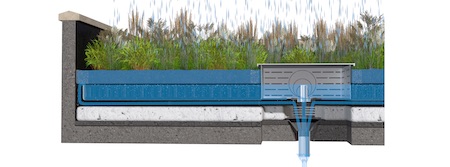
With ACO’s method, off-membrane storage integration means modular tanks positioned above the roof build-up keep rainwater storage separate from the waterproofing layer, protecting the membrane while enabling controlled irrigation, hard landscaping and biosolar interfaces 💧
Keeping the storage away from the waterproof layer stops the repeated wetting and drying that concentrates moisture at joints and roof openings. Reducing that strain on the waterproofing helps preserve manufacturer warranties and avoids the extensive work a membrane replacement would otherwise require on multi-use roofs 👷
For inverted and hard-landscaped roofs, keeping stored water off the insulation also removes the need for heavy ballast and the risk of insulation lifting 👍
Passive irrigation using wicking mats connected to the stored water delivers moisture to planting soil and planters in paved areas without surface ponding or mechanical sprinklers. The result is reliable plant establishment, biosolar edge planting and lower energy and maintenance needs — crucial where access and solar-panel maintenance corridors must be kept clear 🌞
Early, joined-up design is essential: consider tank locations, wicking layout and outlet positions during concept stages to meet the London Plan Urban Greening Factor and avoid late-stage structural clashes. ACO’s method works with wicking networks and PV layouts, offers simpler installation than ballast systems, and delivers predictable weights on the roof, making multifunctional roofscapes coherent, maintainable and compliant ✅
Explore blue roofs in greater detail with our free guide, available here ⬇️
The Flood and Water Management Act Schedule 3 is expected to be implemented in the next year, which means sustainable drainage systems (SuDS) will become mandatory in England for a significant number of new and retrofit developments. In this article, Neill Robinson-Welsh, Consultant at ACO Building Drainage discusses the coming changes and what specifiers need to be aware of, especially when it comes to urban schemes and projects that involve blue green roofs.
With the implementation of Schedule 3 just over the horizon, it is important for specifiers working on property development projects to have a clear understanding of the new requirements and how their responsibilities will likely be impacted. By understanding Schedule 3, specifiers will be better positioned to select the roofing solutions that fall in line with regulations and help mitigate their project’s impact on the environment.
Schedule 3: an overview
Schedule 3 is an umbrella term encompassing several requirements related to sustainable drainage. It comes from the Flood and Water Management Act 2010 and will mandate that all construction projects incorporate SuDS. While there is still some uncertainty, once it is implemented, Schedule 3 is expected to impact both new developments and renovation work on multiple dwelling units or properties over 100 square metres.
The demand for blue roofs is expected to increase
One major change with Schedule 3 will be that there will no longer be an automatic right to connect new and refurbished properties to public sewers. Instead, permission must be given, once appropriate SuDS have been put in place, by the local SuDS Approval Body (SAB). Each local authority will have its own SAB, and it is this body that ensures a drainage proposal meets the standards created by the Department for Environment, Food and Rural Affairs (Defra).
To meet Schedule 3 requirements, it is expected that demand for innovative drainage systems such as blue and blue green roofs will increase. These are viable solutions for many drainage projects in dense urban areas and have a proven record of their efficacy and sustainability.
Relevant regulations
It’s important that specifiers keep in mind that drainage should be selected with those once-in-a-century rainfall events in mind, and not just accounting for average conditions. Along with this consideration, blue roofs need to be installed in compliance with BS EN 12056-3:2000, the British Standard for gravity drainage on flat roofs, as well as BS 6229:2018, for flat roofs with continuously supported flexible waterproof coverings.
On a technical level, it is worth noting that blue and blue green roofs made from solutions like ACO’s RoofBloxx shallow geocellular crates are attenuation systems on roofs and not roofing systems as such. Once installed, they sit on top of a roof, but function separately. It is this distinction that allows roofers to follow BS EN 12056-3:2000[1]and BS 6229:2018[2], which are two seemingly incompatible requirements. In practice, it means water should not be allowed to sit on top of the waterproofing layers as that can risk causing structural damage to the roof.
The difference between blue and blue green roofs
Traditionally, roofs have been designed with the goal of removing water as quickly as possible. Blue and blue green roofs work very differently – intentionally slowing the flow of water off the roof using water storage, flow restrictors, and other features to avoid overwhelming sewers and create more sustainable drainage.
Blue roofs slow the flow of water from a roof mitigating flood risk copy
What differentiates blue from blue green roofs is that the latter is a home to live plants as well as flow slowing solutions. These plants can contribute to biodiversity and act as a natural carbon sink, improving the air quality of their immediate surroundings and offsetting carbon emissions. Many blue green roofs reuse some of the collected water to sustain the plants that fulfil the green aspects of the hybrid design which make them especially eco-friendly roofing options.
Industry changes can present challenges, so it is important for specifiers to be up to date and able to make the right product selections. These can be based on specialist knowledge and experience when specifiers partner with drainage experts such as those at ACO. Demand is growing for solutions that are compliant with Schedule 3 and, by being familiar with available blue and blue green roof options available, specifiers will be well positioned to make informed choices that will benefit the project, the end user, and the environment.
For more on blue roof specification please visit ACO.co.uk.
[1] BS EN 12056-3:2000 contains design guidance for roof and paved area drainage.
[2] BS 6229:2018 outlines best practice for the design, construction and maintenance of roofs with a flat or curved surface.
The newly patented ACO blue roof attenuation system forms an independent tank that can be constructed on any new or existing flat roof where roof waterproofing has been applied. The system can be installed on a warm, inverted, or uninsulated roof using a single ply, cold or hot melt waterproofing system.
ACO have just launched a new series of animation videos to show how the system is built up and how it functions on a number of different roof types. The system provides the following benefits:
Reduces overall building risk by providing greater design resilience for all types of flat roof construction
Ensures compliance with Flat Roofing and Drainage building standards and The Building Regulations, allowing the system to drain slowly in normal use and quickly in extreme conditions.
Ensures compliance with The SuDS Manual hydraulic design guidance and planning conditions
Simplifies design responsibility
Is suitable for new build or retrofit schemes
Is ideal for use as part of a combined passive irrigation or active rainwater harvesting system and embraces the ambition of integrated water management
Kevin Bohea, Divisional Managing Director, stated ‘ACO is proud to bring this patented, market-leading system to the roofing industry.Using ACO RoofBloxx as the key attenuation product in the system, ACO can advise on the build-up of the system for projects and provide the hydraulic calculations needed for different roof types.’

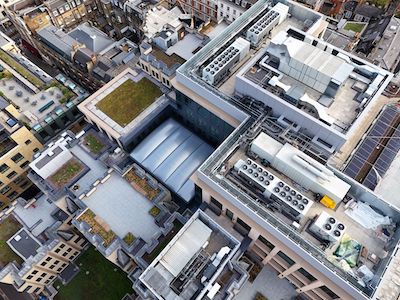
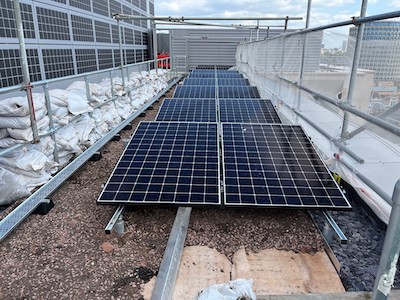 Passive irrigation using wicking mats connected to the stored water delivers moisture to planting soil and planters in paved areas without surface ponding or mechanical sprinklers. The result is reliable plant establishment, biosolar edge planting and lower energy and maintenance needs — crucial where access and solar-panel maintenance corridors must be kept clear 🌞