Skip to content
BPindex — The Largest Building Products Directory in the UK

Net Zero

Britain’s Housing Ambitions Depend on Small Builders

Building Products Index Ltd Blocks, Concrete Leave a Comment

View the H+H UK Ltd entry on BPindex

Visit the H+H UK Ltd website

Phil Knight, Head of Private Housebuilding at H+H UK Ltd gives his thoughts on the importance of SME builders and what the government can do to halt their decline.

Today, SMEs account for just 10% of all new homes built in England – down from around 40% in the 1980s. That decline is not just a problem for small builders; it’s a problem for the nation. Without a thriving SME sector, it is difficult to see how the government can deliver homes at the scale and quality the country needs.

The value of small builders

SMEs bring something different to a housing market dominated by large housebuilders: agility, creativity and a deep connection to place. They broaden the capacity of the industry and help accelerate delivery in areas where demand is greatest.

Small builders are rooted in their communities. They can take on difficult, smaller brownfield land that the volume housebuilders overlook. They use local suppliers, employ local trades, and support apprenticeships—keeping money, skills, and jobs within the regional economy. This “multiplier effect” strengthens local economies and fosters community identity.

SMEs are also just as keen as the volume housebuilders to support innovation. Able to move faster in terms of revisiting their designs, SMEs may have the freedom to trial new materials and methods and are often keen to respond quickly to environmental and design challenges.

At H+H, we’ve seen this first-hand. Our Vertical Wall Panels – an offsite-manufactured, aircrete-based system designed to speed up construction and improve thermal performance – were initially developed for the volume housebuilders. Yet we are also seeing the smaller regional builders adopting this innovative approach. Their willingness to experiment helps drive improvements across the industry.

Innovation and environmental progress

Encouraging SME growth is not only about numbers; it’s also about quality and sustainability. Smaller firms are often at the forefront of embracing low-carbon technologies, modern methods of construction, such as Vertical Wall Panels, and energy-efficient design. With the built environment central to the UK’s net zero ambitions, the government will not meet its environmental goals without the commitment of SME housebuilders.

The barriers holding SMEs back

Despite their importance, SME housebuilders face a range of challenges that prevent them thriving. The planning system remains the single biggest barrier. According to the Home Builders Federation’s Housing Market Intelligence Report 2025, over 90% of SMEs identify planning delays as a major challenge.

Large developers can weather these delays by switching resources to other sites. Smaller firms, often reliant on a single live project, do not have that luxury. The result is lost time, lost income, and, too often, lost businesses.
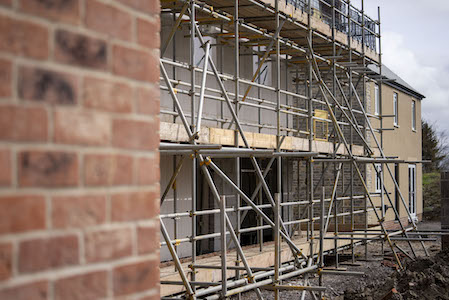
Access to finance remains another persistent problem. Many lenders view small development projects as higher risk, particularly when Section 106 (S106) affordable housing obligations are uncertain. When Registered Providers are unwilling to acquire small numbers of affordable homes with say, fewer than 30 units, SMEs can find themselves unable to secure the project finance needed to get started. Without intervention, this dynamic will continue to choke off supply.

Labour shortages add yet another layer of difficulty. The construction sector faces an ageing workforce and an urgent need for new entrants. Yet the current apprenticeship funding structure makes it difficult for smaller companies to bring in trainees. Rising minimum wages and National Insurance contributions have not been matched by reforms to the Apprenticeship Levy, leaving SMEs to absorb the costs. If we are serious about sustaining the skilled workforce required for housebuilding, apprenticeship funding should be reviewed and expanded.

Signs of progress – but not yet enough

There are reasons for cautious optimism. The government’s *Planning and Infrastructure Bill* aims to simplify and speed up development, and the Ministry of Housing, Communities and Local Government has announced a package of measures to support SME builders. These include streamlined planning for smaller developments, eased Biodiversity Net Gain requirements for sites of up to nine homes, and new exemptions from the Building Safety Levy for medium-sized projects.

Homes England has also pledged to release more land exclusively for SMEs and to pilot a *Small Sites Aggregator* to bring together underused brownfield land.

These are positive steps, but implementation remains slow. With fewer than four years to meet its 1.5 million homes target, the government simply cannot afford to wait.

A call to action

If the government is serious about its pledge to be the party of “builders, not blockers,” it must act decisively to rebuild the SME housebuilding sector. That means:

  • Accelerating planning reform to make smaller projects viable and predictable.
  • Improving access to finance, including flexible support for sites affected by S106 and affordable housing challenges.
  • Reforming apprenticeship funding to encourage more people to enter the industry.
  • Reintroducing targeted first-time buyer support to stimulate demand and restore confidence in local markets.

Reversing the decline of small housebuilders will not be easy, but it is essential. The UK cannot build more homes, better homes, or greener homes without the ingenuity, local focus, and commitment of SMEs. Supporting them is not about favouring developers—it’s about ensuring that every community has a chance to grow.

If the government wants to deliver 1.5 million homes, it must start by building a future in which small builders can once again thrive.

For more information on H+H visit Visit the H+H UK Ltd website
Reaching net zero with structural glass

Building Products Index Ltd Architectural Glass, Uncategorized Leave a Comment
View the Ion Glass entry on BPindex
Visit the Ion Glass website

Modernising or improving with structural glazing offers a sensitive and effective route to achieving net zero ambitions, improving the functionality of the building with minimal impact on the existing structure.

Structural glass specialists, Ion Glass are well-renowned experts in wholly bespoke, frameless or minimally framed glass installations with an impressive portfolio of work across a wide range of contemporary, heritage, historic and listed buildings. Their ethos is to respect the sensitivity of the building whilst working to ensure that the glass installations meet all your current requirements – including the drive towards net zero.

We asked Peter Hazeldean, MD of Ion Glass to share one of the most effective uses of structural glass to improve energy consumption and heat loss.

The benefits of frameless glass entrance doors and porches

Peter’s initial suggestion is to consider the entrance to the building.  Adding a structural glass porch creates a thermal buffer zone, reducing heat loss and improving internal comfort without increasing heating output.  A porch installation has the added advantage of generally falling under the planning umbrella of permitted development.

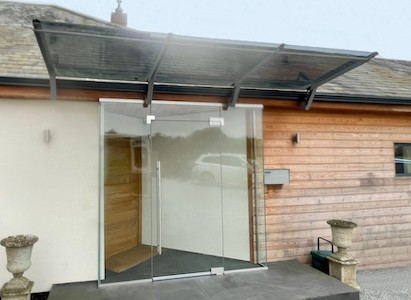
Glass can be used to infill an existing open porch; fitted internally, behind the existing door or used to construct an external structure in either single or double-glazed panels.

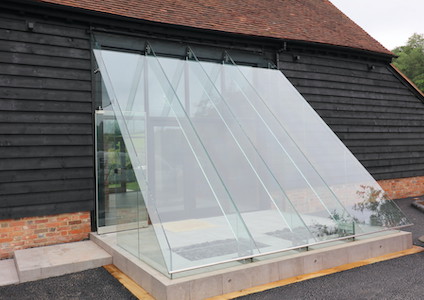
Owners of a heritage barn conversion in Reading commissioned Ion Glass to design and install an impressive, visually striking porch to the front of their new home:  the unusual triangular glass porch followed the steep slope of the original barn roof.  The glass porch serves to retain the heat that would otherwise have been lost via the double doors of the original barn entrance – whilst providing additional security.

Use of structural glass fins and beams to create the porch makes this a fully frameless installation with nothing to compromise the original barn structure.

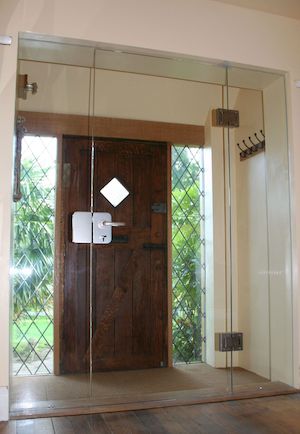
Ion designed an internal  porch to a traditional 1930’s style house, upgrading a draughty front entrance with a new internal glass door set between two fixed side panels. The original timber door was re-used externally, set between two leaded, double-glazed panels to retain the look and feel of the home whilst improving internal light levels to  reduce energy costs and significantly minimising heat loss.

(above) This deceptively simple glass porch infills the original entrance area to create an attractive porch with a frameless glass door, offering considerable benefits for thermal retention.

Peter continued: ‘Replacing timber doors with bespoke glass can eliminate draughts and reduce heat loss whilst also improving the levels of natural light to the interior.  For public buildings, an automatic opening and closing system means the door is only open as required, which improves both heat retention and security.

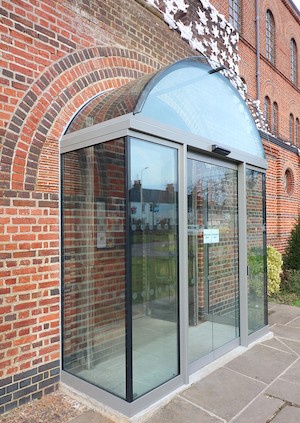
The new porch recently installed at St John the Evangelist Church at Newbury is double-glazed for maximum heat retention, with the curved double-glazed panels perfectly following the distinctive arch of bricks over the original door.  The original wooden doors are now permanently fixed open allowing natural light to flood the interior (saving on lighting costs) whilst the replacement sliding glass doors are fully automatic, providing easy access as required whilst minimising heat loss.

The expert team at Ion Glass will take your bespoke structural glass design from concept to reality, providing technical advice and drawings to ensure your project meets all criteria before our fully trained and experienced installation teams achieve optimum results on site.

For more information on our frameless glass porches and doors, glass screens or other architectural glass installations visit our website www.ionglass.co.uk and book a call to discuss your project.

Call 0345 658 9988 or email  info@ionglass.co.uk

Eurocell’s Modus Windows Central to Energy-Saving Plots at Cornish Park Development

Building Products Index Ltd Doors, PVC-U, PVC-U, Windows Leave a Comment

View the Eurocell entry on BPindex

Visit the Eurocell website

With a legacy spanning generations in windows and doors, H Jarvis Ltd, based in Redcar, has been at the forefront of providing cutting-edge solutions to the housing market.

For over nine years, it has partnered with Eurocell, the leading manufacturer, distributor, and recycler of PVC-U building products, leveraging its expertise to deliver high-quality, energy-efficient systems.

Triple-glazed Modus windows from Eurocell were selected for two energy-efficient demonstration homes at the Cornish Park development in Spennymoor, Durham.

Innovating for Net Zero

As part of Lovell’s Tomorrow Homes pilot program, these homes are designed to showcase innovative construction techniques aimed at meeting the challenges of Net Zero and the Future Homes Standard 2025.

Featuring the latest construction technologies such as:

  • Air-source heat pumps
  • Infrared heating
  • Air-sourced cylinders
  • Photovoltaic panels
  • Battery storage
  • Wastewater heat recovery

These homes set a new standard for sustainable housing. H Jarvis and Lovell have partnered to bring these energy-saving solutions to life, with Eurocell’s Modus windows playing a central role in achieving high levels of energy efficiency and thermal performance.

Collaborative Solution

For these Tomorrow Homes, Eurocell’s Modus window system was chosen due to its superior thermal performance and sustainability. The triple-glazed windows:

  • Help reduce energy consumption and carbon emissions
  • Provide lower energy bills for homeowners
  • Save up to 27% on standard double-glazing costs
  • Contain an average of 50% post-consumer recycled PVC-U

The Modus system is designed to help housebuilders exceed the requirements of the Future Homes Standard 2025 while providing high levels of security through internal beading, tested to the highest standards and BBA-certified.

“It’s vital to work towards a greener future for housing, which is why we have built the exemplar demonstration homes at Cornish Park that feature the most energy-efficient, sustainable aspects of a home. We are delighted to have formed a strong partnership with H Jarvis on these innovative properties to install Eurocell’s Future Homes-ready Modus triple-glazed windows. They are the perfect choice for our homes as we transition towards Net Zero, as they contain recycled PVC-U, have low U-values, and provide high thermal performance.”

– Iain Gillies, Divisional Design & Innovation Manager at Lovell

A Proven Partnership for Success

H Jarvis’ reputation as a trusted fabricator stems from decades of experience and their ability to meet the complex demands of modern housing. Through precision engineering and a commitment to excellence, H Jarvis ensures every product meets the rigorous standards required for projects like these.

“It’s amazing to see our market-leading Modus window profile being used in such a forward-thinking project. Cornish Park is just one example of how the great environmental impact of this range allows housebuilders to tackle sustainability targets.”

– Dean Hawkins, Northern New Build Business Development Manager at Eurocell

For more information on the Tomorrow Homes pilot, you can read more here.

For more information on how Eurocell can assist you in delivering your next project, please contact the team: newbuild@eurocell.co.uk, 0870 120 3003.

BALANCING MADE EASY WITH DANFOSS DYNAMIC VALVE™

Building Products Index Ltd Heating, Valves Leave a Comment

View the Danfoss entry on BPi

Visit the Danfoss website

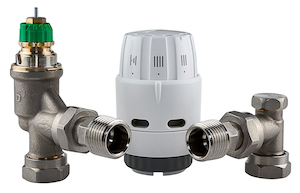
Lifestyle TRV on radiator - girl on floor@0.5xBalancing domestic heating systems just got easier – and faster – with the RAS-B2 Danfoss Dynamic Valve™.  Unlike other TRVs, which only act as flow limiters, this latest addition to the Danfoss TRV family features a differential pressure controller. This ensures that pressure drops over the valve remain at a constant level, so flow through the valve is maintained at both full (winter) and partial (autumn/spring) loads. Additionally, pre-setting of the desired flow is done on the valve, rather than on the lockshield, which it is estimated could save installers up to two hours of valuable working time. Thanks to this innovative product, heating installers can now make sure a system is correctly balanced in a fraction of the time it would normally take.

The new RAS-B2 is specially designed by Danfoss to enable fast and simple hydronic dynamic balancing and to make life even easier this pioneering TRV is also featured on the Danfoss Installer App. Using this time-saving tool, installers can calculate, record and document the correct flow and subsequent setting for each radiator on their smartphone or tablet.

Danfoss-RAS-B2-CO-2Currently the only 100% pressure independent valve demonstrating a constant flow in all conditions, the Danfoss RAS-B2 ensures each radiator receives an equal flow of hot water. As well as optimising end-user comfort, this means that the return temperature is lower (condensing boiler efficiency is best at below a return temperature of 55o C) and the pump can run at a lower speed.

Industry research suggests that between 80% and 90% of heating systems in Europe are unbalanced, which as any heating professional knows can result in the common complaints of noisy radiators and uneven heating.

Summing up, Gareth Ash, Marketing Manager at Danfoss says: “By launching the RAS-B2 Dynamic Valve now Danfoss is offering installers a simple and future-proof solution that will satisfy their customers’ needs today and comply with forthcoming regulations to make existing UK homes more energy efficient as we move towards the ultimate goal of  in 2050.”

The new RAS-B2 Danfoss Dynamic Valve™ is available in a range of convenient radiator packs, including RAS-C2 liquid sensor, and with a choice of 10mm or 15mm fittings to suit different installation requirements.

For more information on the RAS-B2, visit Say hello to the RAS-B2 (danfoss.com) or watch this video to learn more about how the Danfoss RAS-B2 operates – https://youtu.be/cPam9DXk800

DANFOSS WINS PRESTIGIOUS H&V NEWS AWARD

Building Products Index Ltd controls, Heating Leave a Comment

View the Danfoss entry on BPindex

Visit the Danfoss website

Lifestyle TRV on radiator - girl on laptop@0.75xThe Danfoss RAS-B2 Dynamic Valve has won HVAC Product of the Year in the Components and Peripherals category at the H&V News Awards 2021. Danfoss scooped the top prize for its acclaimed technical innovation which, unlike standard TRVs, features a differential pressure controller for fast and easy hydronic dynamic balancing of domestic heating systems in a fraction of the time it would normally take. The expert judging panel, drawn from across the HVAC sector, praised the new Danfoss product for offering installers a practical solution that will help them accurately deliver a balanced system and will help consumers with long-term maintenance of efficiency and comfort.

The winners of the H&V News Awards 2021 were revealed on the 11 November at the Hilton Park Lane, London. The glittering night of recognition and celebration of the sector’s achievements saw the HVAC industry elite come together in person for the first time since April 2019. With 25 categories, the H&V News Awards recognise the leading people, products, projects and services from across the industry and are amongst the most sought-after accolades in the HVAC sector.

Danfoss-RAS-B2-CO-3Currently the only 100% pressure independent valve demonstrating a constant flow in all conditions, the award-winning Danfoss RAS-B2 ensures each radiator receives an equal flow of hot water. This not only optimises end-user comfort but also means that the return temperature is lower (condensing boiler efficiency is best at below a return temperature of 55o C) and the pump can run at a lower speed. Furthermore, pre-setting of the desired flow is done on the valve, rather than on the lockshield, which it is estimated could save installers up to two hours of valuable working time. In addition, the RAS-B2 is featured on the Danfoss Installer App: using this time-saving tool installers can calculate, record and document the correct flow and subsequent setting for each radiator on their smartphone or tablet.

Speaking on behalf of Danfoss, Marketing Manager, Gareth Ash, said: “We are absolutely delighted to win a coveted H&V News Award for our RAS-B2 Dynamic Valve. Danfoss invented the world’s first radiator thermostat back in 1943 and as this latest innovation shows we are still leading the way when it comes to developing cutting-edge solutions that make life easier for installers, deliver real benefits for their customers and will contribute to making UK homes more energy efficient as we journey towards the ultimate goal of Net Zero.” For more information visit  www.danfoss.com